Wesley Chapel Bicycle Accident Lawyer
Armando Personal Injury Law helps cyclists injured in Wesley Chapel seek compensation when someone else's negligence causes a crash. We examine the rider's route, the driver's actions, and the insurance that may cover the injuries. Our work includes claims involving turning vehicles, unsafe passing, and dangerous property conditions.
If you are dealing with treatment, missed work, or an insurer questioning where you were riding, call (813) 482-0355 for a free consultation. We serve Wesley Chapel from our Tampa and St. Petersburg offices.
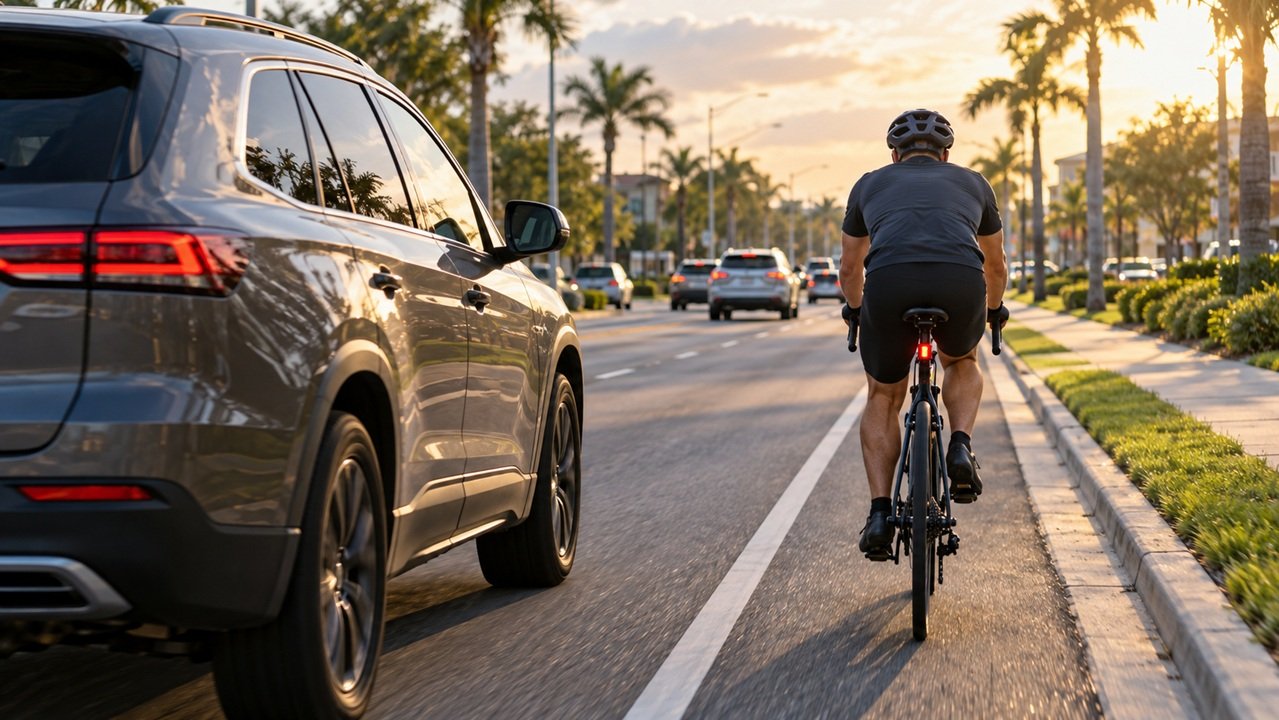
A cyclist's injuries often depend less on the speed of the bike than on the size and speed of the vehicle that hits it.
Understanding what happened on your ride
A collision at an SR 56 shopping-center driveway raises different questions from a passing collision on Bruce B. Downs Boulevard. At a driveway, we may need to establish which way the rider and driver were traveling and what each could see. In a passing crash, the available space and the vehicle's movement may be central.
Tell us the exact intersection, entrance, or stretch of road, including whether you were in a bike lane, on the roadway, or on a sidewalk. A route map can help, but so can a simple description of where you came from and where you were going. You do not need to reconstruct the crash yourself.
Our bicycle accident practice looks beyond labels such as “right hook” or “left cross.” We examine who had the right of way, whether someone turned across the rider's path, and whether an unsafe maneuver caused the injury. A driver's statement that they did not see you does not resolve those questions.
Bike rules that matter to a claim
Florida's bicycle regulations generally give cyclists the rights and duties of vehicle drivers, with bicycle-specific exceptions. The rules must be applied to the actual location and circumstances.
Bike lanes and safe passing
When riding slower than normal traffic, cyclists generally must use an available bike lane. Exceptions include passing, preparing for a left turn, and avoiding conditions that make the lane or right edge unsafe. Leaving the bike lane for a permitted reason does not, by itself, establish fault.
Under section 316.083, drivers passing cyclists in the same travel lane or a bicycle lane must leave a safe distance of at least three feet. If a same-lane pass cannot be made safely, the driver must wait behind the cyclist. The statute treats separated bicycle lanes differently; we check the actual layout rather than assuming every lane is the same.
Night riding and visibility
Between sunset and sunrise, a bicycle needs a white front lamp visible from at least 500 feet and both a red rear lamp and reflector visible from 600 feet. Preserve the lights and reflectors after a crash. Their condition is one part of the evidence, alongside sight lines, street lighting, vehicle speed, and the driver's actions.
Riding with a group
Group-riding permission has limits. Two riders abreast must fit within one lane and may not impede traffic when traveling below its normal speed. In a bike lane too narrow for both, they must ride single file. In a substandard-width road lane, two-abreast riding is temporarily permitted only to avoid hazards or overtake another cyclist.
After a full stop and compliance with other traffic laws, riders may proceed through a stop sign in groups of ten or fewer. A motorist must allow one such group through before moving forward. This does not let an unlimited stream of riders pass without interruption.
What to preserve after a bicycle crash
Get medical attention for your injuries. If it is safe, photograph the bicycle, vehicle, road markings, and surrounding area. Keep the names and contact details of witnesses, including people riding with you.
Keep the bicycle, helmet, damaged clothing, lights, and other equipment in their post-crash condition until their evidentiary value has been assessed. Do not ride damaged equipment. Save receipts and repair estimates, but discuss inspection before authorizing repairs or disposal.
Download original camera files and preserve ride-app or GPS records. Some devices record video; others record only route, speed estimates, or alerts. A radar light is not necessarily a camera, and ride data may not establish an exact lane position. We compare those records with other evidence instead of treating one device as conclusive.
Nearby business or doorbell footage may help if it exists. Let us know where you saw cameras and when the crash happened. Recordings may be overwritten, so identifying possible sources promptly can make a difference.
Which insurance may cover an injured cyclist?
You do not necessarily have to be driving a car to qualify for auto-insurance benefits. Coverage depends on the vehicle involved, physical contact, residency, household and ownership facts, and policy terms.
PIP and medical bills
For a conventional bicycle rider struck by a motor vehicle in Florida, PIP coverage may come from the rider's policy, qualifying household coverage, or, in some circumstances, the striking vehicle's insurer. A fall with no motor-vehicle contact raises a different eligibility question.
PIP generally pays 80% of covered medical expenses and 60% of covered lost income within a standard $10,000 combined medical-and-disability limit. Initial qualifying care must occur within 14 days for medical benefits. Medical benefits above $2,500 require an emergency medical condition determination by a provider authorized under the statute. Percentages, deductibles, limits, and other requirements still apply.
Missing the PIP treatment window does not automatically eliminate a separate liability claim. Tell us when you received care and bring any benefit denial or explanation of payment.
Liability and uninsured motorist coverage
A negligent driver's bodily injury liability coverage may pay covered injury losses, subject to proof and policy limits. Uninsured or underinsured motorist coverage may help when an at-fault driver has no applicable liability coverage or too little. We review who is insured, any rejection or lower-limit election, and the policy's terms.
For an e-bike, we also need the model, class label, motor specifications, and any modifications. Florida's e-bike law generally extends bicycle rights and duties and exempts qualifying e-bikes from motor-vehicle licensing and financial-responsibility requirements. That does not decide whether a particular auto policy or PIP provision covers the rider. Local riding restrictions may also apply.
Compensation should reflect the supported losses
Depending on liability and applicable law, a bicycle injury claim may include medical expenses, lost income, reduced earning capacity, and pain and suffering. Future treatment and long-term limitations need medical and other supporting evidence. Florida's medical-expense rules also affect which amounts can be recovered.
A cyclist injured by a motor vehicle should not assume pain-and-suffering damages are automatic. Where the motor-vehicle injury threshold applies, the injury must involve one of the following:
- Significant and permanent loss of an important bodily function.
- Permanent injury within a reasonable degree of medical probability, other than scarring or disfigurement.
- Significant and permanent scarring or disfigurement.
- Death.
Document the bicycle and gear damaged in the same incident as well. Those losses may accompany an injury claim, but recovery is not automatically the price of brand-new replacements.
Deadlines and allegations that the rider was at fault
Most ordinary Florida negligence claims accruing after March 24, 2023, have a two-year lawsuit deadline under section 95.11 and the 2023 legislation. Earlier claims and claims involving different legal rules need separate review. Do not assume a child's claim can wait until adulthood. An open insurance claim does not satisfy a lawsuit deadline.
In negligence actions governed by section 768.81, a rider more than 50% responsible for their own harm cannot recover. At exactly 50%, compensation is reduced rather than barred. We examine whether an alleged riding violation contributed to the injury; an adjuster's accusation is not a final decision.
Questions riders and parents ask
Does riding without a helmet count against me?
Florida requires compliant helmets for bicycle riders and passengers under 16. But section 316.2065(18) expressly says failure to wear a bicycle helmet, or a parent's failure to prevent a child riding without one, cannot be considered evidence of negligence or contributory negligence. Helmet nonuse should not simply be accepted as a reason to assign blame to the rider.
What if I was riding on a sidewalk?
Under Florida's bicycle regulations, sidewalk and crosswalk riders generally have pedestrian rights and duties. They must yield to pedestrians and give an audible signal before passing them. Local rules and traffic controls still need checking. At a driveway or crossing, we examine both parties' movements and visibility rather than assuming the rider or driver was automatically at fault.
What happens if a child is injured?
A parent or guardian can seek advice on the child's behalf. Keep treatment records and information about effects on school, mobility, and daily activities. We identify the proper representative and any separate claims before discussing a settlement.
Under section 744.387, a minor's net settlement above $15,000 requires a legal guardianship, and a settlement after a lawsuit begins requires court approval. Natural guardians' authority to settle smaller claims is separately addressed in section 744.301. Approval requirements and the child's net proceeds are separate questions; do not sign a release based only on the amount offered.
What if an open car door or damaged pavement caused the crash?
Florida's door-opening law requires a person to wait until opening the door is reasonably safe and will not interfere with other traffic. We still need evidence showing how the door and the rider came into contact.
For a pavement defect, photograph the condition and record its exact location if safe. Responsibility may depend on who controlled or maintained the area and what they knew about the defect. A claim against a government entity involves special notice, immunity, and recovery rules; a pothole alone does not establish liability.
Should I report the crash even if I feel okay?
Notify law enforcement promptly when a vehicle crash causes injury or meets another statutory reporting condition. Section 316.065 also requires immediate notice for apparent property damage of at least $2,000. Call 911 for an emergency; otherwise contact the appropriate agency for reporting instructions. A call does not guarantee an officer will attend or prepare a particular report.
Talk with Armando Personal Injury Law
The firm reports a $1.25 million settlement in a fatal Sarasota bicycle hit-and-run case. That is a prior result in a different community, not an estimate of another claim's value. If a rider has died, Florida's wrongful death action is brought by the personal representative for the eligible survivors and estate.
At a free consultation, we can discuss the crash, your immediate questions, and what information would help evaluate the claim. If we take the case, the contingency fee agreement explains the attorney's fee and how expenses are handled.
Call (813) 482-0355 or contact our team. A report number, photos, insurance correspondence, and the bicycle's make and model are useful if you have them. Missing paperwork should not keep you from asking for help.
About the Author
Attorney Armando Edmiston is the founder of Armando Personal Injury Law in Tampa and St. Pete, Florida. A U.S. Marine veteran, Hillsborough County native, and ACS Forensic Lawyer-Scientist, he represents Floridians in serious personal injury and wrongful death cases.