
Florida Workers’ Compensation for Delivery Drivers
If you’re a delivery employee in Florida, workers’ compensation can pay for authorized medical care and part of your lost wages when you’re hurt doing your job. That can be a fall at a customer’s door or a crash between stops. If another driver caused the crash, you may also have a claim against that driver. You can report the work injury while the police are still sorting out what happened. Florida’s work injury law · Claims against third parties
Genuine independent contractors doing delivery work generally fall outside Florida’s employee coverage. A 1099 alone doesn’t settle which you are. If you took the order through an app, save the order number and pickup time. Those details can matter if you need benefits through the platform’s own insurance. Who counts as an employee in Florida
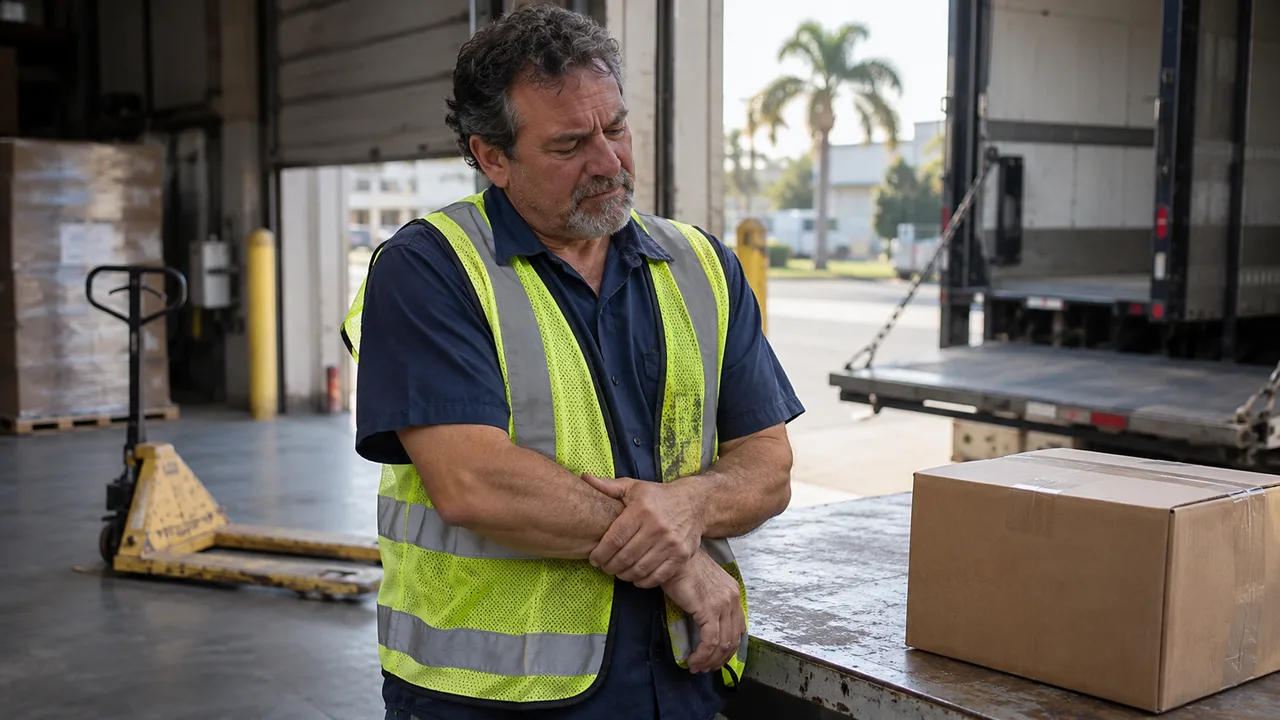
If your wrist starts hurting while you load the van, tell your supervisor what you were lifting and when you first felt it.
What to do the day you get hurt
Get emergency care first if you need it. When you can, tell your supervisor what happened. Say an apartment step gave way as you walked back to the van. Give dispatch the building, the entrance and where you hurt. If you finished a few stops before your ankle swelled enough to take you off the route, say that too.
Ask who insures your employer and where you can get follow-up care. Keep the reply and save a copy of the route screen while you can still open it. If nobody can give you the insurer’s name, look up the employer’s Florida workers’ comp coverage. Search the legal business name on your paystub and use the day you were hurt. Florida’s injury reporting guide
Jump to your question
Who do you report a delivery injury to?
Start with your paystub. If the name at the top is unfamiliar, pull out the offer letter you signed. A company can employ you to drive a van with somebody else’s name on the doors. If a staffing agency hired you, tell both the agency and the supervisor where you were working.
| Where you deliver | Who or what to check |
|---|---|
| UPS | Start with the employer and supervisor on your hiring paperwork. UPS also hires seasonal support drivers who use their own cars. Paying for your own car doesn’t, by itself, make you a contractor. UPS seasonal driver positions |
| FedEx | Some drivers work directly for FedEx. Others work for a local company that contracts with FedEx. If that local company signs your checks, ask it for the injury report and insurer information. FedEx driver jobs · How FedEx service providers operate |
| Amazon DSP or Amazon Flex | If a Delivery Service Partner (DSP) hired you, report the injury to the DSP on your paystub and ask for its workers’ comp insurer. If you accepted a Flex block as an independent contractor, save the block details and ask Flex how to report the incident for that delivery. Amazon DSP employment · How Amazon Flex works |
| DHL, OnTrac and regional couriers | Find the business that hired you. A local delivery company may hold the policy, while the carrier or dispatch service has the route record. You may need information from both. OnTrac’s delivery business arrangements |
| DoorDash, Uber Eats and Grubhub | Hurt while dashing? DoorDash describes occupational accident coverage for U.S. Dashers, subject to its policy terms. Its injury FAQ and claim instructions are a place to start. For an Uber Eats or Grubhub order, save the trip and check that platform’s own terms. Uber’s delivery insurance information |
| Walmart Spark, Instacart, Shipt and Roadie | Check the agreement and the assignment for the particular delivery. If you’re a grocery or pharmacy employee dropping off an order as part of your shift, start with the store that employs you. Spark Driver terms |
If you reported the injury to the customer, the police or app support, check that your employer got the report too. Ask for a copy. An order number and an injury claim number serve different purposes.
“You’re a contractor.” Is that the end of it?
First, check which company actually hired you. Most Florida delivery businesses must carry workers’ compensation once they have four employees. Part-time workers can count. Exemptions can affect that count, and some smaller businesses buy coverage voluntarily. Florida coverage requirements
If the company says you ran your own business, whose name was on the checks, and who paid the expenses? Florida’s nonconstruction test starts with six indicators. Meeting four can satisfy the initial test. They concern a separate business with its own equipment or facilities, a federal employer ID when required, payment to the business, a business bank account for expenses, the ability to serve other customers without going through another hiring process, and certain bidding or task-based pay arrangements. Florida’s independent-contractor test
Fewer than four leaves a second inquiry. Who controlled how the work was done? Who covered the principal expenses and had to make good on an unfinished job? Could you actually lose money on it? Keep the contract, pay statements, expenses and messages about accepting or refusing routes. Those are the records you’ll want if someone disputes your status. Florida Statutes § 440.02(18)(d)
If you own the truck or drive for a subcontractor
Florida has a separate exclusion for certain owner-operators hauling property under a written motor-carrier contract. Check who assumed employer responsibilities, supplied the specified equipment, paid major expenses such as fuel and repairs, and whether you were paid by the load or on some other basis independent of time worked. Florida’s owner-operator provision
If a route company says it didn’t have insurance, check the company above it as well. A contractor that sublets work it was obligated to perform can, in some circumstances, be responsible for benefits owed to an uninsured subcontractor’s employees. And if your own employer was legally required to secure coverage and failed to, Florida law may let you choose between seeking compensation and pursuing damages against that employer. Get the coverage facts before choosing. Subcontracted work · Failure to secure coverage · Employer immunity and exceptions
On the route, on a break or on your way home?
Say the last customer refuses a package. Dispatch texts, “Bring it back tonight.” That text is worth keeping. You may have finished the last delivery, but you still had the company’s package and a job to do. If you had already returned everything and were driving home for the evening, the same crash a mile from the station could raise a different coverage question.
Florida generally excludes an ordinary commute. An employer’s special errand can be an exception.
Work can start in the depot. If you strain your back loading totes before the first scan, record who assigned the loading and who saw it happen. Out on the road, Florida asks whether a traveling employee was actively doing the job. Buying fuel for the van and taking a detour to pick up your child are two very different stops. If you fell during lunch, note where you stopped and whether you were also collecting a customer’s order there. For any detour, it matters why you left the route, whether your employer expressly approved it and whether you’d resumed deliveries when you were hurt. The statute also has a narrow exception for an emergency departure to save life or property. Florida’s rules for work travel and detours
An electrician learned how much the first stop can matter. In DSK Group v. Hernandez, a drunk driver hit him on the way from home to his first job. He was carrying company materials in his car. His paid work began when he arrived, though, and the evidence didn’t show he was reimbursed for those particular commuting miles. The appeals court reversed his workers’ comp award. Read the court’s opinion
For a delivery driver, the practical question is often whether you were headed to pick up your first load or had already picked it up. A pickup receipt, dock video or message telling you to make an extra stop on the way in might settle that point. Write down the order things happened while you can still remember it.
If another driver caused the crash, you may have two claims
A van is sitting at a red light on Hillsborough Avenue in Tampa. Another driver hits it from behind. The delivery driver hurts a wrist and can’t lift packages. The work claim can cover treatment and part of the lost pay. The claim against the driver who hit the van starts with who caused the crash and what the injury cost. Florida’s third-party claim law
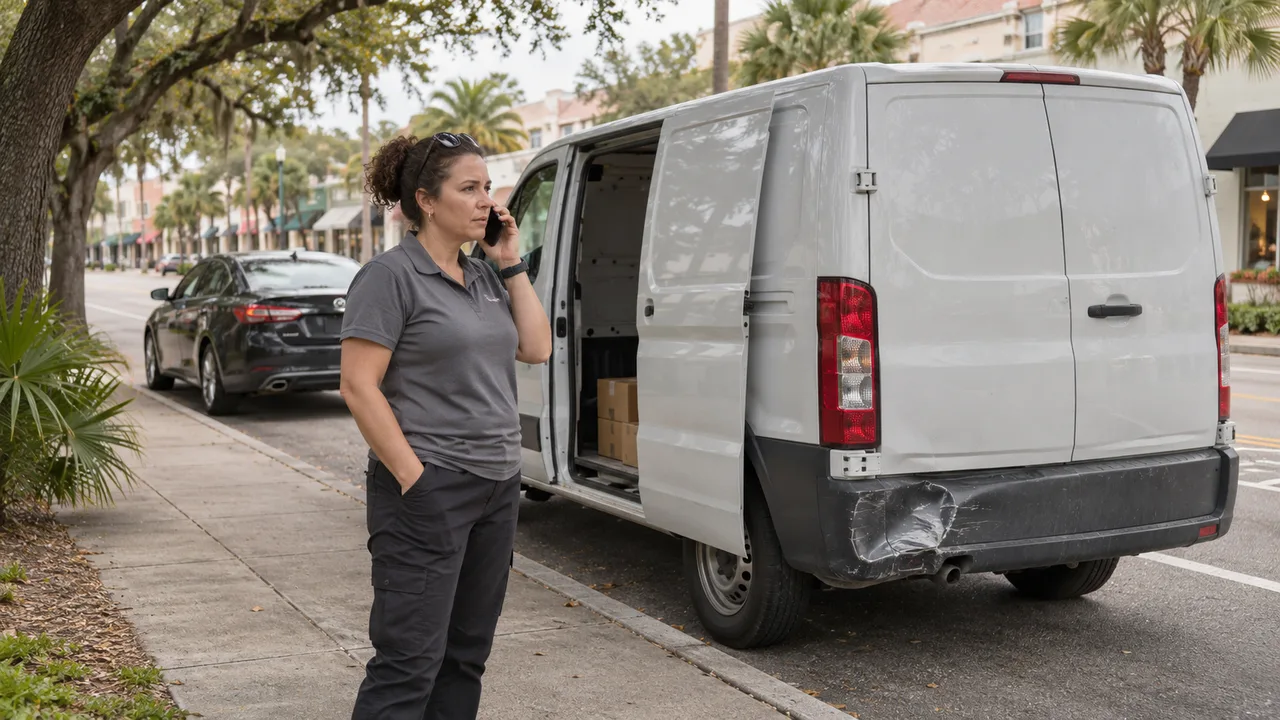
After a crash between stops, save the police report number and the delivery record showing where you were headed.
Report the work injury to your employer. For a covered employee, comp generally turns on what the driver was doing for work and the medical connection to the injury. The last scan and the next assigned stop can help establish that the van was on the route. Ordinary driving error generally doesn’t defeat a comp claim, although Florida law has specific defenses. Comp can pay authorized medical expenses and qualifying wage benefits. Florida workers’ compensation coverage · Tampa workers’ compensation claims
Preserve the claim against the other driver. Get the investigating agency and report number, witness details and the location of any camera facing the light. Those are leads on fault. The first X-ray, the doctor’s lifting limit and the shifts your employer took you off help document the loss. In a third-party claim, you can seek proven losses beyond comp, including uncompensated earnings or a lasting reduction in what you can earn. Tampa car accident injury claims · Florida Statutes § 440.39
Workers’ comp pays no separate amount for pain and suffering. Where Florida’s motor-vehicle injury threshold applies, pain-and-suffering damages require a qualifying injury. That can be a significant and permanent loss of an important bodily function, significant permanent scarring or disfigurement, another permanent injury established within reasonable medical probability, or death. Florida’s motor-vehicle injury threshold
Some wrist fractures are hard to see on the first X-ray. If you still can’t grip a package or your wrist keeps hurting, tell the treating clinician and ask what follow-up you need. Why a wrist fracture can be missed on an early X-ray
If fault is shared, the current Florida rule for an ordinary negligence case generally reduces damages by the injured driver’s share. More than 50% fault for your own harm bars recovery in a case governed by that rule. The comp carrier calculates wage benefits under a different law. Florida comparative fault law · Florida car accident claims and insurance
The other driver’s insurer wants you to sign
Before you accept an offer, get the release itself. Ask what claims it closes and how much of the offer you would actually receive. This matters even if everyone agrees about who hit whom.
By the time an offer arrives, the comp carrier may have paid for surgery and weeks of lost wages. It can have a legal claim to part of the money you recover from the responsible party. Ask for its ledger, with medical and wage payments listed separately. Florida law accounts for fees and costs, and a worker who shows the recovery fell short of the full value of the harm may be entitled to a proportional reduction in what the carrier recovers. Future benefits can be affected too. Florida’s third-party reimbursement law
There’s also a one-year mark worth flagging after a crash. If the worker hasn’t sued the responsible party within one year after the cause of action accrued, a self-insured employer or the comp carrier may sue after giving 30 days’ notice to the worker and their attorney, if represented. In cases governed by that provision where comp is paid or payable, both sides must agree to settle. This doesn’t give you extra time to file the civil case. Third-party suits under § 440.39(4)
If you have an offer in hand, request a free consultation before you sign the release. Bring the offer and any letters from the workers’ comp carrier. We can walk through what the release covers, what you would keep and who else needs notice.
What if the driver fled or had too little insurance?
Uninsured or underinsured motorist coverage (UM) may help. Check the fleet, household and app policies that might cover you. Ask for the coverage selections, including any written rejection or choice of a lower limit.
Suppose the other driver’s insurer offers to settle, but the offer won’t cover your injuries and you intend to pursue underinsured motorist benefits. Before signing, send written notice of the proposed settlement by certified or registered mail to each underinsured motorist insurer that covers you. Each has 30 days from receipt to act. Keep the letter and proof of delivery. Florida’s underinsured motorist settlement procedure
UM can pay additional covered losses without duplicating comp or personal injury protection benefits. Florida also prohibits UM coverage from benefiting a comp carrier directly or indirectly. A carrier’s claim on the at-fault driver’s settlement does not automatically follow the money into a UM payment. Florida’s UM and settlement-notice rules
How soon do I need care for Florida PIP benefits?
When Florida personal injury protection applies, medical benefits generally require qualifying initial care within 14 days of the crash. Comp benefits received must be credited against applicable PIP benefits. Which policy applies can depend on the vehicle and whether you were in it or walking back from the customer’s door when you were hit. Florida PIP benefits · Vehicles covered by the law
Had two delivery apps open? You might have been available on one and halfway to the customer for the other. Save both screens and the acceptance and pickup times. Check each policy’s delivery-use terms. A platform’s occupational accident plan may offer medical or disability payments under its own terms, even when employee workers’ comp is unavailable. Amazon Flex crash coverage · Food-delivery accident insurance · Uber and Lyft accident claims
Falls, dog bites and injuries at the loading dock
Back at the apartment stairs, the delivery photo can show why you were there. It probably shows a package by the door, though. What did the step itself look like? Who maintained the stairwell? Had a tenant already put in a repair request? If you’re able, photograph the whole entrance as well as the damaged edge. Once it’s repaired, even identifying the right staircase can get surprisingly hard. Injuries on someone else’s property
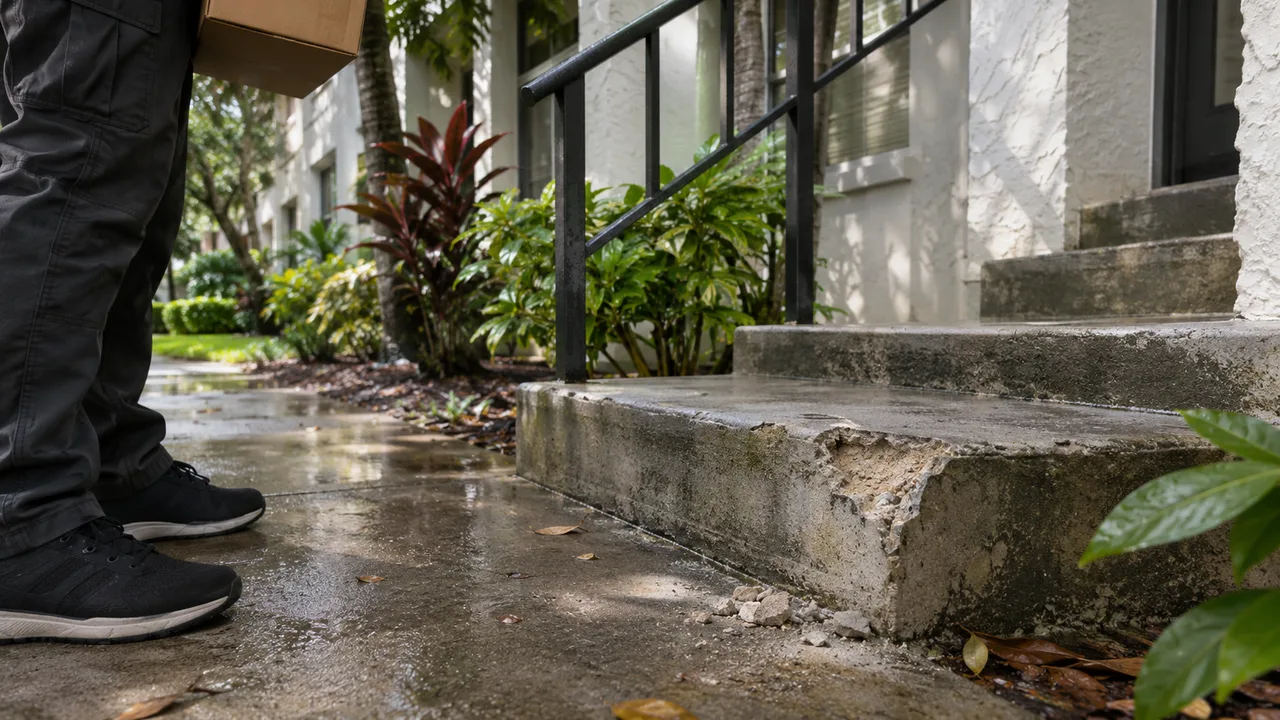
If a step gives way, photograph the damage and the whole entrance so the exact spot can still be identified after a repair.
A spill at a pickup counter
A puddle by a restaurant’s pickup shelf raises a question a broken board doesn’t. In Florida, if you slip on a temporary substance at a business, you generally have to show the business knew or should have known it was there and should have taken action. If a cashier told you they had already called for a mop, write down their name and what they said. Tracks through it, video showing when it appeared, or evidence that the same cooler regularly leaks can help establish what the business should have known. If you saw only the aftermath, say that. Ask for the video from before you fell. Florida’s business slip-and-fall statute
A dog at the door
Save the delivery instructions that invited you onto the property. Find out who owns the dog. The person who answered the door may just be watching it. Florida generally holds the owner responsible for a bite to someone lawfully on private property, even if the dog has never bitten before.
Get a photo of any warning sign and where it hung. A prominently displayed, easily readable “Bad Dog” sign can protect the owner. The law makes exceptions for children under six and for harm caused by the owner’s own negligence. If the injured person’s own negligence helped cause the bite, damages can be reduced. And if the dog knocked you down without biting you, describe the fall. It raises a different legal question. Florida’s dog-bite law
A forklift at the loading dock
Find out who employed the operator. Your coworker, a warehouse employee and a vendor’s driver can look much the same in a safety vest. Get the dock number and the name on the equipment. Ask the facility to keep the footage for that shift. A covered employee can report the work injury right away. Whether there’s also a claim against the operator or another business depends in part on who employed whom and whether workers’ comp immunity applies. Florida employer and coworker immunity · Tampa workplace injury claims
How do you show that delivery work caused the injury?
A box shifts as you lower it and you feel your shoulder go. You can probably name the stop. Wrist pain that built up over six weeks of gripping a scanner is harder to pin down. If you can’t put a date to the first twinge, say so. Tell the doctor when you first noticed it, which tasks set it off and when you started dropping things. Route histories and shift lengths can help fill in what you don’t remember.
Under Florida law, the work accident generally has to account for more than 50% of the resulting injury compared with all other causes combined. The medical opinion connecting the two must be supported by objective findings, such as a strength test or diagnostic imaging, and meet the standard of reasonable medical certainty. Florida’s medical evidence requirements
An older shoulder problem can make the question harder. When the work injury and a preexisting condition combine, the work injury must remain more than 50% responsible for the injury compared with all other causes together. It must also continue to be the major contributing cause of the disability or need for treatment. Repetitive-exposure and occupational disease claims have their own proof rule. The worker needs clear and convincing evidence that the job caused the condition and that the exposure was sufficient to cause it. Florida Statutes § 440.09(1) and (1)(b)
Why an old MRI can matter
You might hesitate to tell the doctor you had shoulder trouble two years ago. Tell them. If you went back to lifting boxes overhead and did it every day until this delivery, say that too. The earlier exam gives the doctor something to compare with the weakness you have now.
J. Armando Edmiston earned a biology degree at the University of South Florida and holds the ACS-CHAL Forensic Lawyer-Scientist designation. If the insurer points to an old MRI, that background helps him frame a question for the treating doctor. The scan showed wear two years ago, when you could still lift a box overhead. Does it explain the loss of strength the doctor measured after this lift?
Heat, a blow to the head or an assault on a route
Confusion or collapse on a hot loading dock can be an emergency. Call 911, move the person somewhere cool if you can and start cooling them while help is coming. After a head injury, a worsening headache, repeated vomiting or difficulty waking up needs emergency attention. The shift report can wait. OSHA heat illness first aid · CDC concussion danger signs
If someone assaulted you, tell the person taking the report what led up to it. An attempted robbery of the packages you were carrying and a personal dispute that followed you to work raise different questions about how the job exposed you to harm. Keep any threatening messages and the police report number. When Florida covers a work injury
Who pays the doctor, and how much of your check comes back?
In an emergency, get treatment. For follow-up care, get the authorized doctor’s name from the comp carrier. If the hospital hands you a referral, send it to the adjuster and ask them to confirm the visit is authorized. Keep the reply. Florida generally allows one change of physician during treatment on written request. The statute sets out who chooses the replacement and when the carrier has to respond. Florida’s medical treatment rules · Florida’s benefits guide for injured workers
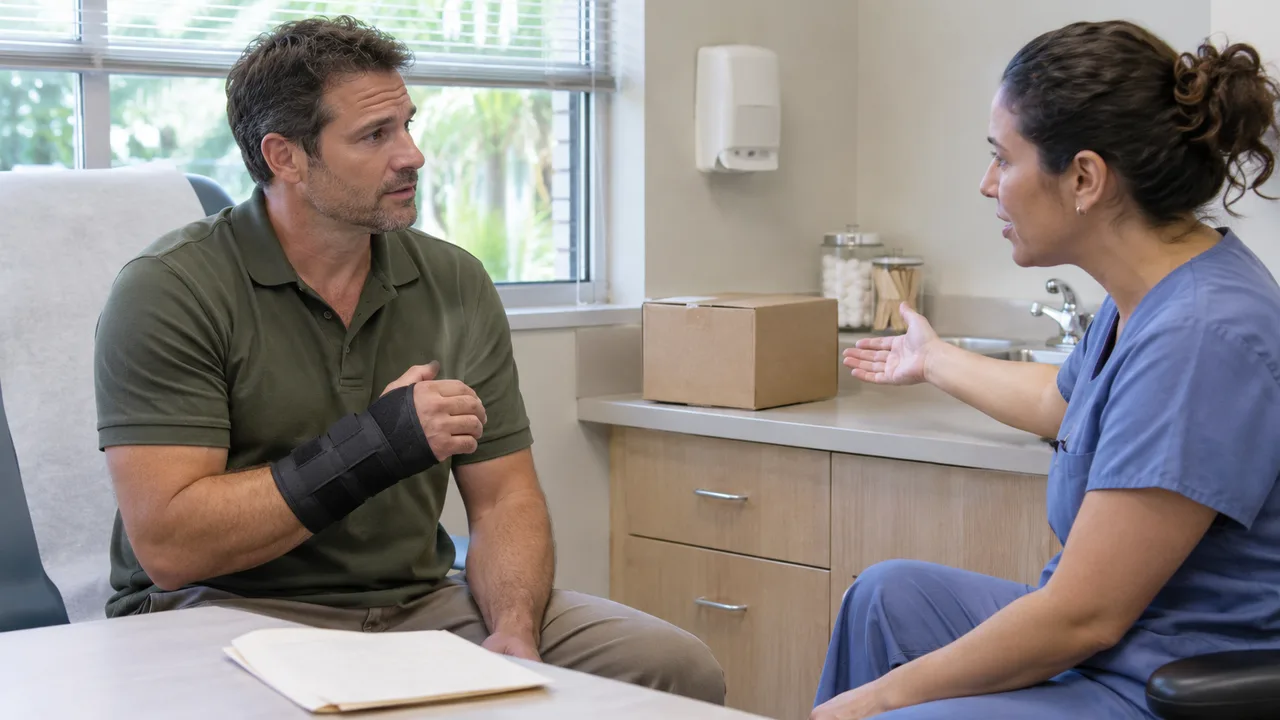
Tell the clinician what a shift involves, down to the weight of the boxes. Ask for any lifting restrictions in writing.
Look at the wage figure first
Ask the adjuster what average weekly wage they used. Florida ordinarily looks at the 13 weeks before the week you were hurt if you worked at least 75% of the customary hours for that period in that employment. If you were hired for the holiday rush and worked only three weeks, the law has other methods, including the wages of a similar employee in certain cases. Pull your paystubs. Look for overtime, reported tips and wages from any other covered job. How Florida sets the average weekly wage
Say your average weekly wage was $900. If the authorized doctor has taken you completely off work and you qualify for ordinary temporary total disability, two-thirds of that wage is $600 for a full payable week, subject to the state maximum for the year you were hurt. Florida generally pays no disability benefits for the first seven days unless the disability lasts more than 21 days. That waiting period doesn’t apply to medical care. Florida’s waiting period · Maximum rates by injury year
Now suppose the doctor clears you to work with lifting restrictions. Your employer has a shorter sorting shift you can do, and your post-injury earning capacity is $500 a week. Under the temporary partial disability formula, start with 80% of $900, or $720. Subtract $500. The benefit is 80% of the remaining $220, or $176 for that week, assuming you otherwise qualify. Save the written restrictions, the offer, the hours actually available and what you earned. Florida temporary disability benefits
When the doctor says you’ve reached maximum medical improvement, ask for the date, any permanent restrictions and your impairment rating in writing. It means further lasting improvement is no longer reasonably expected. You can still have symptoms or need care. Temporary benefits and permanent impairment benefits have different rules. Florida also provides death benefits for eligible dependents when a work injury proves fatal. Florida’s guide to benefits · Benefits after a work-related death
Reporting the injury and filing a claim run on different clocks
Telling dispatch you got hurt can get treatment moving. It doesn’t file a petition with a judge, and it doesn’t start a lawsuit against the driver who hit you. Keep the date of each step and a copy of what you sent.
| What you need to do | When it matters |
|---|---|
| Tell your employer | Generally within 30 days of the accident or the injury’s first manifestation. Exceptions include actual employer knowledge, failure to post the required notice and exceptional circumstances. If a medical opinion was needed to identify the cause, notify the employer within 30 days of obtaining the opinion connecting the injury to work. Injury notice and exceptions |
| Get the report to the carrier | The employer generally has seven days from actual knowledge to report the injury to its carrier and must give you a copy. If that hasn’t happened, you can report it to the carrier yourself. Florida’s Employee Assistance and Ombudsman Office can help at 800-342-1741. Help with an unreported injury |
| File a petition for disputed comp benefits | Generally within two years of when you knew or should have known the injury was work-related. Qualifying wage-benefit payments or remedial care can toll the period for one year. That tolling rule excludes disputes over whether the injury is covered, the date of maximum medical improvement and permanent impairment. Other exceptions can apply. Time limits for a benefits petition |
| File a negligence lawsuit | Florida generally allows two years for an ordinary negligence claim accruing after March 24, 2023. The type of claim, date and identity of the defendant matter. A claim involving a government vehicle can carry its own notice rules. Don’t use the comp deadline to calendar the civil case. Florida civil filing periods · Effective-date provisions |
If the adjuster denies care or the checks stop
Ask for the reason in writing. Identify the benefit you need, such as the shoulder appointment your doctor requested or the check for a particular week. Try to resolve it with the carrier. If that fails, a Petition for Benefits identifies what’s owed and certifies that a good-faith effort to resolve the dispute failed. A judge of compensation claims hears these disputes. The carrier generally has 14 days after proper receipt to pay or file a response explaining what it disputes. Mediation ordinarily takes place within 130 days of filing. If mediation fails, the law generally calls for a final hearing within 90 days of mediation and within 210 days of receipt of the petition, subject to exceptions. Petition requirements · Mediation and hearings
Florida prohibits firing, threatening to fire, intimidating or coercing an employee because they made a valid claim or tried to claim benefits. Keep the messages and your schedules if that happens. Florida’s retaliation law
A few questions drivers ask once they’re home
Dispatch offered light duty. What if I can’t do it?
Get the actual duties in writing. “Help in the warehouse” could mean scanning envelopes or moving loaded carts. Give the authorized doctor the description and ask whether it fits your restrictions. Florida can suspend compensation if you refuse suitable work without justification. If the job turns out to involve lifting more than the doctor allowed, document what you were asked to lift and notify the employer and doctor promptly. Florida’s suitable-work rule
I live in Tampa, but the crash was across the bay. Who has my report?
Check the agency named on your crash exchange form. If St. Petersburg police investigated, you can request the crash report from the St. Petersburg Police Records Division. For a Highway Patrol crash or a report from another agency, use the state’s crash report resources. Save the intersection, time and report number while you’re at it. Those details help a nearby business find the right stretch of camera footage. St. Petersburg car accident guide
For a Wesley Chapel delivery on State Road 54, keep the direction of travel and the driveway or cross street. Two businesses can share a street address and have cameras facing opposite directions. If someone pulled across your lane, the camera facing the entrance may show the turn even if it missed the impact. Wesley Chapel car accident guide
What if my route crosses the state line or takes me to a port?
If the same injury would qualify here, Florida can cover an out-of-state accident when your employment contract was made here or your work was principally based here. Tell both the adjuster and your lawyer if you’ve received benefits in another state. At Port Tampa Bay, get the terminal name and describe the work itself. Dropping a parcel at an office and regularly loading cargo onto vessels can fall under different compensation rules. Florida coverage outside the state · Maritime employment under federal law · Locations covered by the Longshore Act
Talk to Armando Personal Injury Law
If a delivery injury has kept you off work or another driver’s insurer wants you to sign a release, call Armando Personal Injury Law at (813) 482-0355 or request a free consultation. Tell us who paid you for the route and what you need help with now. If you have the offer, a denial letter or the doctor’s lifting restrictions, have it handy. We can start there.
Click here for a printable PDF of this article, “Florida Workers’ Compensation for Delivery Drivers.”

About the Author
Attorney Armando Edmiston is the founding attorney of Armando Personal Injury Law in Tampa and St. Pete, Florida. A U.S. Marine veteran and Hillsborough County native, he represents injured people and families in serious injury cases, including car accidents, truck accidents, motorcycle accidents, wrongful death, negligent security, premises liability, and nursing home abuse and neglect claims. Armando earned a B.S. in Biology from the University of South Florida and a J.D., cum laude, from Nova Southeastern University. He is also one of only six lawyers in Florida listed with the ACS Forensic Lawyer-Scientist designation.