
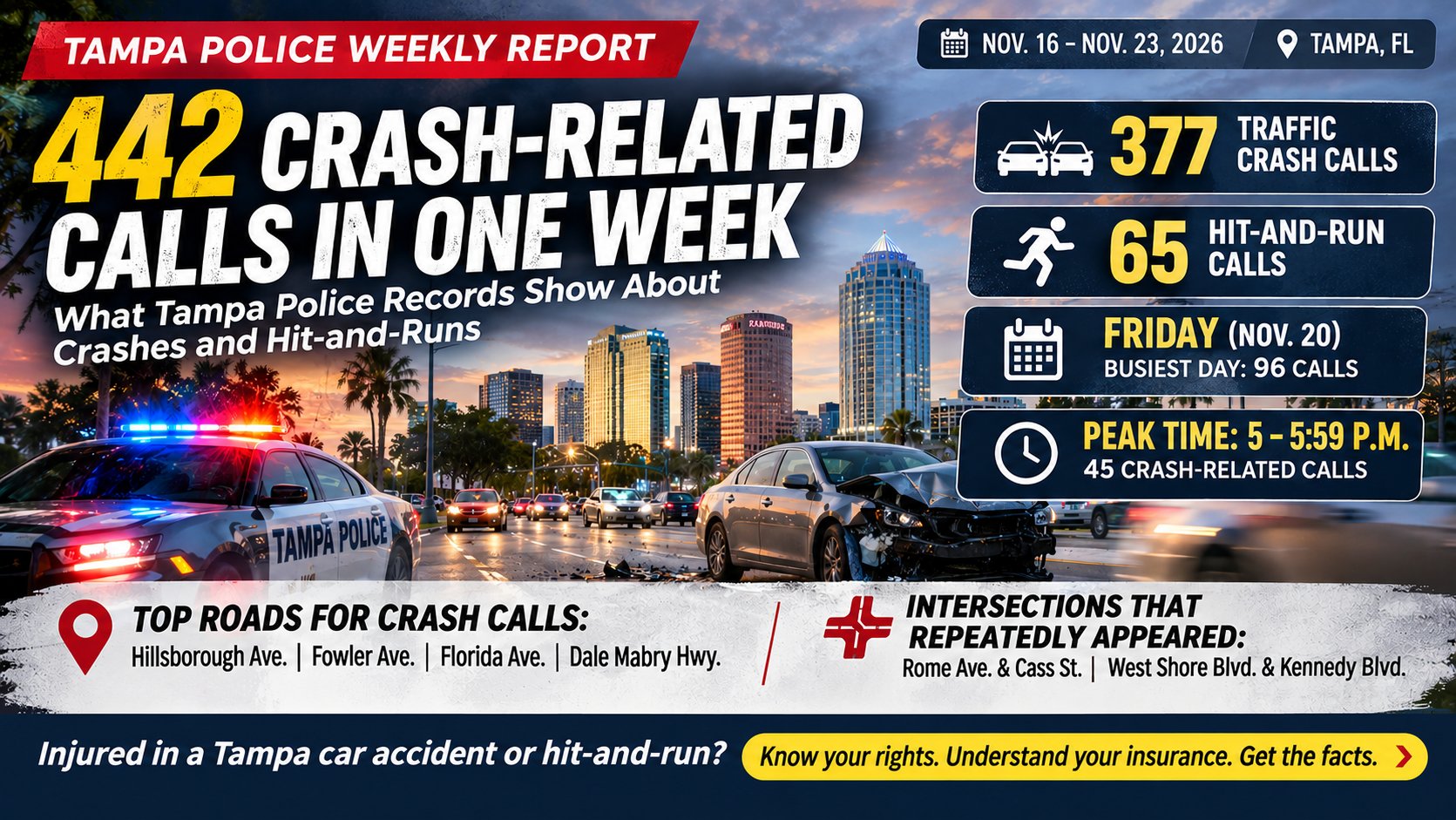
Tampa Police logged 442 crash-related calls from November 16 to 23, 2026, and nearly half of them came in between noon and 6 p.m.
Friday, November 20, was a rough day on Tampa roads.
By midnight, Tampa Police had received 96 calls involving traffic crashes or hit-and-runs. That's an average of four every hour, all day long.
Tuesday wasn't much better. Police logged 91 calls that day.
We wanted to see what the rest of the week looked like, so Armando Personal Injury Law reviewed the Tampa Police Department's calls-for-service records from November 16 through November 23, 2026.
The numbers added up quickly.
377 traffic crash calls. Another 65 hit-and-runs. That's 442 crash-related calls in roughly one week.
Almost 15% were classified as hit-and-runs.
And while those numbers are concerning on their own, the locations tell us more. Certain roads appeared again and again. A few intersections showed up multiple times in just a matter of days. And late afternoons were particularly busy.
These are police calls for service, not completed crash investigations. The records don't tell us who caused each collision or whether anyone was injured. But they do offer a look at how often Tampa Police were being called to crashes around the city.
How Many Traffic Crashes Were Reported in Tampa November 16–23?
The records begin at 10:37 a.m. on Monday, November 16, and end at 8:30 a.m. on Monday, November 23.
That means both Mondays are partial days. The six days between them give us the best picture of what a full day of crash calls looked like.
| Date | Traffic Crashes | Hit-and-Runs | Total |
|---|---|---|---|
| Monday, Nov. 16* | 41 | 3 | 44 |
| Tuesday, Nov. 17 | 79 | 12 | 91 |
| Wednesday, Nov. 18 | 45 | 11 | 56 |
| Thursday, Nov. 19 | 59 | 8 | 67 |
| Friday, Nov. 20 | 84 | 12 | 96 |
| Saturday, Nov. 21 | 40 | 4 | 44 |
| Sunday, Nov. 22 | 24 | 14 | 38 |
| Monday, Nov. 23* | 5 | 1 | 6 |
| Total | 377 | 65 | 442 |
November 16 and November 23 are partial days in the available records.
During the six complete days, Tampa Police averaged a little more than 65 crash-related calls per day.
Friday had the most, with 84 traffic crash calls and 12 hit-and-runs.
Sunday was different.
Police received only 38 crash-related calls on November 22, but 14 were classified as hit-and-runs. That's more than a third of the day's total.
Think about that. On a day with fewer crash calls overall, the portion involving reports of drivers leaving the scene was unusually high.
We can't tell from these records whether those drivers were later found or what happened in each investigation. But the number caught our attention.
If you've been injured in a collision, our Tampa car accident lawyer page explains what matters when dealing with medical bills, insurance companies, and questions about who was responsible.
Where Were Tampa's Most Frequently Reported Crashes?
A few intersections kept appearing in the records.
That doesn't necessarily make them Tampa's most dangerous intersections. A single week is too short to make that kind of judgment, and roads with heavy traffic naturally have more opportunities for crashes.
Still, when the same location appears several times in a few days, it's worth taking a closer look.
Rome Avenue and Cass Street: Four Crash Calls
The intersection of N. Rome Avenue and W. Cass Street appeared four times in the traffic crash records.
The calls were recorded on November 17, 19, and 20.
Two came in less than 20 minutes apart on November 19.
That timing raises a question the data can't answer: Were those two separate collisions, or were police receiving separate calls related to the same incident?
The records have different report numbers, but without the underlying crash investigations, we can't say for certain.
What we can say is that the intersection appeared repeatedly during the week.
West Shore Boulevard and Kennedy Boulevard: Four Calls, Including Two Hit-and-Runs
The intersection of N. West Shore Boulevard and W. Kennedy Boulevard also appeared four times.
Two calls were classified as traffic crashes. The other two were hit-and-runs.
Three of those calls came in on November 17.
That combination stood out. We don't know what caused the collisions, and the data doesn't establish whether any of them involved injuries. But having both traffic crash and hit-and-run calls recorded at the same intersection during such a short period makes it a location worth watching.
Other Tampa Intersections Appearing Multiple Times
Several other intersections appeared three times during the reporting period.
| Intersection | Traffic Crashes | Hit-and-Runs | Total |
|---|---|---|---|
| N Rome Ave & W Cass St | 4 | 0 | 4 |
| N West Shore Blvd & W Kennedy Blvd | 2 | 2 | 4 |
| Bruce B. Downs Blvd & E County Line Rd | 3 | 0 | 3 |
| Bruce B. Downs Blvd & E Fowler Ave | 3 | 0 | 3 |
| Bruce B. Downs Blvd & I-75 | 3 | 0 | 3 |
| E Fowler Ave & Leroy Collins Blvd | 3 | 0 | 3 |
| E Fowler Ave & N 46th St | 2 | 1 | 3 |
| E Busch Blvd & N 26th St | 2 | 1 | 3 |
| E Waters Ave & N Florida Ave | 3 | 0 | 3 |
There isn't enough information here to explain why these locations appeared repeatedly.
Was someone running a red light? Making an unsafe turn? Following too closely? Distracted?
We don't know. The calls-for-service records don't include those findings.
What matters after a serious intersection crash is figuring out what actually happened. That may mean reviewing traffic-camera footage, witness statements, vehicle damage, signal timing, and the investigating officer's findings.
We discuss those issues in more detail on our Tampa intersection accident lawyer page.
Hillsborough Avenue and Fowler Avenue Led the Roadway Counts
When we looked beyond individual intersections and grouped calls by road name, two major Tampa roads finished tied at the top.
Hillsborough Avenue and Fowler Avenue each appeared in 28 crash-related location records.
Florida Avenue was just behind them with 27. Dale Mabry Highway had 25.
Here's how the major corridors compared.
| Roadway | Traffic Crashes | Hit-and-Runs | Total |
|---|---|---|---|
| Hillsborough Avenue | 26 | 2 | 28 |
| Fowler Avenue | 26 | 2 | 28 |
| Florida Avenue | 21 | 6 | 27 |
| Dale Mabry Highway | 23 | 2 | 25 |
| Nebraska Avenue | 19 | 2 | 21 |
| Busch Boulevard | 17 | 4 | 21 |
| Bruce B. Downs Boulevard | 17 | 2 | 19 |
| Dr. Martin Luther King Jr. Boulevard | 17 | 1 | 18 |
| Kennedy Boulevard | 12 | 5 | 17 |
| I-275 | 17 | 0 | 17 |
| West Shore Boulevard | 11 | 4 | 15 |
These are roadway references, not unique crashes assigned to one road. If a collision was recorded at Hillsborough Avenue and Florida Avenue, that call can appear in the count for both.
And a longer, busier road may naturally have more calls than a short neighborhood street.
So we aren't labeling Hillsborough Avenue or Fowler Avenue the most dangerous roads in Tampa based on these numbers alone.
But the repeated activity is hard to ignore.
Florida Avenue is particularly interesting. Of its 27 crash-related calls, six were classified as hit-and-runs.
Kennedy Boulevard had five hit-and-run calls among its 17 entries. Busch Boulevard had four.
Those figures give us a reason to look more closely at the hit-and-run reports.
The Afternoon Hours Were the Busiest for Crash Calls
If you've spent time driving through Tampa in the late afternoon, you know traffic can get frustrating.
People are leaving work. Parents are picking up children. Delivery vehicles are still making stops. Drivers are trying to get through intersections before traffic backs up again.
The police data doesn't tell us whether any of those circumstances caused a particular crash.
It does show when the calls were coming in.
Between noon and 5:59 p.m., Tampa Police recorded 197 crash-related calls, about 45% of the week's total.
The busiest hour was 5 p.m. to 5:59 p.m., with 45 calls across the reporting period.
| Time | Crash-Related Calls |
|---|---|
| 5–5:59 p.m. | 45 |
| 6–6:59 p.m. | 42 |
| 4–4:59 p.m. | 40 |
| 3–3:59 p.m. | 37 |
| Noon–12:59 p.m. | 28 |
| 2–2:59 p.m. | 27 |
| 1–1:59 p.m. | 20 |
From 3 p.m. through 5:59 p.m., police logged 122 crash-related calls.
That's more than a quarter of the entire reporting period's total occurring during those three afternoon hours across the week.
Again, the data doesn't establish why.
But it does show that the afternoon and evening deserve attention when looking at Tampa's traffic crash patterns.
65 Hit-and-Run Calls in One Week. What Happens to the People Left Behind?
The 65 hit-and-run calls are one of the more troubling parts of this report.
Not because we know how each incident ended. We don't.
It's because a hit-and-run can leave someone dealing with a problem they never expected.
Another driver causes a crash and disappears.
Maybe someone gets a license plate number. Maybe there's a witness. Maybe a business camera catches the vehicle leaving.
Sometimes none of that happens.
And when the driver can't be identified, the injured person may have no obvious insurance company to turn to for compensation.
That can make an already difficult situation worse.
Where Were Tampa Hit-and-Runs Reported More Than Once?
Several locations appeared twice in the hit-and-run records.
- N. West Shore Boulevard and W. Kennedy Boulevard: Two hit-and-run calls.
- S. Florida Avenue and Channelside Drive: Two hit-and-run calls.
- 2223 N. West Shore Boulevard: Two hit-and-run calls.
- 11711 N. 50th Street: Two hit-and-run calls.
The addresses come directly from the Tampa Police records. They do not establish that any nearby business, resident, or property owner caused or contributed to a collision.
The records also don't tell us whether the drivers were eventually identified.
What they show is where police received those reports.
For someone injured by a driver who leaves the scene, the next concern is often insurance.
And that brings up coverage many Florida drivers don't think about until they need it.
Why Uninsured Motorist Coverage Matters After a Tampa Hit-and-Run
Ask someone whether they have car insurance and they'll probably know the answer.
Ask whether they have uninsured motorist coverage, and you may get a different response.
Some drivers know exactly what they've purchased. Others have heard the phrase "full coverage" and assume they're protected against just about anything.
Unfortunately, that's not how auto insurance works.
What Is Uninsured Motorist Coverage?
Uninsured motorist coverage, usually called UM coverage, may help when you're injured by an at-fault driver who doesn't have applicable bodily injury liability insurance.
Depending on the policy and the circumstances, it may also apply when an unidentified driver causes a hit-and-run.
Consider a fairly simple example.
You're driving through an intersection. Another vehicle runs a red light and hits you. Before anyone can exchange information, the other driver takes off.
You're injured. Your vehicle is damaged. Police respond, but nobody has enough information to identify the other driver.
Now what?
If you have applicable UM coverage, your own insurance policy may provide a way to pursue compensation for qualifying injuries.
That could include medical expenses, lost income, future treatment, and legally recoverable pain and suffering.
But UM benefits aren't automatic simply because a driver leaves the scene. Liability, available evidence, policy language, coverage limits, and Florida law all matter.
Our guide to uninsured and underinsured motorist accidents in Florida explains what this coverage may provide and how those claims work.
Does "Full Coverage" Include Uninsured Motorist Insurance?
Not necessarily.
"Full coverage" is a phrase people use to describe different combinations of insurance. It doesn't guarantee that a policy includes UM protection.
You may have collision coverage, comprehensive coverage, and the insurance required to register your vehicle without carrying uninsured motorist coverage.
Under Florida Statute § 627.727, UM coverage generally must be provided with qualifying Florida motor vehicle liability policies that include bodily injury liability coverage, unless the named insured validly rejects it in writing or selects lower limits as permitted by law.
That doesn't mean every Florida driver is required to buy UM coverage.
If you're unsure what you have, look at your insurance declarations page. Ask your agent about your UM limits and whether the coverage is stacked or non-stacked.
It's worth understanding before you get into an accident, not afterward when you're trying to figure out who's paying the bills.
Florida PIP Insurance Is Not the Same as UM Coverage
Florida's Personal Injury Protection coverage, commonly called PIP, serves a different purpose.
PIP generally provides certain medical and lost-income benefits after a qualifying motor vehicle accident, regardless of who caused it.
But there are limits.
Under Florida Statute § 627.736, initial qualifying medical services and care generally must be received within 14 days of the accident for medical benefits to be payable.
The amount available can also depend on whether a qualifying emergency medical condition is established.
Someone dealing with a serious injury can easily face expenses beyond what PIP covers.
UM coverage may provide another source of compensation when an at-fault driver has no applicable insurance, insufficient insurance, or cannot be identified after a covered hit-and-run.
The two coverages do different jobs. Having PIP doesn't mean you have UM.
Our Florida PIP claims guide explains those requirements in more detail.
Hit by a Driver Who Took Off? Here's What Matters
The first thing is safety.
If another driver hits you and leaves, don't try to chase them down.
Get out of danger if you can. Call 911 if someone is injured or needs emergency assistance, and report the crash to law enforcement.
Then try to preserve whatever information you have.
Maybe you saw part of the license plate. Maybe you remember the color or model of the vehicle. Even the direction it was traveling could help.
If witnesses stopped, get their contact information.
Take pictures if it's safe. That includes the damage to your vehicle, debris, the roadway, and anything else that might help explain what happened.
And think about cameras.
Nearby businesses, homes, and other vehicles may have recorded the collision or the driver leaving. That footage can disappear quickly if nobody asks for it.
If you're injured, get appropriate medical attention. Keep your treatment records and insurance paperwork.
You'll also want to notify your insurer as required by your policy and determine whether you carry uninsured motorist coverage.
There's a more detailed explanation on our page about what to do after a Tampa car accident.
What Does This Week's Tampa Crash Data Tell Us?
It would be easy to take 442 crash-related calls and declare Tampa's roads are getting worse.
But one week doesn't prove that.
We'd need consistent records over several months, preferably years, to know whether the number of crashes is increasing or decreasing.
What this week does show is how frequently Tampa Police were receiving calls involving collisions.
442 crash-related calls between November 16 and November 23.
Of those, 65 were classified as hit-and-runs.
Friday alone accounted for 96 crash-related calls.
And nearly half of the week's calls came in between noon and 6 p.m.
Hillsborough Avenue and Fowler Avenue were the most frequently referenced major roads. Rome Avenue at Cass Street and West Shore Boulevard at Kennedy Boulevard were among the intersections that appeared repeatedly.
Those are the numbers.
What they don't tell us is how many people went home hurt, how many vehicles were totaled, or how many families are now trying to figure out how to pay for medical treatment.
Some of these calls may have involved minor damage.
Others may have involved injuries that take months, sometimes years, to recover from.
That's why the details of any individual crash matter more than the weekly total.
And when the responsible driver leaves the scene, knowing what insurance coverage is available can become especially important.
Injured in a Tampa Car Accident?
Armando Personal Injury Law represents people injured in car accidents, hit-and-runs, and serious collisions throughout Tampa and Hillsborough County.
Attorney Armando Edmiston and his team investigate what happened, review available insurance coverage, and help injured people understand their options.
If another driver's negligence caused your injuries, contact our Tampa car accident attorney for a free consultation.
There is no attorney fee unless there is a recovery.
Frequently Asked Questions About Tampa Traffic Crashes
How many traffic crashes were reported in Tampa November 16–23, 2026?
Tampa Police recorded 377 calls classified as traffic crashes and 65 classified as hit-and-runs. That's 442 crash-related calls during the reporting period.
Which Tampa roads had the most crash-related calls?
Hillsborough Avenue and Fowler Avenue each appeared in 28 crash-related location records. Florida Avenue followed with 27, and Dale Mabry Highway had 25.
What day had the most crash-related calls?
Friday, November 20, had the highest combined total, with 96 calls.
How many hit-and-runs were reported?
Tampa Police recorded 65 hit-and-run calls. Sunday, November 22, had the highest daily number, with 14.
What time were the most crashes reported?
The busiest hour was 5 p.m. to 5:59 p.m., with 45 crash-related calls recorded during that hour across the reporting period.
Can uninsured motorist coverage help after a Tampa hit-and-run?
Yes, in some circumstances. Applicable UM coverage may provide compensation when an unidentified at-fault driver causes injuries. Whether benefits are available depends on the evidence, policy language, coverage limits, and Florida law.
Data Source and Methodology
Armando Personal Injury Law reviewed the Tampa Police Department Traffic Calls for Service export on November 23, 2026.
The records cover November 16, 2026, at 10:37 a.m. through November 23, 2026, at 8:30 a.m.
The CSV contained 497 valid calls-for-service records: 377 classified as Traffic Crash, 65 as Hit and Run, 37 as Street Obstruction, and 18 as Traffic Light Out.
Only the 442 traffic crash and hit-and-run calls were included in this analysis. All 497 records had unique report numbers.
Roadway totals reflect how often a road was named in the location field. A single intersection call may be included under two different roads. Intersection counts combine entries listing the same streets in reverse order.
These are police calls for service, not final crash investigation findings. The data does not independently establish fault, injury severity, criminal charges, or whether separate calls necessarily represent unrelated collisions.
About the Author
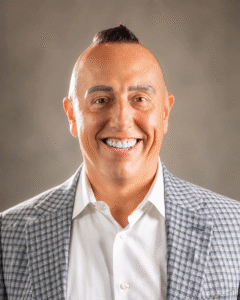
Attorney Armando Edmiston is the founder of Armando Personal Injury Law in Tampa and St. Pete, Florida. A U.S. Marine veteran, Hillsborough County native, and ACS Forensic Lawyer-Scientist, he represents Floridians in serious personal injury and wrongful death cases.