Olympus Scope Lawsuit Lawyer
Nationwide Case ReviewPublished: July 20, 2026 | Last updated: July 20, 2026 | Legally reviewed: July 20, 2026
A serious infection after a scope procedure raises a basic question: was this a known complication, a cleaning failure, or a problem with the device itself? The answer usually is not sitting in the discharge papers.
A real investigation starts with the records. We need to know which scope or accessory was used, how it was cleaned, whether it was damaged, what the cultures showed, and whether other patients were affected. The responsible party may be the manufacturer, the facility, a provider, a contractor, or more than one of them.
Armando Personal Injury Law evaluates serious personal injury claims involving difficult medical and scientific evidence from across the country. When another state requires local counsel, the firm may work with qualified attorneys there while helping coordinate the investigation and case strategy.
Call (813) 482-0355 to talk through what happened.
Medical warning: Fever, chills, confusion, severe pain, trouble breathing, weakness, a rapid heart rate, or symptoms that are getting worse after a procedure can require urgent care. Seek medical attention. A legal consultation is not emergency treatment.
Free Case Review
- Key Facts
- What These Cases Are About
- Latest Recall & Litigation Updates
- Devices & Procedures Involved
- Injuries That Matter
- Finding Out Which Scope Was Used
- How Causation Is Proven
- Who Could Be Responsible
- Product Liability vs. Malpractice
- What to Do Now
- How We Evaluate a Scope Claim
- Frequently Asked Questions
Olympus Scope Lawsuit: Key Facts
| Question | Direct Answer |
|---|---|
| Who may have a claim? | A patient with a serious infection or physical injury after a procedure involving an Olympus scope, accessory, or reprocessing system. |
| What injuries matter most? | Sepsis, hospitalization, organ damage, additional surgery, permanent impairment, or death. |
| What evidence matters? | The device identity, procedure records, cultures, reprocessing logs, maintenance history, and medical causation evidence. |
| Who may be responsible? | Olympus or another manufacturer, a hospital or surgery center, a provider, a reprocessing contractor, or several parties. |
| Is there a federal MDL? | No Olympus MDL appears on the official active MDL report dated July 1, 2026. |
| Are claims limited to Florida? | No. The firm accepts inquiries nationwide, subject to jurisdiction and case-specific requirements. |
You May Have a Potential Claim If
- ✓You had an endoscopy, ERCP, bronchoscopy, cystoscopy, ureteroscopy, colonoscopy, laparoscopic procedure, or another procedure involving a reusable scope
- ✓You developed a documented infection or serious physical injury afterward
- ✓You needed hospitalization, IV antibiotics, surgery, intensive care, or extended treatment
- ✓Testing identified bacteria or another infectious organism
- ✓You were diagnosed with bacteremia, sepsis, septic shock, an abscess, organ failure, perforation, internal bleeding, or another major complication
- ✓A hospital or physician warned you about possible contamination or infection exposure
- ✓An Olympus scope, MAJ-891 accessory, automated reprocessor, or another Olympus device may have been used
- ✓A family member died after an infection or injury connected to the procedure
"Armando and his team are awesome! It didn't matter what day I called or texted, he would ALWAYS answer or reply back promptly. He got the maximum payout for me. They truly went to work on my case and didn't stop until I got what was deserved."— Maria C. Actual client. Results may vary; each case is different.
"Armando was wonderful and always kept me updated about my claim. It was the best decision I made to go to him. I would recommend him to anyone in need of his services."— Bina S. Actual client. Results may vary; each case is different.
These facts do not prove a case by themselves. They are enough to justify a closer look at the device, the medical records, the cultures, and the facility's cleaning and infection-control records.
What These Olympus Scope Cases Are Really About
These cases are not all the same. Some involve the design of a reusable scope. Some involve an accessory. Others turn on poor cleaning, a damaged device, weak instructions, or a hospital that missed signs of an infection cluster.
Reusable scopes have narrow channels, valves, ports, connectors, and removable parts. Staff have to clean and disinfect or sterilize them according to the manufacturer's Instructions for Use, usually called the IFU. That process is known as reprocessing. If biomaterial, microorganisms, or biofilm stays inside the device, the next patient may be exposed.
The Investigation May Focus On:
- ✓A design that was hard to clean completely
- ✓Reprocessing instructions that were inadequate or difficult to follow
- ✓A manufacturing or quality-system problem
- ✓Failure to validate cleaning and disinfection procedures
- ✓Failure to report adverse events or pass along safety information
- ✓Warnings that did not adequately address contamination or device damage
- ✓Poor cleaning, drying, storage, inspection, or maintenance by a facility
- ✓Continued use of a damaged device or one that failed leak testing
- ✓Failure to investigate or respond to a cluster of infections
An infection after a scope procedure does not automatically mean the scope caused it. The investigation also has to look at the patient's health, the procedure, other hospital exposures, facility practices, device damage, and other possible sources.
"Armando and his team were incredible! They are so responsive, explain everything thoroughly and are incredibly intelligent!! They won my case which has a low success rate, but due to their hard work were able to prevail with an incredible outcome! I can't recommend them enough!"— Brittany S. Actual client. Results may vary; each case is different.
"Armando and his team go above and beyond; not just for clients, but for friends and family as well. He's genuine, relentless, and truly cares about helping people get the justice and peace of mind they deserve."— Eric A. Actual client. Results may vary; each case is different.
An infection after a scope procedure does not automatically mean the scope caused it. The investigation also has to look at the patient's health, the procedure, other hospital exposures, facility practices, device damage, and other possible sources.
Latest Olympus Scope Recall and Litigation Updates
| Date | Development | What It Means |
|---|---|---|
| July 1, 2026 | Federal MDL status | The official JPML active MDL report does not list an Olympus scope MDL. |
| July 20, 2026 | MAJ-891 recall status | The FDA recall database lists the action as Open, Classified and identifies it as a Class I recall. |
| June 24, 2025 | Import alerts | The FDA Olympus import-alert letter identifies specific ureterorenoscopes, bronchoscopes, laparoscopes, and automated reprocessors. |
| March 5, 2025 | MAJ-891 FDA update | The FDA recall update reports 120 injuries and one death associated with infection after procedures involving the accessory with a CYF cystoscope. |
| January 2023 | FDA warning letters | The FDA announcement describes reporting and quality-system concerns involving Olympus endoscopes, accessories, and reprocessors. |
| December 10, 2018 | DOJ resolution | The Department of Justice announcement concerns failures to file required adverse-event reports involving TJF-Q180V infections. |
Is There an Olympus Scope MDL or Class Action?
As of July 1, 2026, the official list of active federal multidistrict litigations does not show an Olympus scope MDL. That does not stop a patient from filing an individual case. It means the federal courts have not created a centralized Olympus proceeding for coordinated pretrial work.
As of July 20, 2026, our review has not identified a nationwide class action that replaces individual injury claims. These cases usually turn on the device used, the patient's infection, the facility records, the state law that applies, and the damages suffered. Those facts are rarely identical from one patient to the next.
What Is the MAJ-891 Recall?
The MAJ-891 is a reusable forceps and irrigation plug used with certain Olympus cystoscopes, ureteroscopes, choledochoscopes, and hysteroscopes. The FDA classifies the action as Class I, its most serious recall category.
The problem is reprocessing. If the plug is not disconnected, taken apart, and cleaned correctly, contamination can remain. The FDA reported 120 injuries and one death from infections after procedures involving the MAJ-891 with a CYF-series cystoscope. This is not a general colonoscope recall. It concerns a specific accessory used with identified urological, biliary, and gynecological scopes.
What Do the June 2025 Import Alerts Mean?
The FDA used import alerts to block future U.S. shipments of specific Olympus devices made in Japan because of unresolved quality-system concerns. The list includes certain ureterorenoscopes, bronchoscopes, laparoscopes, and automated endoscope reprocessors.
An import alert is not the same thing as a recall. The FDA did not tell hospitals to remove every Olympus scope or cancel every procedure. It said existing devices could still be used when providers were not experiencing problems, as long as they followed reprocessing instructions, avoided damaged devices, and kept up with inspections.
Which Devices and Procedures May Be Involved?
| Device Category | Common Use | Why It May Matter |
|---|---|---|
| Duodenoscopes | ERCP and treatment of bile or pancreatic ducts | Earlier infection investigations and complex reprocessing components |
| Cystoscopes | Bladder and urethra procedures | CYF-series devices were used with the MAJ-891 accessory |
| Ureteroscopes and ureterorenoscopes | Kidney stone and urinary-tract procedures | URF-series compatibility and models included in FDA import alerts |
| Bronchoscopes | Lung and airway procedures | Multiple models appear on the June 2025 import-alert list |
| Laparoscopes | Minimally invasive abdominal and pelvic procedures | Certain models appear on the import-alert list |
| GI endoscopes and colonoscopes | Upper endoscopy, colonoscopy, biopsy, and treatment | The exact device and patient-specific causation still have to be proved |
| Automated endoscope reprocessors | Cleaning and high-level disinfection | Cycle records, compatibility, maintenance, and chemical concentration may matter |
| Accessories | Irrigation, biopsy, and instrument access | Plugs, valves, ports, and other parts may raise separate issues |
"Olympus scope lawsuit" is a broad label. It does not identify the product, procedure, or failure. The model, accessory, and reprocessing system matter.
What Injuries Matter in These Cases?
The clearest infection cases usually involve more than a brief fever or a precautionary prescription. They involve a documented infection, meaningful treatment, and a medical timeline that fits the procedure.
- ✓Urinary tract or procedure-site infection
- ✓Bacteremia or bloodstream infection
- ✓Drug-resistant bacterial infection
- ✓Abscess
- ✓Sepsis or septic shock
- ✓Organ injury or organ failure
- ✓Extended hospitalization or intensive care
- ✓Long-term oral or IV antibiotics
- ✓Drainage procedures or additional surgery
- ✓Permanent impairment
- ✓Death
Some cases involve a mechanical injury instead, such as perforation, internal bleeding, burns, tissue damage, or a detached component. That is a different injury mechanism and needs to be analyzed that way.
Who May Qualify to File a Claim?
Device Involvement
An Olympus scope, accessory, or reprocessing system was used, or facility records can reasonably identify it.
Significant Injury
The patient developed a serious infection or physical injury after the procedure.
Causation
Medical and technical evidence connects the device, procedure, reprocessing process, or responsible conduct to the injury.
Legal Fault
A manufacturer, facility, provider, contractor, or another party may have breached a duty.
Damages
The patient or family suffered medical bills, lost income, pain, disability, death-related losses, or other compensable harm.
Timeliness
The claim is still within the applicable limitation, repose, notice, and presuit deadlines.
"I cannot express the gratitude that I have for Armando and the staff at the office. This was a very long journey and they have been there for me every step of the way. I appreciate that they put my health above everything and always made sure I was OK. Communication has always been very clear and so helpful."— Terri K. Actual client. Results may vary; each case is different.
"Armando and his team handled everything professionally and kept me informed throughout the entire process. I felt supported from start to finish and would recommend them without hesitation."— Dillon H. Actual client. Results may vary; each case is different.
"Armando came to my house to make sure I was comfortable and available throughout the whole process. My case was resolved without a lawsuit and I couldn't be more pleased with the outcome."— Monica R. Actual client. Results may vary; each case is different.
"Highly recommend this law firm — professional and precise. They took on my case and made everything as easy as possible, always answered my calls and questions. Armando and his staff went above and beyond for my case."— Troy W. Actual client. Results may vary; each case is different.

Identifying the exact scope, accessory, and reprocessing system used in a procedure often requires a close review of medical, equipment, and cleaning records. This documentation can be key evidence in a product liability or medical negligence claim.
How Do You Find Out Which Scope Was Used?
Most patients do not know the manufacturer or model number. That is normal. The answer may be buried in a tracking log, charge record, reprocessing entry, or service file instead of the ordinary discharge paperwork.
| Record Category | What to Look For |
|---|---|
| Procedure records | Operative report, endoscopy report, physician note, and nursing record |
| Device identity | Manufacturer, scope family, model number, serial number, and UDI |
| Tracking data | Equipment-use log, scope tracking record, supply entry, or charge record |
| Reprocessing evidence | Cleaning log, automated reprocessor cycle, disinfection record, and leak test |
| Condition and maintenance | Inspection, repair, service, quarantine, and removal-from-use records |
| Infection evidence | Cultures, susceptibility testing, infection-control reports, and outbreak investigation |
| Safety communications | Manufacturer notices, FDA communications, and patient-notification letters |
The FDA's AccessGUDID database can help identify a medical device from its Unique Device Identifier. A lawyer may also send preservation notices so records are not overwritten and a device is not repaired, returned, discarded, or altered before it can be evaluated.
You do not need the model number before calling. The facility, procedure date, physician, type of procedure, and infection diagnosis may be enough to start. The records can be used to work backward and identify the device.
How Is Causation Proven?
Timing matters, but timing alone is weak proof. A strong case pulls together the medical timeline, the organism, the lab results, the device records, the cleaning history, and reasonable alternative causes.
The Medical Timeline and Cultures
The procedure date, symptom onset, hospital course, diagnostic tests, cultures, antibiotics, and recovery all matter. Blood, urine, tissue, respiratory, or wound cultures may identify the organism and help show whether the infection fits a health care exposure.
Susceptibility and Outbreak Evidence
Antibiotic susceptibility testing shows how the organism responds to treatment. In an outbreak, more advanced testing may show whether organisms from different patients, devices, or environmental sources are related. Similar infections tied to the same facility, scope, accessory, or reprocessor can be important.
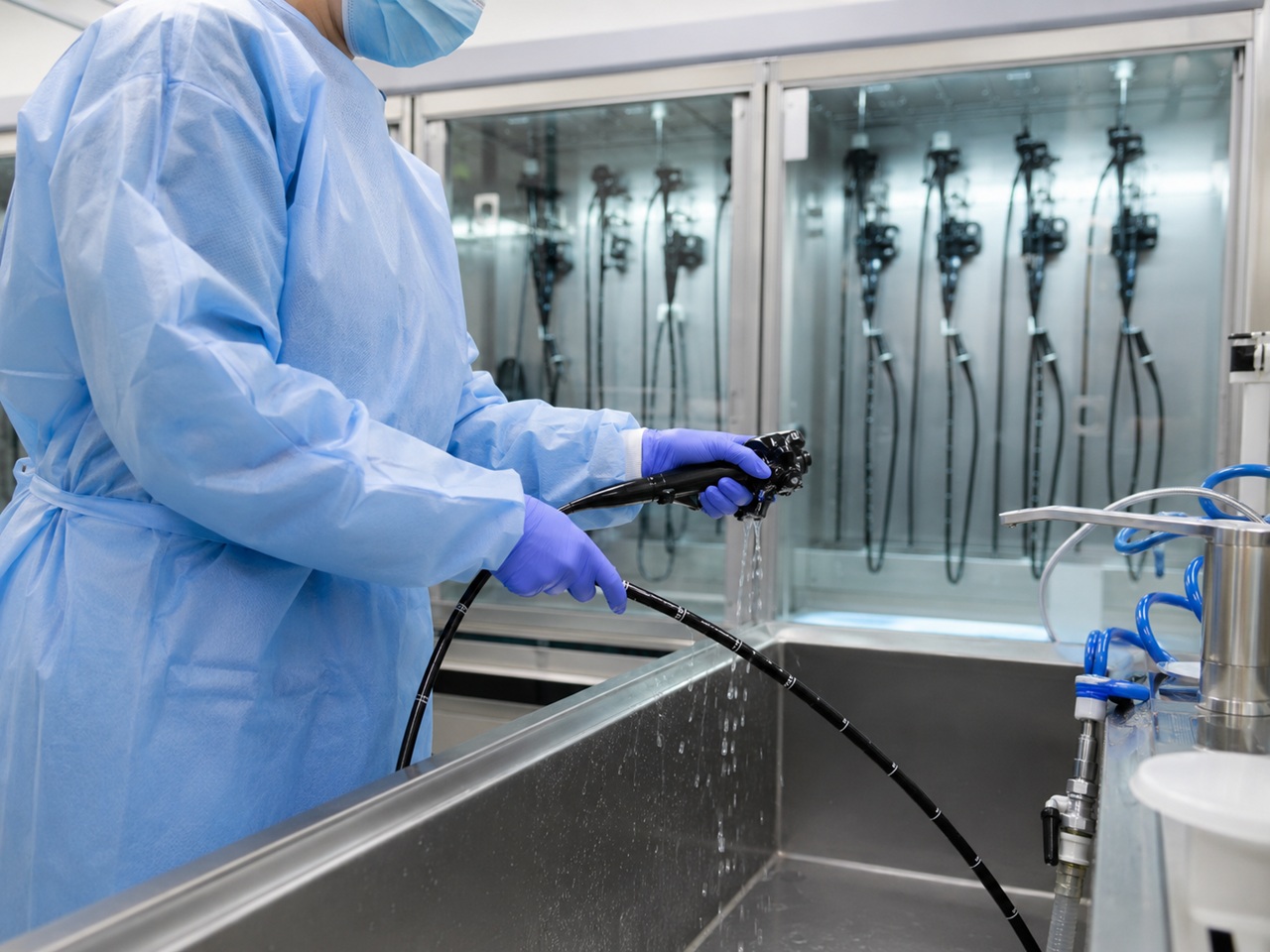
Reusable scopes must be cleaned and disinfected according to strict manufacturer instructions before each use. When reprocessing steps are skipped or done incorrectly, patients can be exposed to serious infections, and the facility or manufacturer may be held liable.
The Cleaning and Maintenance Trail
Investigators may look at whether staff performed required precleaning, disconnected and disassembled removable parts, brushed and flushed required channels, used compatible chemicals at the right concentration and contact time, completed leak testing, dried and stored the device correctly, inspected the scope and accessories for damage, followed the IFU, documented each cycle, and removed suspect equipment from service.
Biofilm or retained biomaterial can make contamination harder to remove. Damage to a channel, valve, seal, connector, or biopsy component can also interfere with cleaning.
Other Possible Sources
The scope may not be the only explanation. The investigation also has to consider preexisting infection, another procedure, a catheter or implant, immune suppression, community exposure, a surgical wound, and unrelated hospital exposure.
These cases may require infectious-disease, microbiology, epidemiology, gastroenterology, urology, pulmonology, surgery, biomedical-engineering, infection-prevention, reprocessing, life-care, and economic experts.
ACS Forensic Lawyer-Scientist
Attorney Armando Edmiston holds the ACS Forensic Lawyer-Scientist designation — one of only six lawyers in Florida. This science-based credential matters in cases built on microbiology, device design, and causation evidence.
"Armando's firm handled my case very well. Ms. Cheryl was very attentive to my care and overall case. She always handled my inquiries fast and within a good time frame. Would highly recommend."— Antwanique B. Actual client. Results may vary; each case is different.
"Armando and his team were able to get maximum recovery available without having to go to court. Armando is very personable and available — he'd answer my worried, overthinking texts at 9pm. He's a great lawyer and someone you'd enjoy having at your family gathering."— Kellie N. Actual client. Results may vary; each case is different.
"First time having to get an injury attorney and so glad I ended up with Armando. He personally came to my job when I was too busy to go to him and got the ball rolling fast. Had me taking physical therapy immediately and got back into recovery fast. On top I got my settlement in under a year."— Joshua D. Actual client. Results may vary; each case is different.
"This practice is extremely ethical, amazingly friendly, and will do anything to help you! Amazing group of people who make you feel like family!"— Kandace K. Actual client. Results may vary; each case is different.
"He was easy to work with, helped me report the claim and get medical help. We settled my case for a very fair amount."— Fabian B. Actual client. Results may vary; each case is different.
Who Could Be Responsible?
| Potential Defendant | What the Claim May Involve |
|---|---|
| Manufacturer | Defective design, manufacturing defect, inadequate warning or IFU, negligent testing, reporting failures, or failure to correct a known problem |
| Hospital or surgery center | Poor cleaning, drying, storage, inspection, maintenance, staff training, outbreak response, or patient notification |
| Physician or provider | Use of damaged equipment, delayed diagnosis, failure to respond to symptoms, or another departure from the applicable standard of care |
| Reprocessing or maintenance contractor | Negligent cleaning, repair, testing, maintenance, documentation, or equipment service |
| Several parties | A hard-to-clean product combined with facility noncompliance, device damage, delayed diagnosis, or another contributing failure |
State law controls strict liability, negligence, medical malpractice, comparative fault, damages, and how responsibility is split among defendants. A nationwide case review has to identify the right law, the right court, and every party that may have contributed.
Is This Product Liability or Medical Malpractice?
It may be one, the other, or both. A design, manufacturing, warning, or instruction failure points toward product liability. Poor reprocessing, inspection, maintenance, diagnosis, or treatment may support a medical malpractice claim or a facility-negligence claim, depending on state law.
The label matters less than the underlying conduct. That distinction can change the defendants, experts, presuit steps, deadlines, defenses, and damages.
What Compensation May Be Available?
Depending on the law and the proof, recoverable losses may include:
- ✓Emergency care, hospitalization, intensive care, medication, and additional procedures
- ✓Rehabilitation, future medical care, and long-term support
- ✓Lost wages and reduced earning capacity
- ✓Pain, suffering, mental anguish, and loss of normal life
- ✓Physical impairment, disability, scarring, or disfigurement
- ✓Loss of consortium and other family-related damages
- ✓Other losses allowed under the governing state's law
Case value turns on the injury, permanency, medical expenses, income loss, causation evidence, defendants, available resources, jurisdiction, and many other facts. No lawyer can honestly promise a number before the case is investigated.
Can a Family File a Wrongful Death Claim?
When a patient dies from sepsis, organ failure, or another complication connected to a contaminated or defective scope, the person authorized under state law may be able to bring a wrongful death claim or survival action.
The eligible family members and available damages differ by state. Medical and funeral expenses, financial support, companionship, guidance, mental suffering, and estate losses may be recoverable in some jurisdictions. These claims have strict deadlines.
How Long Do You Have to File?
There is no single nationwide deadline. The answer depends on the state law that applies, the type of claim, when the injury and its cause were discovered, the defendants, and whether the patient died.
Product liability, ordinary negligence, medical malpractice, wrongful death, and government-defendant claims may all have different time limits. Some states also require presuit notice, an expert affidavit, or another step before filing.
The deadline may change when the procedure occurred in a different state from where the patient lives, several states have a meaningful connection to the claim, a public hospital or government defendant is involved, the patient was a minor or legally incapacitated, the cause was not discovered right away, fraud or concealment delayed discovery, a medical malpractice presuit investigation is required, or the patient died.
Florida deadline example: For Florida claims, different periods and procedures may apply to product liability, medical negligence, and wrongful death. See Florida Statutes section 95.11 and the Florida medical malpractice presuit statute. Other states may impose shorter or different deadlines. Do not use a general website deadline to decide whether a claim is still open. The shortest potentially applicable deadline may control.
"Armando and his team did an amazing job with everything for my daughter and I. After a horrific experience and long term trauma and injuries, Armando made sure we felt taken care of every step of the way. We appreciate you and your entire team for making us feel safe and with hope."— JoAnn M. Actual client. Results may vary; each case is different.
"I was looking for legal representation from someone who would fight for me and not sell out to the big insurance companies. Someone who listens to your needs, tells you how it is with real expectations and goes to bat for you — that's Armando."— Raiven M. Actual client. Results may vary; each case is different.
"Nothing but greatness and professionalism from Armando and his team. From the moment I gave them a call they made me feel comfortable and at ease. Armando and his team made sure I was taken care of and I got what I deserved."— Hector L. Actual client. Results may vary; each case is different.
"Armando is amazing! I trusted him with helping with the insurance company after my case. Besides Armando being professional he was also very efficient. Would recommend him to anyone."— Lina M. Actual client. Results may vary; each case is different.
What Should You Do Now?
- 1 Get medical care. Tell the treating provider about the procedure and any notice of possible exposure.
- 2 Write down the basics. Record the procedure date, facility, physician, procedure type, symptom onset, diagnosis, and later treatment.
- 3 Request the full records. Ask for procedure, hospital, lab, microbiology, billing, equipment, and infection-control records, not just the portal summary.
- 4 Ask what equipment was used. Request the manufacturer, scope type, model, serial number, UDI, accessories, and reprocessing system.
- 5 Keep every notice. Save letters, emails, portal messages, voicemails, and anything else about infection exposure, recalls, or follow-up testing.
- 6 Keep proof of the losses. Save bills, insurance statements, prescription receipts, wage records, travel costs, photographs, and symptom notes.
- 7 Be careful with releases. Understand any authorization, statement, settlement, or release before signing it.
- 8 Talk to a lawyer promptly. Counsel can identify defendants, send preservation notices, evaluate deadlines, and decide which experts may be needed.
"Armando and his staff are incredible. Very professional and attentive. Any time I had questions or concerns about my case they were happy to answer and give me peace of mind. If I ever have a need for an attorney in the future I will always use and recommend Armando."— Matt C. Actual client. Results may vary; each case is different.
How Armando Personal Injury Law Evaluates a Scope Claim
| Step | What We Do |
|---|---|
| Identify | Pin down the procedure, device, accessory, reprocessor, facility, and possible defendants. |
| Reconstruct | Build the medical timeline and review cultures, symptoms, treatment, and damages. |
| Analyze | Compare the IFU with the cleaning logs, maintenance, outbreak evidence, and other possible causes. |
| Position | Determine the governing law, proper jurisdiction, legal theories, experts, and case strategy. |
Regulatory history can tell us where to look. It does not prove a patient's case. The case still has to be built from the patient's records and the evidence tied to the actual device and facility.
Why Armando Personal Injury Law?
These cases sit at the intersection of microbiology, device design, hospital cleaning practices, federal regulation, product liability, and medical negligence. That is a lot of moving parts. It calls for careful work, not assumptions.
Attorney Armando Edmiston founded Armando Personal Injury Law. He earned a Bachelor of Science in Biology from the University of South Florida and his law degree, cum laude, from Nova Southeastern University. He is a U.S. Marine Corps veteran, a Hillsborough County native, and one of only six lawyers in Florida listed with the ACS Forensic Lawyer-Scientist designation.
The firm is based in Tampa Bay and accepts inquiries from patients and families throughout the United States. Its Tampa personal injury practice is the home base. When a case belongs in another jurisdiction, the firm may work with qualified local counsel while helping coordinate the investigation and strategy.
"Armando contacted me directly and was very transparent and communicative through the entire process. I didn't want a billboard/TV attorney where my case was just another number. I wanted to have access to the attorney and feel like my case was a priority. Armando and his team did a great job."— Brian W. Actual client. Results may vary; each case is different.
"I truly appreciate everything that Armando and his team has done for me. I would have been completely lost without them. I couldn't recommend a better team for a lawyer to be behind you."— Divine W. Actual client. Results may vary; each case is different.
Frequently Asked Questions About Olympus Scope Infection Claims
Is there an Olympus scope MDL?
No Olympus scope MDL appears on the official JPML active MDL report dated July 1, 2026. Individual cases may still be filed. The status can change.
Is there an Olympus scope class action?
As of July 20, 2026, our review has not identified a nationwide class action that replaces individual injury claims. These cases usually require patient-specific proof.
Does an infection after a colonoscopy or endoscopy prove the scope was contaminated?
No. The scope is one possible source. The records and medical evidence have to connect the infection to the device, procedure, cleaning process, or another responsible act.
How do I know whether an Olympus scope was used?
The answer may be in the procedure report, equipment log, tracking record, charge entry, reprocessing log, maintenance file, model number, serial number, or UDI.
Is the Olympus MAJ-891 a colonoscopy device?
No. It is a reusable forceps and irrigation plug used with certain cystoscopes, ureteroscopes, choledochoscopes, and hysteroscopes.
Does the FDA import alert mean all Olympus scopes were recalled?
No. The import alerts apply to specific models. The FDA did not tell providers to stop using every Olympus device or cancel every procedure.
Can the hospital and Olympus both be responsible?
Yes, depending on the evidence. A product problem and a facility cleaning or maintenance failure can exist in the same case.
What records matter most?
Start with the procedure report, device and tracking records, reprocessing logs, maintenance history, cultures, antibiotic records, and infection-control investigation.
How soon after a scope procedure can an infection appear?
There is no single timeline. It depends on the organism, procedure, patient, symptoms, cultures, treatment, and other exposures.
Can a family file a claim if the patient died?
Potentially. The person authorized under the applicable state law may be able to bring wrongful death or survival claims.
Can I contact the firm if the procedure happened outside Florida?
Yes. The firm accepts inquiries nationwide and may work with qualified counsel in the state where the claim belongs.
How much is an Olympus scope lawsuit worth?
There is no honest one-size-fits-all number. Value depends on the injury, medical costs, income loss, future care, evidence, defendants, state law, and other facts.
What should I do if the hospital sent an infection notice?
Keep it. Follow the medical testing instructions, request the full records, write down the symptoms and treatment, and talk to counsel about preserving the device and cleaning records.
Sources and Update Record
This page uses primary government sources for regulatory, recall, enforcement, and MDL information. Review the source list monthly and whenever a material development occurs.
| Source | Date or Use |
|---|---|
| FDA import alerts for certain Olympus devices | June 24, 2025 |
| FDA MAJ-891 recall update | Content current March 5, 2025 |
| FDA Class I recall database entry for MAJ-891 | Checked July 20, 2026 |
| Official JPML active MDL report | Report dated July 1, 2026 |
| FDA warning letters involving Olympus endoscopes | January 10, 2023 |
| Department of Justice Olympus plea announcement | December 10, 2018 |
| FDA AccessGUDID medical device database | Device-identification resource |
| FDA MedWatch reporting portal | Adverse-event reporting resource |
Speak With an Olympus Scope Lawsuit Lawyer
A serious infection after a medical procedure can turn into weeks in the hospital, repeat surgery, lost income, permanent health problems, or the death of a family member. You deserve a straight answer about whether a defective product, weak warning, cleaning failure, damaged device, or medical error played a part.
Call Armando Personal Injury Law at (813) 482-0355 from anywhere in the United States. You do not need the model number. The facility, procedure date, type of procedure, and infection diagnosis may be enough to begin.
Not every case will qualify, and no result can be promised. Early review can still matter because records disappear, devices are repaired or returned, and deadlines do not wait.
"I recommend Armando Personal Injury Law to anyone who's in search of receiving 5-star service from start to finish of their case. Every question I had was answered with a detailed explanation. Received a thorough timeline of expectations. Very happy with results."— S.G. Actual client. Results may vary; each case is different.
Free Case Review
About the Author
Attorney Armando Edmiston is the founding attorney of Armando Personal Injury Law in Tampa and St. Pete, Florida. In addition to representing injury victims and families in serious personal injury and wrongful death cases, Armando brings a science-based background to evidence-heavy claims. He earned a B.S. in Biology from the University of South Florida, a J.D., cum laude, from Nova Southeastern University, and is one of only six lawyers in Florida listed with the ACS Forensic Lawyer-Scientist designation. His practice background includes personal injury litigation, medical malpractice-related work, and public defense, which supports a disciplined, evidence-driven approach to complex injury cases.