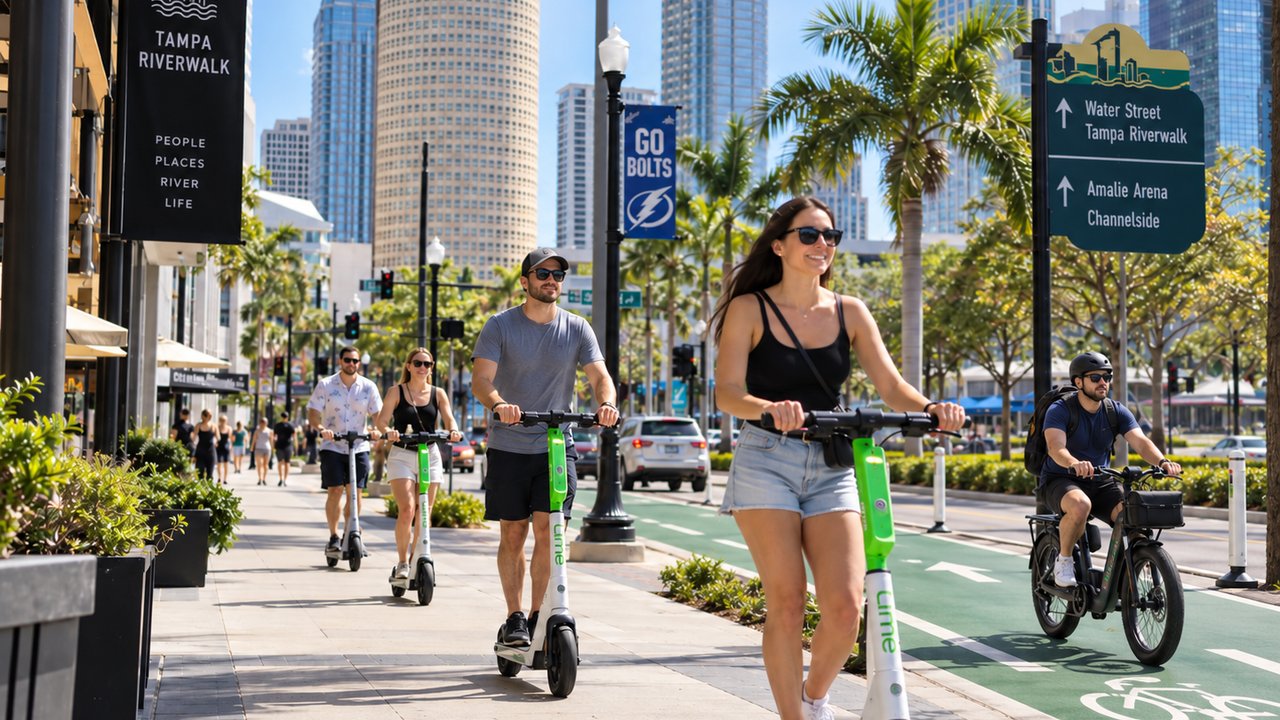
The proposed ordinance would set different maximum speeds for sidewalks, shared-use paths and trails, and roadways and bike lanes.
An e-bike ride through Hillsborough County can take you from a neighborhood street to a sidewalk or shared trail. Under a proposed county ordinance, those changes in location would also mean changes in the speed you’re allowed to travel.
The draft calls for maximum speeds of 10 mph on sidewalks, 15 mph on shared-use paths and trails, and 28 mph on roadways, shoulders, bicycle lanes, and bicycle paths. Lower posted limits and restrictions would still apply.
The proposal appears in the county’s October 21, 2026, agenda materials. This article explains that draft; it does not report a final vote or an effective ordinance.
For someone hurt in a collision, these distinctions have practical consequences. Where you were riding, what device you were using, and which rules applied at the time can all matter when investigating a claim. Our Tampa e-bike and e-scooter accident lawyer page explains how Armando Personal Injury Law helps injured riders.
What Hillsborough County wants to change
Tampa Bay 28’s October 21 report describes concerns about serious injuries involving e-bikes and scooters. The county’s proposed ordinance and agenda packet show how officials propose to address riding behavior, equipment, parking, and enforcement.
The draft reaches beyond electric devices. It also covers traditional bicycles and other devices included in its micromobility definition.
The agenda asks commissioners to approve the proposal and authorize advertising a public hearing for November 10, 2026, at 10 a.m. Moving a proposal toward a hearing does not, by itself, make it enforceable. The draft’s effective-date provision says the ordinance would take effect upon filing with the Florida Department of State.
Proposed speed limits depend on where you ride
Section 4 B(1)(i) of the draft sets out three speed limits:
| Riding location | Proposed maximum speed |
|---|---|
| Sidewalks | 10 mph |
| Shared-use paths, multiuse paths, and trails | 15 mph |
| Roadways, shoulders, bicycle lanes, and bicycle paths | 28 mph |
Signs imposing a lower limit or prohibiting riding would still control. The proposal would not give someone permission to ride a device in an area where it is otherwise prohibited.
A bicycle path and a shared-use path also fall into different categories in this draft. Before assuming a limit applies, riders would need to check the route’s designation and signs. And a bike’s ability to reach a certain speed would not make that speed lawful everywhere it can travel.
Would the same rules apply in Tampa and other cities?
Not necessarily. The draft would cover incorporated and unincorporated Hillsborough County, but Section 3 makes an exception for municipal ordinances.
If a city maintains an ordinance covering the same subject, activity, or conduct, the matching portion of the county ordinance would not apply there. Riders in Tampa, Plant City, and Temple Terrace would therefore need to consider city rules as well as county requirements and posted restrictions.
This is one reason the exact location matters after a crash. Photos of a path entrance, intersection, lane marking, or sign may help establish which rules applied to that part of the trip.
The proposal also addresses parking and pedestrian safety
Speed limits are only part of the draft. It would also regulate how riders share space and leave their devices:
- Passing and yielding. In the circumstances specified by the draft, riders would have to yield to pedestrians and nonmotorized bicycles and give an audible signal before passing.
- Parking. Devices could not obstruct curb ramps, crosswalks, pedestrian access, transit stops, entrances, or other protected access points.
- Lights and reflectors. The proposal includes equipment requirements and an extended lighting period for riding on sidewalks, paths, and trails.
- Unsafe riding. It addresses street takeovers, stunt riding, towing, and operation in areas closed to these devices.
Officers could use education and warnings to encourage compliance. The draft also provides for citations and other enforcement measures, including possible impoundment for certain violations.
What the draft says about helmets
The helmet provision refers to properly fitted helmets for operators or riders under 16. It is not written as a new helmet mandate for every adult rider.
Florida’s existing bicycle helmet law also requires helmets for bicycle riders and passengers under 16. It contains a separate protection that matters in injury claims: failure to wear a bicycle helmet, or a parent’s failure to prevent a child from riding without one, may not be considered evidence of negligence or contributory negligence.
Florida treats e-bikes and scooters under separate laws
Florida Statutes §316.20655 generally gives e-bike riders the rights and duties of bicycle riders. It also allows local authorities to regulate operation and restrict access to certain routes.
Florida Statutes §316.2128 applies a bicycle-rider framework to motorized scooters and micromobility devices, with specified exceptions and room for local regulation.
That distinction matters when a device has been modified or its classification is unclear. The name used in an advertisement or rental app may not answer every legal question about where and how it can be ridden.
Our guide to Florida personal mobility equipment accident claims discusses how a crash investigation can differ depending on the equipment, route, and cause.
How riding rules can affect an injury claim
The starting point is the law in force when and where the collision happened. A proposed rule should not be treated as an existing requirement or automatically applied to an earlier crash.
Consider a driver turning across a rider’s path. An investigation may need to establish who had the right-of-way, how fast each person was traveling, what each could see, and whether either had time to avoid the collision. A claim that the rider was going too fast does not answer all of those questions.
The same care is needed when fault is disputed. Under Florida’s comparative-fault statute, a claimant found more than 50% at fault for their own harm cannot recover damages in a negligence action to which the rule applies. At 50% or less, damages are reduced by the claimant’s share of fault.
An insurance company’s allegation is not a final finding of fault. Witness accounts, photographs, available recordings, and physical evidence can help establish what actually happened.
Our guide to filing an e-bike accident claim in Florida explains how to organize injury records and other information after a collision.
What to save after an e-bike or scooter crash
Get appropriate medical care first. Call 911 if anyone needs emergency help. Once it is safe, document the crash and the equipment involved.
Photograph the scene and route. Include signs, lane markings, crossings, driveways, surface conditions, and the positions of vehicles and devices.
Record the device’s details. Keep its make, model, serial number, classification label, and rental identification number, if there is one.
Save the records you have. Trip receipts, app screenshots, rental communications, and video may be useful. Some devices do not retain speed or location data, so do not assume those records will be available later.
Preserve the equipment. Before repairing, modifying, or discarding your device, get advice about preserving it for an investigation. If it was rented, document its identification and seek help promptly with a preservation request to the operator.
Keep medical and work records. Save bills, treatment records, receipts, and evidence of missed work. Keep witness contact information and the investigating agency’s report details together.
Good records make it easier to examine the crash without relying on assumptions about how an e-bike or scooter rider must have behaved.
Related reading on e-bike and scooter crashes
Two earlier articles on our site explore the investigation questions that can follow a serious collision:
- Plant City e-bike crash and liability considerations
- Electric scooter crash investigations and roadway crossings
Each concerns a separate reported incident. The facts and responsibility in any other crash require their own investigation.
Get help after an e-bike or scooter injury
After a crash, you may be dealing with treatment, time away from work, and questions from an insurer while still trying to understand what happened.
Armando Personal Injury Law helps injured riders evaluate their claims and preserve evidence. Learn more about our work on Tampa e-bike and electric scooter injury cases, or speak with us about your situation.
Call (813) 482-0355 or request a free consultation.

About the Author
Attorney Armando Edmiston is the founder of Armando Personal Injury Law in Tampa and St. Pete, Florida. A U.S. Marine veteran, Hillsborough County native, and ACS Forensic Lawyer-Scientist, he represents Floridians in serious personal injury and wrongful death cases.