Electric scooter safety depends on visibility, safe crossings, driver awareness, and roadway design.
Our condolences go out to the family and friends of Colton Remsburg, the 13-year-old who died after an electric scooter crash with a pickup truck in Orlando. No family should have to face that kind of loss, especially after a child leaves home for something as ordinary and loving as buying flowers for Mother’s Day.
According to WESH 2 News, the crash happened near Savannah Pines Drive and Moss Park Road in the South Lake Nona area of Orlando. The Florida Highway Patrol said the pickup truck was traveling east on Moss Park Road when the teen, who was riding an electric scooter, was crossing the street near a Methodist church and was hit. WESH reported that the teen later died from his injuries and that the case was assigned to traffic homicide investigators as a delayed fatality.
This article is based on the public news report and is not a conclusion about fault. That distinction matters. A crash involving a child, an electric scooter, and a pickup truck should be handled carefully because the first public facts rarely tell the full story.
For Florida families, the tragedy raises difficult questions about scooter safety, helmet use, child roadway crossings, driver awareness, roadway design, and what happens when an ordinary trip becomes a fatal crash.
A Child on a Scooter Has Almost No Protection Against a Pickup Truck
Electric scooters are now part of daily life in many Florida communities. Children and teens use them in neighborhoods, near schools, around churches, and along roads that were mostly designed for cars and trucks.
The problem is the difference in protection. A pickup truck has weight, height, structure, and crash protection. A scooter rider has none of that. There is no frame, airbag, seatbelt, or metal barrier between the rider and the road.
That does not automatically mean the driver is legally responsible. It does mean the investigation should look closely at visibility, speed, roadway design, traffic controls, lighting, sight lines, and whether the driver and rider had enough time to see each other and react.
What Florida Law Says About Electric Scooters
Florida law treats many motorized scooter and micromobility-device operators as having the rights and duties of bicycle riders. Under Florida Statute § 316.2128, the operator of a motorized scooter or micromobility device has the rights and duties applicable to a bicycle rider under Florida Statute § 316.2065, with certain exceptions. The same statute also allows local governments to regulate where scooters and micromobility devices may operate.
That means a scooter crash may involve several overlapping questions: Was the rider crossing in a crosswalk? Was the scooter being operated in a place where local rules allowed it? Were there traffic signals, warning signs, sidewalks, bike lanes, or lighting? Did the driver have a clear view of the crossing area?
The City of Orlando’s e-bike and scooter guidance tells riders to obey traffic laws, wear a helmet, ride with the flow of traffic, yield to pedestrians, and avoid riding under the influence. The city also notes that helmets are required for riders under 16 and strongly encouraged for all riders.
Helmet Use Matters for Safety, But It Should Not End the Legal Analysis
WESH reported comments from a family friend that the teen was not wearing a helmet. That fact is painful, and it is a reminder that helmets matter. But it should not be used to oversimplify a fatal crash.
A helmet may be important medically, especially in a head-injury case. But helmet use does not answer the legal questions about driver conduct, roadway design, vehicle speed, lighting, sight distance, or whether the collision could have been avoided.
Florida bicycle law also contains an important protection: Florida Statute § 316.2065(18) states that the failure to wear a bicycle helmet, or a parent’s failure to prevent a child from riding without a helmet, may not be considered evidence of negligence or contributory negligence. Because Florida’s motorized scooter statute links scooter riders to bicycle rider rights and duties, helmet issues in a scooter case deserve careful legal review rather than quick blame.
Drivers Still Have Duties When Children Are Near the Road
Children do not always judge speed, distance, or vehicle visibility the way adults do. Florida law recognizes that drivers must use extra care around children.
Florida Statute § 316.130 includes a general duty for drivers to exercise due care to avoid colliding with pedestrians and to use proper precaution when observing a child or a person who is obviously confused or incapacitated. While every case depends on the facts, that child-specific language can matter in a crash involving a young rider crossing a road.
The Florida Department of Highway Safety and Motor Vehicles also reminds drivers to look out for pedestrians everywhere, use extra caution in hard-to-see conditions, slow down near crosswalks, and be prepared to stop. Those principles are especially important near homes, churches, schools, parks, and shopping areas where children may cross.
No Ticket or Criminal Charge Does Not Automatically Mean No Civil Claim
WESH reported that troopers originally said the pickup driver stayed at the scene, rendered aid, and likely would not be charged or ticketed. WESH also reported that it was unclear whether that could change after the teen’s death and that the case was assigned to traffic homicide investigators.
That is an important distinction. A criminal charge, a traffic citation, and a civil wrongful death claim are not the same thing.
A driver may avoid a ticket and still face civil liability if evidence later shows that negligence contributed to the crash. Civil claims often involve a deeper review of speed, sight distance, braking, reaction time, roadway lighting, driver distraction, vehicle data, camera footage, witness statements, and crash reconstruction.
For families, the practical takeaway is simple: do not assume the legal case is over because the first report says charges are unlikely. The civil evidence still needs to be reviewed.
What Investigators May Look at After a Fatal Scooter Crash
Fatal scooter crashes require fast evidence preservation. In a case like this, the important evidence may include:
- The FHP traffic homicide investigation file
- The Florida crash report and supplemental reports
- 911 audio, CAD notes, and dispatch records
- Photos and measurements from the scene
- The condition of the scooter, including brakes, lights, and reflectors
- The pickup truck’s damage pattern and electronic data, if available
- Nearby surveillance video, doorbell video, dashcam footage, or church-area cameras
- Witness statements
- Lighting, roadway design, crossing layout, signage, and sight-distance issues
- Insurance coverage for the driver, vehicle owner, household, or any other potentially responsible party
Some of this evidence can disappear quickly. Video may be overwritten. Vehicles may be repaired. Scene conditions may change. Witnesses may become harder to locate. That is why a family should not wait too long to ask questions.
Florida Wrongful Death Claims After a Child Is Killed in a Crash
When a child dies because of another party’s negligence, Florida’s Wrongful Death Act may allow the family and estate to bring a claim. Florida law allows certain survivors to seek damages after a wrongful death, including damages for mental pain and suffering in specific circumstances. For the death of a minor child, Florida Statute § 768.21 specifically addresses the rights of parents.
A wrongful death claim may also involve medical expenses, funeral expenses, loss of support and services, and other damages depending on the family relationship and case facts. Families can learn more through Armando Personal Injury Law’s Florida wrongful death lawyer resource.
Timing is also important. Florida law generally provides a two-year limitation period for negligence and wrongful death claims. See Florida Statute § 95.11. Waiting can also make the case harder because key evidence may disappear long before the legal deadline expires.
Insurance Issues Can Be Complicated in Scooter and Child Injury Cases
Electric scooter crashes can create confusing insurance questions. Depending on the facts, coverage may involve auto insurance, household insurance, umbrella coverage, uninsured or underinsured motorist coverage, or other sources.
Florida also uses a comparative fault system in negligence cases. Under Florida Statute § 768.81, fault may be divided among responsible parties, and a party found more than 50 percent at fault may be barred from recovering damages in many negligence cases. Insurance companies may use that rule to argue about fault, which makes evidence preservation even more important.
If the at-fault driver has limited insurance, families may need to review whether uninsured or underinsured motorist coverage or another policy may apply. These coverage questions should be reviewed before a family accepts an insurer’s explanation of what is available.
Safety Lessons for Florida Families and Drivers
This tragedy happened in Orlando, but the concern is statewide. Electric scooters, e-bikes, bicycles, pedestrians, and cars now share the same roads across Florida. Many roads were not designed for that mix.
Parents can reduce risk by making helmets non-negotiable, checking scooter lights and brakes, helping children understand where they should and should not ride, and avoiding high-speed crossings whenever possible. Young riders should never assume a driver sees them.
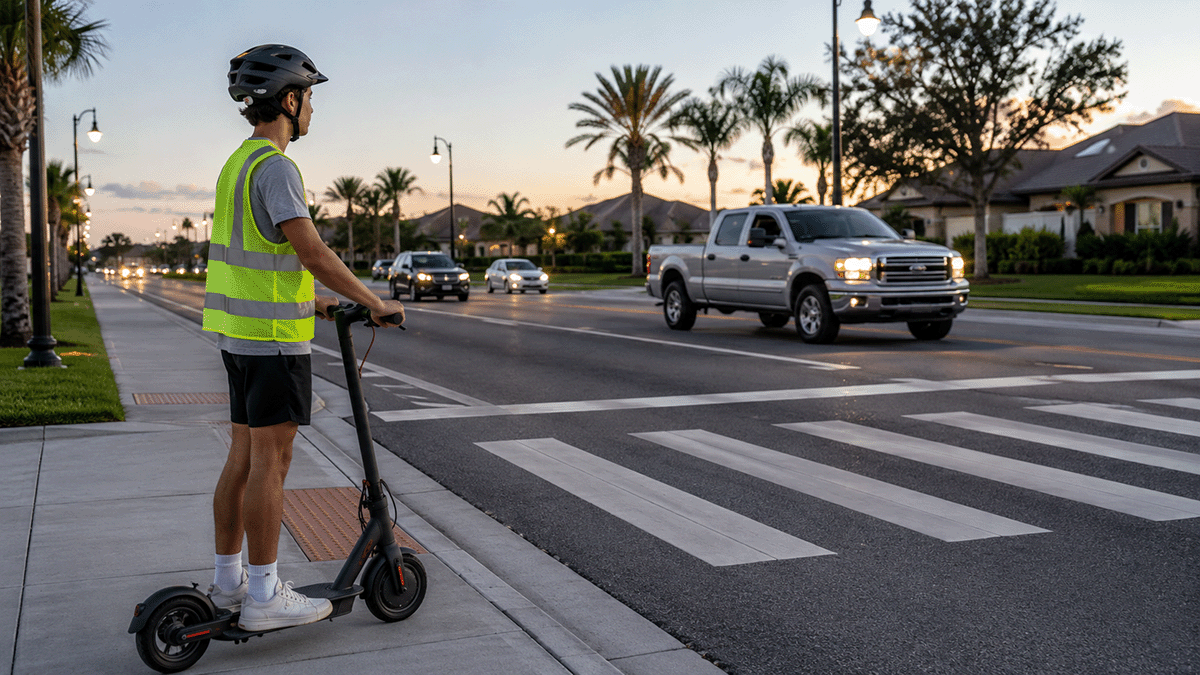
Drivers need to adjust, too. A child on a scooter can appear quickly and may be difficult to see near dusk, near curves, near parked vehicles, or at wide intersections. The safer approach is to slow down around neighborhoods, churches, schools, shopping areas, and any place where a child may cross.
Talk to a Florida Injury Lawyer After a Serious Scooter, Pedestrian, or Bicycle Crash
After a fatal crash, families are often left with grief, unanswered questions, and pressure from insurance companies. They should not have to investigate the crash alone.
Armando Personal Injury Law helps injured Floridians and grieving families understand what happened, preserve evidence, identify insurance coverage, and pursue accountability when negligence caused harm. The firm also provides resources for Florida car accident claims, pedestrian accident claims, and fault disputes after pedestrian crashes.
If your child or loved one was injured or killed in a scooter, pedestrian, bicycle, or vehicle crash in Florida, call Armando Personal Injury Law at (813) 482-0355 or contact the firm online for a free consultation.

About the Author
Attorney Armando Edmiston is the founder of Armando Personal Injury Law in Tampa and St. Pete, Florida. A U.S. Marine veteran, Hillsborough County native, and ACS Forensic Lawyer-Scientist, he represents Floridians in serious personal injury and wrongful death cases.