
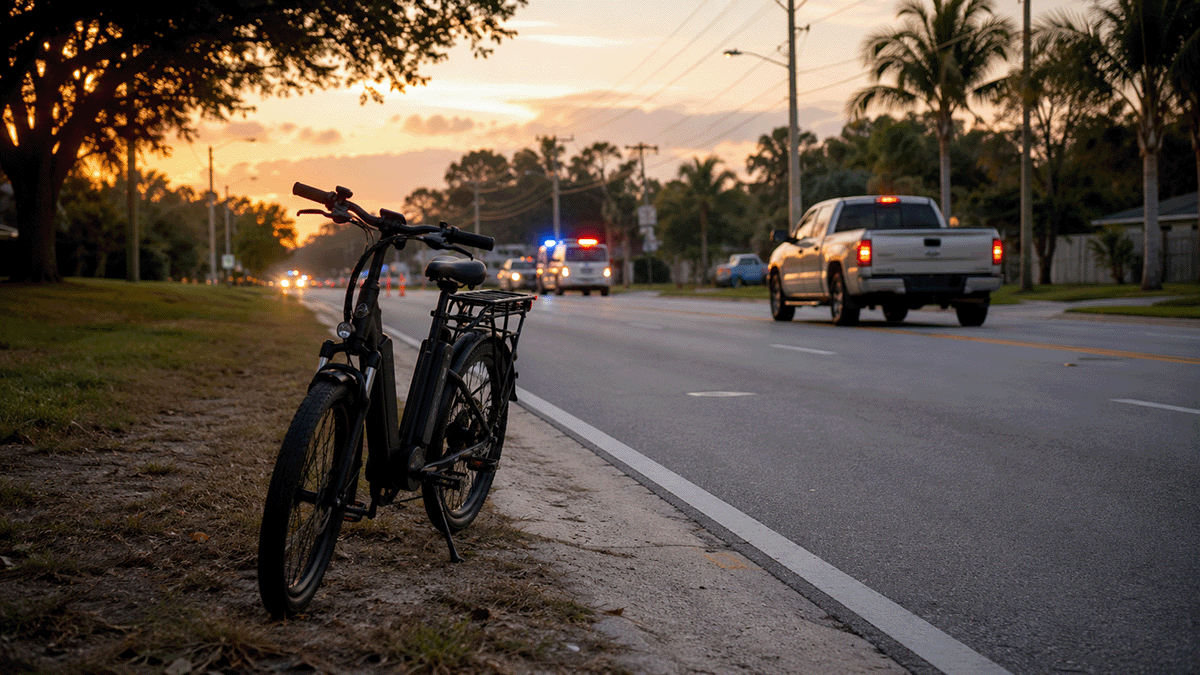
A fatal e-bike crash in Plant City highlights the serious risks young riders face when sharing Florida roads with larger vehicles.
Armando Personal Injury Law extends its sincere condolences to the family of the 14-year-old Plant City teen who lost his life after an e-bike crash involving a pickup truck. No family should have to experience the sudden loss of a child, and this tragedy is especially painful because it happened close to home, in a community where kids should be able to travel safely between neighborhoods.
According to Tampa Bay 28, the crash happened on May 11, 2026 around 7:30 p.m. near Wilder Road and Bryce Ravine Avenue in Plant City. The teen was reportedly riding an e-bike when he was struck by a pickup truck. He was airlifted to the hospital and died two days later. The Hillsborough County Sheriff's Office is investigating, and the report states that the driver stayed at the scene and was not facing charges at the time of publication.
That last detail matters, but it does not end the legal conversation. A driver may avoid criminal charges and still face civil liability if evidence later shows that negligence contributed to the crash. Criminal charges focus on whether the State can prove a crime. A civil injury or wrongful death lawsuit in Florida focuses on whether someone's careless actions caused preventable harm.
Why Fatal E-Bike Crashes Require a Careful Investigation
E-bikes are becoming more common across Florida, especially among teenagers and families who use them to move between neighborhoods, schools, parks, and local roads. But when an e-bike and a pickup truck collide, the person on the e-bike has almost no physical protection. Families dealing with a serious or fatal crash should understand how an e-bike accident claim in Florida may be investigated differently from an ordinary property-damage crash.
A fatal e-bike crash investigation should look beyond the basic police summary. Important questions may include:
- Was the pickup driver speeding, distracted, or failing to keep a proper lookout?
- Did the driver have enough time and distance to see the e-bike rider?
- Was the e-bike rider visible in the roadway or intersection?
- Were there streetlights, stop signs, traffic controls, bike lanes, sidewalks, or sight-line obstructions?
- Did roadway design contribute to the danger?
- Was the crash location known for speeding, cut-through traffic, or poor visibility?
- Was any video available from nearby homes, businesses, dash cameras, or traffic cameras? See more on evidence that can prove distracted driving in Florida.
- Were cell phone records, vehicle data, or witness statements preserved?
These questions matter because serious crash cases are often won or lost on evidence that disappears quickly. Video may be overwritten. Vehicles may be repaired or destroyed. Witnesses may become harder to find. Roadway conditions can change. That is why families often benefit from speaking with a Plant City car accident lawyer before insurance companies control the evidence narrative.
Florida E-Bike Law: E-Bikes Are Treated Much Like Bicycles
Florida law gives electric bicycles many of the same rights and duties as regular bicycles. Under Florida Statute Section 316.20655, an electric bicycle and its operator generally receive the rights and privileges of a bicycle and are subject to the duties of a bicycle operator. The statute also says an e-bike is not subject to vehicle registration, title, driver's license, or financial responsibility laws.
That means e-bike riders may be allowed in many places where bicycles are allowed, including streets, highways, roadways, shoulders, bicycle lanes, and bicycle or multiuse paths, unless a local rule says otherwise. Florida law also allows local governments to adopt ordinances setting minimum age requirements or requiring government-issued photo identification for e-bike operation.
For families, this creates a difficult reality. E-bikes can legally operate in traffic environments where riders are exposed to the same dangers as adult cyclists, but many riders are still children or young teens with limited experience judging speed, distance, vehicle blind spots, and intersection risk. For broader context on bicycle rules, see Armando Personal Injury Law's guide to Florida bike laws.
Helmet Law and Minors in Florida Bicycle and E-Bike Cases
Florida bicycle law requires riders and passengers under age 16 to wear a properly fitted and securely fastened helmet that meets federal safety standards. Because Florida e-bike law generally applies bicycle duties to e-bike riders, Florida Statute Section 316.2065 is an important safety reference in cases involving minors.
However, Florida law also states that failure to wear a bicycle helmet, or a parent's failure to prevent a child from riding without one, may not be considered evidence of negligence or contributory negligence. That distinction is critical. Insurance companies may still try to shift blame onto a child or family after a crash, but Florida law places limits on how helmet evidence can be used.
A helmet can reduce the risk of head injury, but it does not prevent a pickup truck from striking a child. It does not fix poor roadway design. It does not excuse a distracted driver. It does not replace the duty every driver has to watch for vulnerable road users.
E-Bike Crashes Are Part of a Larger Traffic Safety Problem
National data confirms that cyclists remain highly vulnerable in motor vehicle crashes. NHTSA's 2023 Traffic Safety Facts for Bicyclists and Other Cyclists reported 1,166 pedalcyclist deaths in 2023, along with an estimated 49,989 injuries. NHTSA also notes that beginning in 2022, pedalcyclist data includes riders on bicycles powered by pedals and/or motors, which brings many e-bike-related traffic crashes into the broader cyclist crash data category.
NHTSA's bicycle safety guidance emphasizes that drivers must share the road, yield to bicyclists as they would other motorists, look carefully before turning, reduce speed for road conditions, and give cyclists enough room when passing. Those duties become even more important when children are riding near neighborhoods, parks, schools, or residential roads.
No Criminal Charges Does Not Mean No Civil Liability
After a fatal crash, families often hear that the driver was not arrested or is not facing charges. That can feel like the end of accountability. Legally, it is not.
A criminal case and a civil wrongful death claim have different standards, different goals, and different evidence rules. Prosecutors must prove a crime beyond a reasonable doubt. A civil claim asks whether negligence caused the death and whether the surviving family members and estate are entitled to compensation under Florida law. For fatal roadway cases, families may need help from a lawyer who understands both fatal accident claims and the evidence issues that arise when a vulnerable road user is struck by a larger vehicle.
Examples of civil negligence in an e-bike crash may include:
- Failing to yield the right of way
- Driving too fast for conditions
- Failing to see what was there to be seen
- Distracted driving
- Unsafe passing
- Turning without properly checking for cyclists
- Failing to slow near children, neighborhoods, intersections, or low-light areas
In some cases, liability may also involve parties beyond the driver, including a vehicle owner, employer, roadway contractor, public entity responsible for unsafe roadway conditions, or a manufacturer if an e-bike defect contributed to the crash.
Florida Wrongful Death Claims After a Fatal E-Bike Crash
Florida's Wrongful Death Act allows a civil claim when a person's death is caused by another party's wrongful act, negligence, default, or breach of contract or warranty. That right of action appears in Florida Statute Section 768.19.
In a case involving the death of a minor child, Florida law may allow the child's parents to recover damages for mental pain and suffering from the date of injury. Florida Statute Section 768.21 also addresses damages such as support and services, medical expenses, and funeral expenses, depending on who paid them and how the claim is brought.
These cases are not just about bills. They are about accountability, answers, and the full legal impact of a preventable death. For a grieving family, a wrongful death claim may help uncover what happened, preserve evidence, and force insurance companies or responsible parties to confront the consequences of unsafe choices. Families can also review Armando Personal Injury Law's broader explanation of how wrongful death lawsuits work in Florida.
What Families Should Do After a Fatal E-Bike Crash
No family should have to manage evidence, insurance calls, and legal deadlines while grieving. But early action can be important. After a fatal e-bike crash, families should consider:
- Requesting the crash report when available
- Preserving the e-bike, helmet, clothing, lights, and any damaged personal items
- Identifying witnesses and nearby cameras
- Saving text messages, photos, location data, and route information
- Avoiding recorded statements to insurance companies without legal guidance
- Speaking with a lawyer before signing any release or settlement document
Florida's statute of limitations for wrongful death actions is generally two years, and Florida Statute Section 95.11 specifically includes an action for wrongful death within the two-year limitations category. Waiting can make a case harder. The sooner evidence is preserved, the stronger the investigation can be.
E-Bike Safety Must Include Driver Accountability
It is easy for public conversations after an e-bike crash to focus only on the rider: Was the child wearing a helmet? Was the child in the road? Was the e-bike too fast? Those questions may matter, but they are not the whole story.
Drivers operating pickup trucks, SUVs, and passenger vehicles have a duty to watch for children, cyclists, pedestrians, and other vulnerable road users. Neighborhood roads are not racetracks. Intersections are not places for distracted driving. Low-light conditions require more caution, not less.
Florida families are increasingly sharing roads with e-bikes, scooters, bicycles, golf carts, pedestrians, and other forms of personal mobility. The law must keep up, but so must driver behavior. For injured riders and families, a Florida bicycle accident lawyer can evaluate the evidence and determine whether a civil claim may be available.
Talk to a Florida E-Bike Accident Lawyer
If your family lost a loved one in an e-bike crash, bicycle crash, pedestrian crash, or fatal car accident in Plant City, Hillsborough County, or anywhere in Florida, Armando Personal Injury Law can help you understand your legal options.
Our team investigates serious and fatal crash cases, preserves evidence, deals with insurance companies, and fights for families who deserve answers. Call Armando Personal Injury Law at (813) 482-0355 for a free consultation.