Florida Personal Mobility Equipment Accident Lawyer
If you were hurt while riding a scooter, Onewheel, bicycle, electric bike, or similar personal mobility device in Florida, the first step is figuring out what kind of case you may actually have and what Florida rules apply to the way the crash happened.
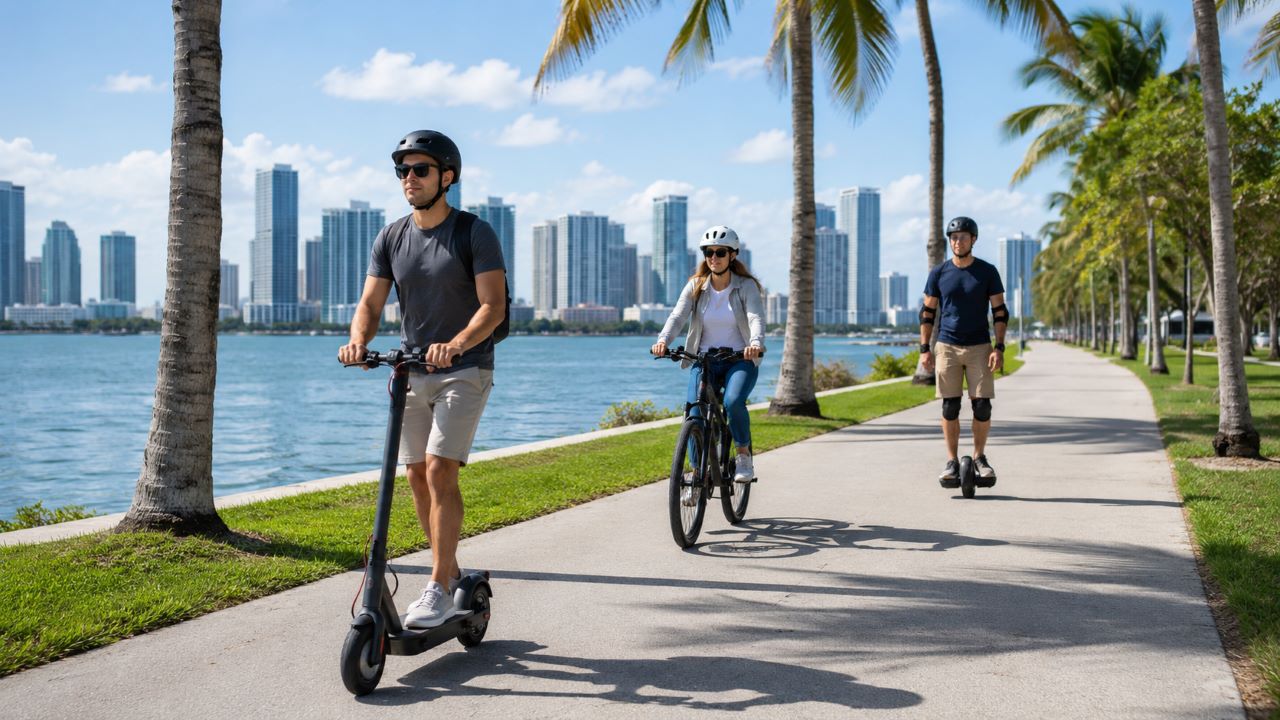
Florida personal mobility equipment crashes can involve scooters, Onewheels, bicycles, electric bicycles, dangerous routes, and negligent drivers.
These crashes do not all belong in the same box. Some involve a driver who failed to yield. Some involve a dangerous sidewalk, trail transition, or roadway condition. Some involve defective equipment. Some involve more than one cause at the same time.
A scooter crash with a car is not built the same way as a Onewheel ejection case. A bicycle collision is not the same as an e-bike defect claim. A fall caused by a dangerous trail transition is not the same as a rental-equipment case. Florida law overlaps in important places, but the right legal path still depends on the device involved, where the crash happened, and whether the main problem was a driver, a dangerous surface, a defective product, or some combination of those factors.
At Armando Personal Injury Law, we help injured people and families across Florida evaluate personal mobility equipment accident claims, preserve the right evidence, and pursue compensation from every party that helped cause the crash.
What Counts as Personal Mobility Equipment in Florida?
Personal mobility equipment in this context includes devices commonly used for local travel, short-distance commuting, recreation, and mixed-use urban transportation, including:
- electric scooters and motorized scooters
- Onewheels and similar self-balancing boards
- bicycles
- electric bicycles
- other micromobility devices used on streets, sidewalks, bike lanes, trails, and mixed-use paths
These devices do not all fit into one perfect statutory category. Florida law treats bicycles, electric bicycles, micromobility devices, and motorized scooters through related but distinct provisions. Some devices, including Onewheels, also raise classification questions that need to be analyzed carefully based on the actual facts of the case. That does not make these claims weaker. It makes them more important to investigate correctly.
How Florida Law Treats Different Personal Mobility Equipment
Florida does not place every personal mobility device into one perfect category. The safer approach is to look at the main device types separately and then apply the operating rules that fit each one.
Micromobility devices
Florida law defines a micromobility device in section 316.003 as a motorized transportation device made available for private use by reservation through an online application, website, or software for point-to-point trips and not capable of traveling faster than 20 miles per hour on level ground. Section 316.2128 generally gives operators of micromobility devices the same rights and duties as bicycle riders, while allowing local governments to regulate where those devices may be used.
Motorized scooters
Florida law defines a motorized scooter in section 316.003 as a vehicle or micromobility device powered by a motor, with or without a seat or saddle, designed to travel on not more than three wheels and not capable of more than 20 miles per hour on level ground. Section 316.2128 generally gives motorized scooter operators the same rights and duties as bicycle riders, subject to local regulation.
Bicycles
Florida’s bicycle rules remain the baseline for much of this area of law. Section 316.2065 sets out the rights and duties of bicycle riders, and section 316.2128 borrows that framework for micromobility devices and motorized scooters.
Electric bicycles
Electric bicycles are addressed separately under section 316.20655. In general, Florida gives electric bicycles and their operators the same rights and duties as bicycles and bicycle riders, while also recognizing classifications and local restrictions that may affect where they can be operated.
Onewheels and similar one-wheel boards
Florida law does not name Onewheels directly, and a Onewheel does not fit neatly into every statutory definition. In practice, lawyers and insurers often look to the broader micromobility and bicycle-rule framework, the exact device involved, the route being used, and any local restrictions that applied where the crash happened. What matters most is whether the rider was using the route in a reasonably foreseeable way and whether another party’s negligence or a defective product caused the crash.
Florida Laws That Shape Personal Mobility Equipment Accident Claims
Florida law gives micromobility devices and motorized scooters an important starting point under section 316.2128. That statute says operators of micromobility devices and motorized scooters generally have the same rights and duties as bicycle riders under section 316.2065, while also allowing local governments to regulate where those devices may be used.
Electric bicycles are addressed separately in section 316.20655, which generally gives electric bicycles and their operators the same rights and duties as bicycles and bicycle riders, while also recognizing local authority over where they may be operated.
That statewide framework matters because many injury cases turn on questions like:
- whether the rider was lawfully using the street, bike lane, sidewalk, or path
- whether the route was one where this type of device was reasonably expected
- whether a local government imposed route-specific restrictions
- whether a driver failed to yield to a rider with the same basic roadway protections as a bicyclist
- whether a property owner or public entity allowed a known surface hazard to remain in a foreseeable route of travel
Florida’s comparative-fault statute, section 768.81, also matters in many of these cases. Defendants and insurers often argue that the rider was using the wrong route, going too fast, not wearing enough protective gear, or otherwise contributed to the crash. Those arguments have to be addressed with facts, not assumptions.
Why These Accidents Happen Across Florida
Personal mobility equipment crashes happen in recurring patterns across the state.
Driver negligence
Drivers fail to yield, turn across the rider’s path, misjudge the speed of a smaller device, pull out of parking lots or driveways without looking, or simply do not recognize the device until it is too late.
Dangerous surfaces
Many personal mobility devices are less forgiving than cars or even bicycles when they hit cracked pavement, abrupt sidewalk seams, potholes, loose gravel, raised panels, broken pavement edges, poorly maintained trail transitions, or driveway-apron dips.
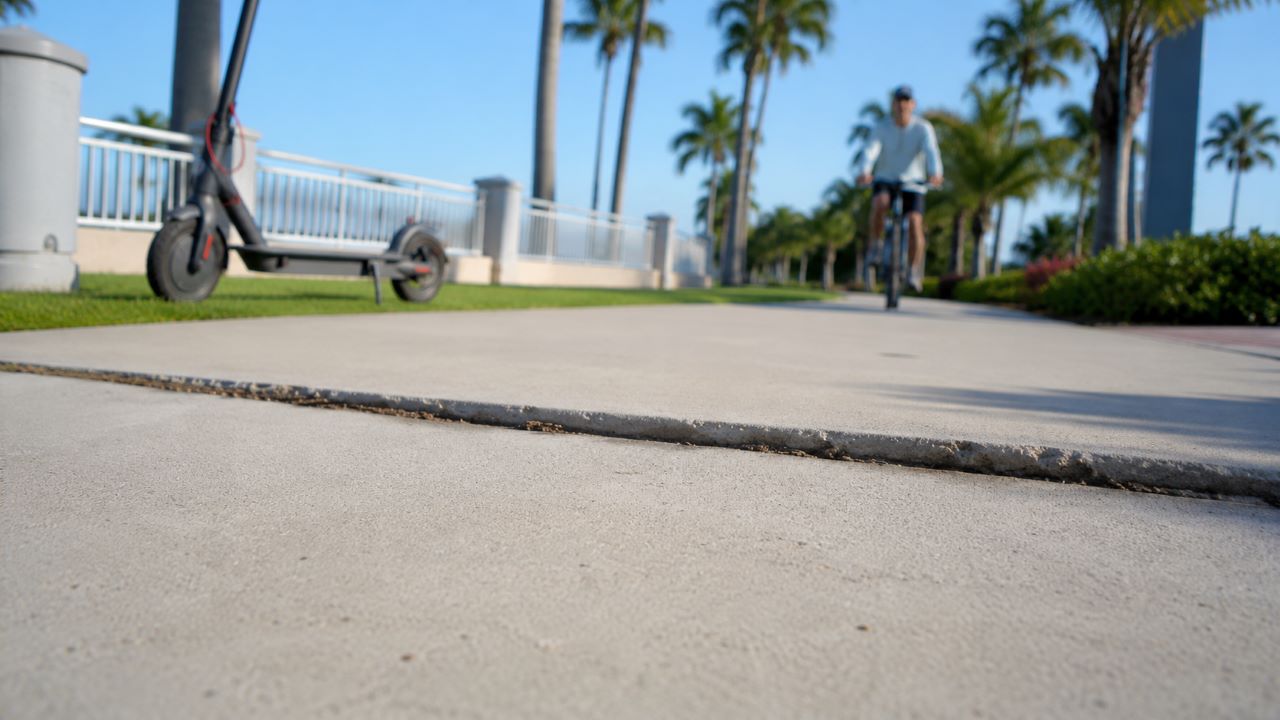
Cracked pavement, raised panels, and abrupt trail transitions can cause serious scooter, Onewheel, bicycle, and e-bike crashes across Florida.
Product defects
Some crashes are caused or worsened by failures in the equipment itself. That can include sudden power loss, brake or throttle issues, steering problems, battery failures, ejection hazards, structural failures, or dangerous design choices.
Mixed-use route conflicts
Florida riders often share space with pedestrians, cyclists, parked vehicles, delivery traffic, event crowds, and narrow access points on waterfront paths, downtown routes, college-area connectors, greenways, and trails. Those conflict points matter.
Multiple causes at once
A rider may be forced into an evasive move by a vehicle and then hit a dangerous surface. A defective board may fail when the rider encounters a route condition that should have been manageable. A property owner may create a hazard in an area where micromobility traffic is entirely foreseeable. The strongest cases do not force the facts into one narrow story too early.
Who May Be Liable in a Florida Personal Mobility Equipment Accident?
More than one party may be responsible.
Negligent drivers
When a driver hits a rider or forces a rider into a crash, the case may involve the same negligence principles that apply in bicycle and pedestrian claims. Duty, breach, causation, visibility, route position, speed, and failure to yield all matter.
Property owners and businesses
Commercial property owners, apartment complexes, retailers, parking operators, and other private entities may face liability when dangerous surface conditions or design problems create foreseeable risk for riders.
Cities, counties, and government entities
If the crash was caused by a public-surface hazard, a defective trail transition, poor maintenance, or another dangerous condition on public property, a claim may involve a city, county, or another governmental entity. These claims can require specific notice and procedural steps.
Manufacturers and product sellers
A product liability claim may exist when the equipment failed because of a design defect, manufacturing defect, inadequate warning, battery hazard, braking problem, steering failure, or another dangerous product condition.
Rental companies and shared-mobility operators
When the equipment was rented, businesses may face liability for poor maintenance, defective equipment, unsafe deployment, inadequate warnings, or other failures tied to the device and how it was placed into use.
Employers or commercial users
If the person who caused the crash was using the device in the course of employment, an employer or business may also be part of the liability picture.
Scooter, Onewheel, Bicycle, and E-Bike Cases Are Not All the Same
These categories overlap, but they are not interchangeable, and the right legal strategy usually starts with identifying the device and the main cause of the crash.
Scooter accidents
Scooter crashes often involve driver conflicts, deployment issues, roadway hazards, sidewalk-use disputes, rental-company questions, and visibility problems.
Onewheel accidents
Onewheel cases often require closer analysis of product-defect theories, recall history, route-surface changes, and the exact mechanics of ejection.
Bicycle and electric bicycle accidents
Bicycle and e-bike cases often overlap, but they can raise different speed, equipment, route-use, and statutory issues. Riders dealing with a bicycle or e-bike crash should usually start with Florida bicycle accident lawyer, Tampa e-bike and e-scooter accident lawyer, or St. Petersburg bicycle accident lawyer.
Why the routing matters
The point is to reduce confusion quickly. Someone dealing with a serious crash should be able to identify the right accident type, the right Florida legal framework, and the right city-specific article without guessing.
Common Injuries in Florida Personal Mobility Equipment Crashes
These crashes can cause serious injuries because riders are often exposed, unprotected, and thrown directly onto pavement, curbs, vehicles, or fixed objects.
Common injuries include:
- traumatic brain injuries and concussions
- wrist, arm, shoulder, and clavicle fractures
- spinal and neck injuries
- knee, ankle, hip, and lower-body trauma
- road rash, skin loss, and scarring
- facial injuries and dental trauma
- internal injuries
- wrongful death in fatal cases
What To Do After a Personal Mobility Equipment Accident in Florida
What happens in the first hours and days after the crash can shape the claim.
Get medical care right away
Do not assume you are fine because you stood up, finished the ride, or felt better later that day. Brain injuries, spinal injuries, and internal injuries often become more obvious with time.
Photograph the device, the route, and the hazard
Take photos of the equipment, the exact surface, the surrounding area, route markings, traffic controls, vehicles involved, visible injuries, and any condition that may have contributed to the crash.
Preserve the equipment
Do not repair, return, modify, update, or discard the scooter, board, bicycle, battery, or related parts if a product issue may be involved.
Report the crash when appropriate
If a driver was involved, call law enforcement. If the crash happened because of a dangerous public or private condition, document notice to the appropriate entity.
Do not let the defense reduce the case to rider error
These cases are often oversimplified by insurers and corporate defendants. Early evidence preservation matters.
How We Build Florida Personal Mobility Equipment Cases
The strongest cases are built on detail.
Depending on the type of crash, important evidence may include:
- the device itself and its condition after the crash
- product model, recall status, and maintenance history
- app, firmware, or update history when relevant
- crash and incident reports
- photos and video from the scene
- surveillance from nearby businesses, homes, or public cameras
- witness statements
- roadway, trail, sidewalk, or property-condition records
- maintenance logs, complaints, or prior notice evidence
- medical records showing how symptoms developed over time
- proof of route use, speed, visibility, and surrounding traffic
These cases are often won by preserving and organizing evidence early, not by guessing what happened.
Compensation in a Florida Personal Mobility Equipment Injury Claim
A serious personal mobility equipment claim may involve medical expenses, surgery, imaging, rehabilitation, future treatment, lost income, reduced earning capacity, pain and suffering, emotional distress, loss of enjoyment of life, disfigurement, scarring, and wrongful death damages in fatal cases.
The value of the case depends on more than the first emergency bill. It depends on the injury pattern, the quality of the evidence, the available insurance or defendant resources, and whether the damage continues affecting work, treatment, and daily life long after the crash.
Why People Across Florida Call Armando Personal Injury Law
After a serious crash involving a scooter, Onewheel, bicycle, or e-bike, people want more than a generic promise to fight for them.
They want to know what category of claim may apply, whether the equipment itself needs to be preserved, whether a dangerous surface or negligent driver contributed to the crash, what statutes may control the route issue, and which legal path best fits the case.
Armando Personal Injury Law helps injured people and families investigate complex mobility-equipment cases involving defective products, dangerous surfaces, negligent drivers, and overlapping fault issues. We build the case carefully, preserve the evidence early, and help people understand which legal path fits the crash they are dealing with.
Frequently Asked Questions About Florida Personal Mobility Equipment Accidents
Does Florida treat scooters and micromobility devices like bicycles?
In many situations, yes. Florida section 316.2128 generally gives operators of micromobility devices and motorized scooters the rights and duties applicable to bicycle riders, while also allowing local governments to regulate where those devices can be used.
Are electric bicycles treated the same as bicycles in Florida?
In general, yes. Florida section 316.20655 gives electric bicycles and their operators the rights and duties of bicycles and bicycle riders, subject to the statute’s requirements and local restrictions.
What if the device itself failed?
Then a product liability claim may need to be investigated. The device should be preserved exactly as it was after the crash if possible.
What if the crash happened because of a dangerous sidewalk, trail, or roadway condition?
A premises or governmental negligence claim may exist, depending on who controlled the area and whether the hazard should have been fixed or warned about before the crash.
Can more than one party be liable?
Yes. Many of these cases involve overlapping causes, and more than one defendant may share responsibility.
How soon should I talk to a lawyer?
As soon as possible. Device condition, surveillance, route evidence, maintenance records, and witness information can all become harder to prove with time.
Talk to a Florida Personal Mobility Equipment Accident Lawyer
A serious crash involving a scooter, Onewheel, bicycle, or e-bike can leave you dealing with head injury symptoms, fractures, scarring, work disruption, and a legal problem that is more complicated than it first looks.
If you already know whether this was a scooter, Onewheel, bicycle, or e-bike crash, start with the article that matches the device. If you are not sure whether the case is primarily a driver case, a dangerous-surface case, a product case, or a combined-liability case, contact Armando Personal Injury Law to discuss what happened, what evidence should be preserved now, and what legal path makes the most sense.
We handle these cases on a contingency fee basis, so there is no fee unless we recover compensation for you.

About the Author
Attorney Armando Edmiston is the founding attorney of Armando Personal Injury Law in Tampa and St. Pete, Florida. A U.S. Marine veteran and Hillsborough County native, he represents injured people and families in serious injury cases, including car accidents, truck accidents, motorcycle accidents, wrongful death, negligent security, premises liability, and nursing home abuse and neglect claims. Armando earned a B.S. in Biology from the University of South Florida and a J.D., cum laude, from Nova Southeastern University. He is also one of only six lawyers in Florida listed with the ACS Forensic Lawyer-Scientist designation.