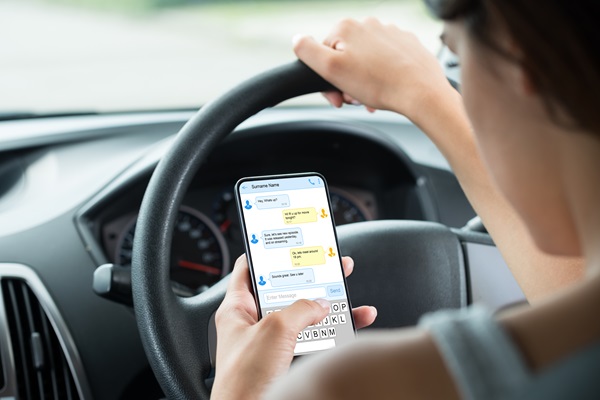
Texting while driving is a common form of distracted driving linked to higher crash risk, delayed reaction time, and increased liability in Tampa car accident claims.
The High Stakes of Tampa Traffic
A split-second glance at a phone on I-275, Dale Mabry Highway, or Hillsborough Avenue can transform a routine commute into a catastrophic wreck. This April, during Distracted Driving Awareness Month, the Florida Highway Safety and Motor Vehicles (FLHSMV) is amplifying its "Put It Down" campaign.
The data from 2025 is a stark warning: nearly 53,000 crashes in Florida were caused by distracted drivers, resulting in over 300 fatalities. At Armando Personal Injury Law, we see the human toll behind these numbers—the neck pain, back injuries, and financial stress that follow a moment of inattention. When a driver chooses a screen over safety, they create an accident every 44 seconds in our state. We’re here to make sure they're held accountable.
Decoding Florida’s Distracted Driving Laws
Florida law is designed to punish inattention, but proving a violation after a crash requires a specific legal approach. Two key statutes govern these cases:
- Florida Statutes § 316.305: The "Ban on Texting While Driving Law" makes it illegal to type, send, or read data while operating a vehicle.
- Florida Statutes § 316.306: Prohibits the handheld use of any wireless device in designated school and work zones.
These laws provide a foundation for your claim. If we can prove the other driver was texting or scrolling, it establishes negligence per se. This connects their illegal conduct directly to your injuries, making it much harder for insurance companies to deny responsibility.
Why Tampa Roads are "Zero-Margin" Zones
In a high-density city like Tampa, traffic patterns shift instantly. A driver looking down at a notification loses the critical seconds needed to react to stopped traffic or a pedestrian. At Armando Personal Injury Law, we frequently investigate crashes caused by:
- Delayed Reaction to Traffic: Missing the brake lights ahead on crowded Tampa avenues.
- Lane Drift Collisions: Wandering out of a lane while interacting with a device.
- Failure to See Vulnerable Road Users: Overlooking the many motorcyclists and bicyclists that share our coastal roads.
- Rear-End Impacts: Striking a vehicle ahead in stop-and-go conditions because of a "quick" check of an app.
How Distracted Driving Affects Tampa Car Accident Claims
When distraction plays a role in a crash, it often becomes a central issue in evaluating the claim.
In these cases, the focus is not just on what happened, but on how the driver’s attention affected their ability to respond to traffic conditions.
That can influence:
- Liability Determination: Whether the driver failed to react to slowing traffic or hazards.
- Comparative Fault Arguments: Whether the insurance company attempts to shift blame.
- Severity of Impact: Delayed reactions often lead to harder collisions and more serious injuries.
- Insurance Strategy: Strong evidence of distraction can increase pressure on insurers to resolve the claim fairly.
- Case Narrative: Establishing a clear sequence of events leading up to the crash.
In many Tampa cases, the key issue is whether the crash resulted from a moment of inattention that could have been avoided.
Building a Case That Insurance Companies Can’t Ignore
An insurance company will often treat a rear-end wreck as a minor incident, but we look deeper to find the "why." To build a strong claim, we secure multiple layers of proof:
- Digital Forensics: Subpoenaing cellphone records to see if a text or call occurred at the exact time of impact.
- Video Evidence: Retrieving footage from Tampa traffic cameras, dashcams, or nearby business surveillance.
- Black Box Data: Analyzing the vehicle's internal computer to prove there was no braking before the collision.
- Witness Accounts: Finding bystanders who saw the driver looking down or holding a device.
For example, imagine a Tampa driver approaching a busy intersection while reading a message at a red light. The light changes, traffic moves, and the driver keeps glancing at the screen instead of watching the road. A few seconds later, that driver slams into another vehicle that had slowed to turn into traffic ahead. On paper, it might start as a simple rear-end crash. In reality, the injured person may be left with months of treatment, lost income, and an insurance company already trying to settle cheaply.
Details like timing, phone use, and roadway conditions often shape how these cases are evaluated.
How Can A Distracted Driving Accident Lawyer Help?
A distracted driving crash can look obvious at first, but building a strong claim often takes more work than injured people expect. At Armando Personal Injury Law, we know these cases are not just about opening a file and waiting for the insurance company to do the right thing. They are evidence cases, injury cases, and pressure cases. That is especially true when the other driver denies being distracted, or the insurer pushes blame back on you.
We can investigate what happened, preserve key evidence, document the full impact of your injuries, and push back when the insurance company tries to move too fast or pay too little. That approach matters because serious crash claims often depend on timing, proof, and pressure. If the evidence is strong and the case is built the right way, the insurer has a harder time minimizing what happened.
We consistently recover significant results for injured clients, including a $1.25 million settlement in one car accident case. Discover what we can do for you. Contact us and schedule a free consultation with Armando Personal Injury Law. We can explain your options, protect the evidence that matters, and fight for the compensation you need to move forward.
FAQs About Distracted Driving Accidents in Tampa
Is it illegal to hold a phone while driving in Tampa?
In Florida, it is currently illegal to use a wireless device in a handheld manner while driving through designated school crossing zones, school zones, or active work zones. While Florida law bans texting while driving statewide, it is generally a "secondary" offense in other areas, meaning a driver can be cited if they are pulled over for another violation. However, any phone use, handheld or not, can be used as evidence of negligence in a personal injury claim.
What if the other driver denies they were texting?
This is very common. Most drivers will not admit to being distracted at the scene. We overcome this by subpoenaing cellphone records, which show the exact timestamp of texts, emails, or data usage. We also look for "electronic footprints" from the vehicle’s onboard computer and check for nearby traffic or business surveillance cameras that may have captured the driver’s behavior.
Can I still recover compensation if I was partially at fault?
Yes. Florida follows a comparative negligence system. As long as you are not more than 50% responsible for the crash, you can still recover damages. Your total compensation will simply be reduced by your percentage of fault. For example, if a jury finds the distracted driver 80% at fault and you 20% at fault, you would still receive 80% of the total award.
Does insurance cover distracted driving accidents?
Initially, your own Personal Injury Protection (PIP) insurance covers up to $10,000 of your medical bills and lost wages, regardless of who caused the wreck. However, distracted driving often leads to high-speed impacts and "no-brake" collisions that cause injuries far exceeding that $10,000 limit. In these cases, we can file a claim against the at-fault driver’s bodily injury liability insurance to cover the remaining costs.
How long do I have to file a claim in Florida?
For most car accident cases in Florida, you have two years from the date of the accident to file a lawsuit. However, waiting is risky. Evidence such as dashcam footage, witness accounts, and even cellphone data can disappear or be overwritten within weeks. Starting the process immediately allows us to preserve the proof we need to win.
What kind of damages can I recover?
If you are injured by a distracted driver, you may be entitled to compensation for:
- Current and future medical expenses (surgeries, PT, meds)
- Lost wages and loss of future earning capacity
- Property damage (vehicle repairs or replacement)
- Pain and suffering
- Emotional distress and loss of enjoyment of life
Client Testimonial
“I cannot express the gratitude that I have for Armando and the staff at the office. I was in an auto accident with a commercial vehicle back in August 2018. I was scared and in pain when I reached out to Armando for help. This was a very long journey, and they have been there for me every step of the way… I highly recommend Armando and his staff for any personal injury needs you may have. Thank you again for everything! You are all truly amazing to work with.” — Terri K., ⭐⭐⭐⭐⭐
Results vary; past results do not guarantee a similar outcome.
About the Author
 Attorney Armando Edmiston is the founding attorney of Armando Personal Injury Law in Tampa, Florida, a law firm dedicated to helping people harmed in car, truck, motorcycle, nursing home, and other serious injury cases. A U.S. Marine Corps veteran and personal injury lawyer, Armando draws on his real-world courtroom experience and years of representing injured Floridians to write and carefully review the legal content on this website. Every guide is written in clear, straightforward language so injured people and their families can better understand their rights, and is reviewed for legal accuracy before publication.