Mandatory Insurance for Rental Cars in Florida (Including Turo)
What’s Required, What’s Optional, and What Actually Protects You
Renting a car in Florida feels simple until you hit the checkout screen and see a wall of coverage options. Many drivers assume Florida requires certain coverages on every rental, or that the rental company automatically provides full protection. The reality is more nuanced.
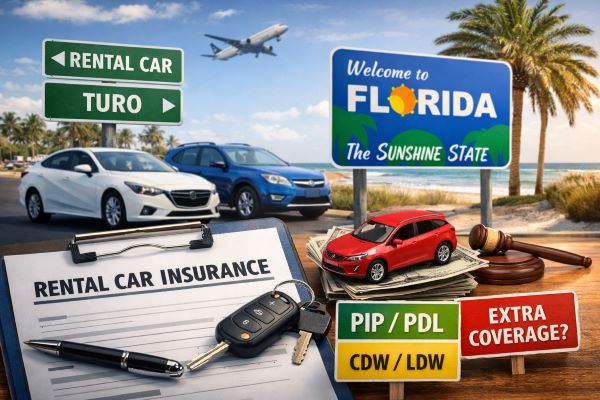
Florida has minimum insurance rules tied to Florida vehicle registration, separate “financial responsibility” requirements that can be triggered after a car accident, and special rules that affect rental car owners and lessors. Add peer-to-peer platforms like Turo and credit card benefits, and it is easy to misunderstand what is truly mandatory versus what is simply being offered.
This guide breaks it down in plain English so you can make smart decisions before you drive.
Quick Answer: What You Need to Know Before You Rent (FLHSMV)
- Florida’s baseline for Florida-registered vehicles is $10,000 PIP + $10,000 Property Damage Liability (PDL).
- Bodily injury liability (BI) is not universally required for every Florida driver at all times, but it becomes crucial when someone is seriously hurt.
- CDW/LDW is usually optional and is often a contractual damage waiver, not traditional insurance.
- Turo is plan-based. Turo’s third-party liability coverage is generally designed to ensure approved drivers are insured up to the state minimum limits, and it is commonly described as secondary (excess) unless a jurisdiction requires primary coverage.
Note: Florida’s PIP/PDL requirement is tied to registering vehicles in Florida. Visitors typically rely on their out-of-state policy and/or rental or platform coverage, depending on the contract and policy terms.
- Even if nothing is “mandatory” at checkout, you still need to be legally covered and practically protected. Declining add-ons without solid coverage can leave you exposed to large out-of-pocket costs.
Table of Contents
- Florida’s baseline insurance rules (PIP + PDL)
- Florida “financial responsibility” requirements (why people get confused)
- What insurance is actually “mandatory” for a rental car in Florida?
- Mandatory vs Optional vs Smart-to-Have (simple table)
- CDW/LDW, SLP, PAI, PEC: what these add-ons actually do
- Turo in Florida: what guests get vs what hosts carry
- Which coverage applies first? Personal policy vs rental vs Turo vs credit card
- Uninsured/Underinsured Motorist coverage (UM/UIM): the Florida gap people miss
- Airport rentals vs off-airport rentals vs peer-to-peer
- If you crash in a rental or Turo in Florida: what to do immediately
- FAQs
- Call to Action
- Disclaimer
Key Definitions (so the rest makes sense)
- PIP (Personal Injury Protection): Florida no-fault coverage that may help pay certain medical expenses and related losses for the insured person, subject to policy rules and eligibility.
- PDL (Property Damage Liability): Pays for damage you cause to someone else’s property (vehicle, fence, building).
- Bodily Injury Liability (BI): Pays other people’s injury claims if you caused the crash.
- UM/UIM (Uninsured/Underinsured Motorist): Helps protect you if the at-fault driver has no insurance or not enough insurance.
- CDW/LDW: Damage waiver products that may limit what the rental company can charge you for damage or theft of the rental car, depending on the contract.
- SLP: Supplemental liability coverage that may increase liability limits beyond what is otherwise available.
Florida’s Baseline Insurance Rules (PIP + PDL)
Florida’s registration requirement (PIP + Property Damage)
To register most vehicles in Florida, the state generally requires proof of:
- Personal Injury Protection (PIP): at least $10,000
- Property Damage Liability (PDL): at least $10,000
What PIP does (and does not do)
PIP is Florida’s no-fault medical coverage. It is designed to help cover certain losses of the insured person (subject to the policy terms and Florida’s PIP rules).
Important limitation: PIP is not the same thing as bodily injury liability. PIP does not exist to pay the other driver’s injury claim if you caused the crash.
Florida and bodily injury liability
Florida is widely known for not requiring every driver to carry bodily injury liability the way many other states do. That can matter a lot when a crash involves serious injuries.
Also important: bodily injury liability can become required in certain situations (especially after a crash with injuries), and even when not technically required at all times, it is often the coverage that protects you from the largest financial exposure when someone is severely injured.
Florida “Financial Responsibility” Requirements (Why People Get Confused)
Florida also has a “financial responsibility” framework that often becomes relevant after a crash, particularly when there are injuries or significant damages.
For example, FLHSMV’s guidance on crashes involving injuries references minimum limits commonly described as:
- $10,000 bodily injury per person / $20,000 bodily injury per crash
- $10,000 property damage liability per crash (Fla. Stat. §324.021)
- $10,000 PIP
Florida statutes also describe proof of financial responsibility limits in the 10/20 framework.
Key point: These “financial responsibility” requirements are not the same thing as “rental counter add-ons.” People get tripped up because they see these numbers and assume the rental company must sell them “full coverage” at checkout. The law and the checkout screen are different systems.
What Insurance Is Actually “Mandatory” for a Rental Car in Florida?
Direct answer: Do I have to buy coverage at checkout?
Usually no. Florida generally does not require you to buy rental counter add-ons. But the rental company or platform can require you to show acceptable coverage or purchase protection as a condition of renting.
Here is the cleanest way to think about it.
Direct answer: Florida generally does not require you to buy add-ons at checkout
Florida’s minimum requirements are about being properly insured under Florida law, and rental companies are not obligated to give every renter “full coverage” automatically.
What can be “mandatory” in practice: proving you have acceptable coverage
Even if Florida law does not force you to buy a specific add-on, a rental company or platform can require you to have acceptable coverage as a condition of renting. If you cannot demonstrate coverage that applies, the business may require you to purchase a protection product to complete the rental.
Rental companies and the Graves Amendment (important, but not insurance for you)
The federal Graves Amendment generally limits vicarious liability claims against rental and leasing companies based only on ownership, subject to exceptions. It can affect recovery strategy after a crash, but it does not provide insurance for you as the driver.
It can limit claims against a rental company based solely on ownership, but claims based on a company’s own negligence are treated differently.
Mandatory vs Optional vs Smart-to-Have (Simple Table)
| Coverage / Item | Required by Florida law? | Usually included automatically? | What it protects | Common gaps |
| PIP | Required for many FL-registered vehicles | Usually tied to personal policy | Your own medical-related losses (subject to rules) | May not cover all losses; does not replace BI liability |
| PDL | Required for many FL-registered vehicles | Usually tied to personal policy | Damage you cause to others’ property | Low limits can be risky in multi-vehicle crashes |
| BI liability | Not universally required at all times | Often low or absent unless selected | Injuries you cause to others | Biggest exposure category in severe injury crashes |
| SLP (extra liability) | No | Sold by rental companies; varies by platform | Higher liability limits | Terms, exclusions, and priority rules |
| CDW/LDW | No | Optional add-on | Damage/theft of the rental vehicle under the contract | Loss of use/admin fees/exclusions/prohibited use |
| Credit card coverage | No | Only if your card provides it and rules are followed | Often rental vehicle damage only | Usually no liability coverage; strict exclusions |
| UM/UIM | Not required to buy | Only if your policy has it | Protects you if at-fault driver has no or low insurance | Many drivers carry low limits; serious injury gaps |
CDW/LDW, SLP, PAI, PEC: What These Add-Ons Actually Do
Direct answer: Is CDW/LDW insurance?
Usually not. CDW/LDW is typically a contractual waiver that can limit what the rental company can charge you for damage or theft, subject to the contract terms and exclusions.
At the counter or online checkout, you will often see:
- CDW/LDW (Collision Damage Waiver / Loss Damage Waiver)
- SLP (Supplemental Liability Protection)
- PAI (Personal Accident Insurance)
- PEC (Personal Effects Coverage)
CDW/LDW is usually not “insurance”
CDW/LDW is typically a contractual waiver. It may reduce or eliminate what the rental company can charge you for damage or theft of the rental car, depending on the agreement.
Why it can matter even if you have insurance: rental companies may pursue charges that some insurers dispute or limit depending on the policy and facts, such as:
- loss of use
- diminished value
- administrative fees
- towing and storage
The rental contract language controls what the company can seek.
SLP is about liability limits
SLP is usually meant to increase liability protection beyond whatever baseline exists. In a serious injury crash, low liability limits can be financially devastating.
PAI and PEC are situational
PAI and PEC can be helpful for some travelers, but many people already have overlapping coverage through health insurance, renters/homeowners policies, or other products. It depends on your situation.
Turo in Florida: What Guests Get vs What Hosts Carry
Turo is peer-to-peer car sharing. The coverage structure is plan-based and depends on eligibility, terms, and what was selected during booking.
Turo guest protection plans (US guests)
Turo’s materials describe third-party liability coverage intended to ensure approved drivers are insured up to the state minimum limits, and they describe the Travelers policy as secondary (excess) unless primary coverage is required by an applicable state statute.
Also important: coverage is not a blank check. Prohibited use, unauthorized drivers, impairment, and other violations can affect eligibility.
Turo host protection plans (US hosts)
Turo host plans are also described as plan-based; Turo’s host materials describe third-party liability coverage levels (with state/airport exceptions).
Bottom line for Turo in Florida
Do not assume “full coverage” exists automatically. Review the plan you selected, confirm whether your personal policy treats peer-to-peer rentals differently, and save documentation.
Which Coverage Applies First? Personal Policy vs Rental vs Turo vs Credit Card
Direct answer: Does my personal auto policy cover Turo?
Sometimes, but not always. Coverage depends on your policy language and any endorsements. Confirm whether your policy treats peer-to-peer rentals differently before booking.
Every situation depends on the policy language and facts, but here is the practical “layer” framework.
Layer 1: Your personal auto policy (if you have one)
Many personal auto policies extend to rental vehicles you drive, but the scope varies. Some treat peer-to-peer rentals differently. Never assume.
Before you rent, check:
- Does your policy cover traditional rentals?
- Does it cover peer-to-peer rentals like Turo?
- What are your liability limits (especially BI)?
- Do you have collision and comprehensive?
- What is your deductible?
- Do you carry UM/UIM?
Layer 2: Rental company or platform coverage
Traditional rental companies may offer SLP and CDW/LDW that change your exposure. Turo is plan-based and depends on what you selected and whether you remain eligible.
Layer 3: Credit card benefits (often vehicle damage only)
Many cards offer rental coverage, but it is often limited to physical damage to the rental vehicle and may be secondary. Benefits can be denied if you do not follow the guide precisely.
Uninsured/Underinsured Motorist Coverage (UM/UIM): The Florida Gap People Miss
If you only remember one section of this article, remember this.
Florida’s baseline requirements focus on PIP and PDL, and serious injury crashes can expose gaps when the at-fault driver has little or no bodily injury coverage.
UM/UIM is designed to protect you and your household if the at-fault driver has:
- no insurance, or
- not enough insurance to cover serious injuries
Why it matters in rentals and travel: if you are injured in a rental vehicle, recovery may depend on:
- the at-fault driver’s limits,
- whether your UM/UIM extends to the rental, and
- whether there are other applicable policies (household, umbrella, employer, platform, or rental layers)
Airport Rentals vs Off-Airport Rentals vs Peer-to-Peer
Not all rentals are structured the same.
- Airport rentals: more out-of-state drivers and more aggressive upselling at checkout. Know your coverage before you arrive.
- Off-airport rentals: similar products, but sometimes different verification, deposits, or coverage policies.
- Peer-to-peer (Turo): platform terms, plan selection, and eligibility issues can drive the outcome.
Best practice for all three: confirm coverage before pickup and keep documentation.
If You Crash in a Rental or Turo in Florida: What to Do Immediately
- Call 911 if anyone is injured or there is danger.
- Document the scene: photos, video, vehicle positions, damage, road conditions, signage.
- Get driver info: license, insurance, phone, address.
- Get witness contact info.
- Preserve rental documentation:
- rental agreement or app confirmation
- screenshots of the coverage you selected
- receipt and checkout summary
- Do not guess about coverage in statements. Stick to facts.
- Seek medical care promptly and follow up.
- Notify insurers and the platform/company as required by your contract, but do it carefully.
FAQs About Rental Car Insurance Requirements in Florida
What insurance is required to rent a car in Florida?
Florida has baseline requirements tied to Florida vehicle registration (PIP/PDL) and separate financial responsibility requirements that can apply after a crash. Rental companies and platforms may require you to show acceptable coverage to rent.
Does Florida require rental companies to give me full insurance?
No. Florida’s minimum coverage concepts and rental owner liability rules are not the same as “full coverage included with every rental.”
Is CDW/LDW required in Florida?
Usually no. It is typically optional, but it can be required by the business if you cannot demonstrate coverage or if their policies require it for certain renters.
Does my insurance cover a rental car in Florida?
Often it can, but it depends on your policy language. Confirm whether your policy extends to rentals and whether it treats peer-to-peer rentals like Turo differently.
Does Turo include insurance in Florida?
Turo protection plans are plan-based and depend on terms, eligibility, and what you selected. Turo describes third-party liability coverage intended to ensure approved drivers are insured up to state minimum limits, commonly described as secondary (excess) unless primary coverage is required by state statute.
If I have no insurance, can I still rent?
Some companies/platforms may allow it if you purchase their products, but driving without meaningful coverage creates serious personal risk. If you cause a crash with major injuries, the financial consequences can be severe.
Call to Action
If you or someone you love was injured in a Florida crash involving a rental car or a Turo vehicle, insurance details can decide the outcome. When injuries are serious, the case often turns on policy limits, coverage priority, exclusions, and documentation.
Armando Personal Injury Law helps clients across Tampa, St. Petersburg, Hillsborough County, and Pinellas County understand coverage, preserve evidence, and pursue accountability.
Call (813) 482-0355 or visit armandoinjurylaw.com.
Disclaimer: This article is for informational purposes only and does not constitute legal advice. Coverage questions are fact-specific and depend on policy language, contracts, and eligibility rules. Every case is different.
About the Author
 Attorney Armando Edmiston is the founding attorney of Armando Personal Injury Law in Tampa, Florida, a law firm dedicated to helping people harmed in car, truck, motorcycle, nursing home, and other serious injury cases. A U.S. Marine Corps veteran and personal injury lawyer, Armando draws on his real-world courtroom experience and years of representing injured Floridians to write and carefully review the legal content on this website. Every guide is written in clear, straightforward language so injured people and their families can better understand their rights, and is reviewed for legal accuracy before publication.
Client Testimonial
“Armando is the best! He makes everything easy, trustworthy and always has clients' best interests in mind. A lawyer you can trust!” – Heather W., ⭐⭐⭐⭐⭐
Actual client. Results may vary; each case is different.