What Tampa Pedestrians Should Know About Parking Lot and Garage Accidents
A Tampa pedestrian accident lawyer explains driver negligence, possible property-owner liability, insurance coverage, comparative fault, and evidence preservation.
Key answer: A pedestrian injured in a Tampa parking lot or garage may have a claim against a negligent driver. A property owner may also be responsible when a dangerous condition, such as poor lighting, obstructed sight lines, or an unsafe traffic layout, contributed to the collision and the legal requirements for duty, notice, and causation are met. Private property does not eliminate the need for reasonable care.
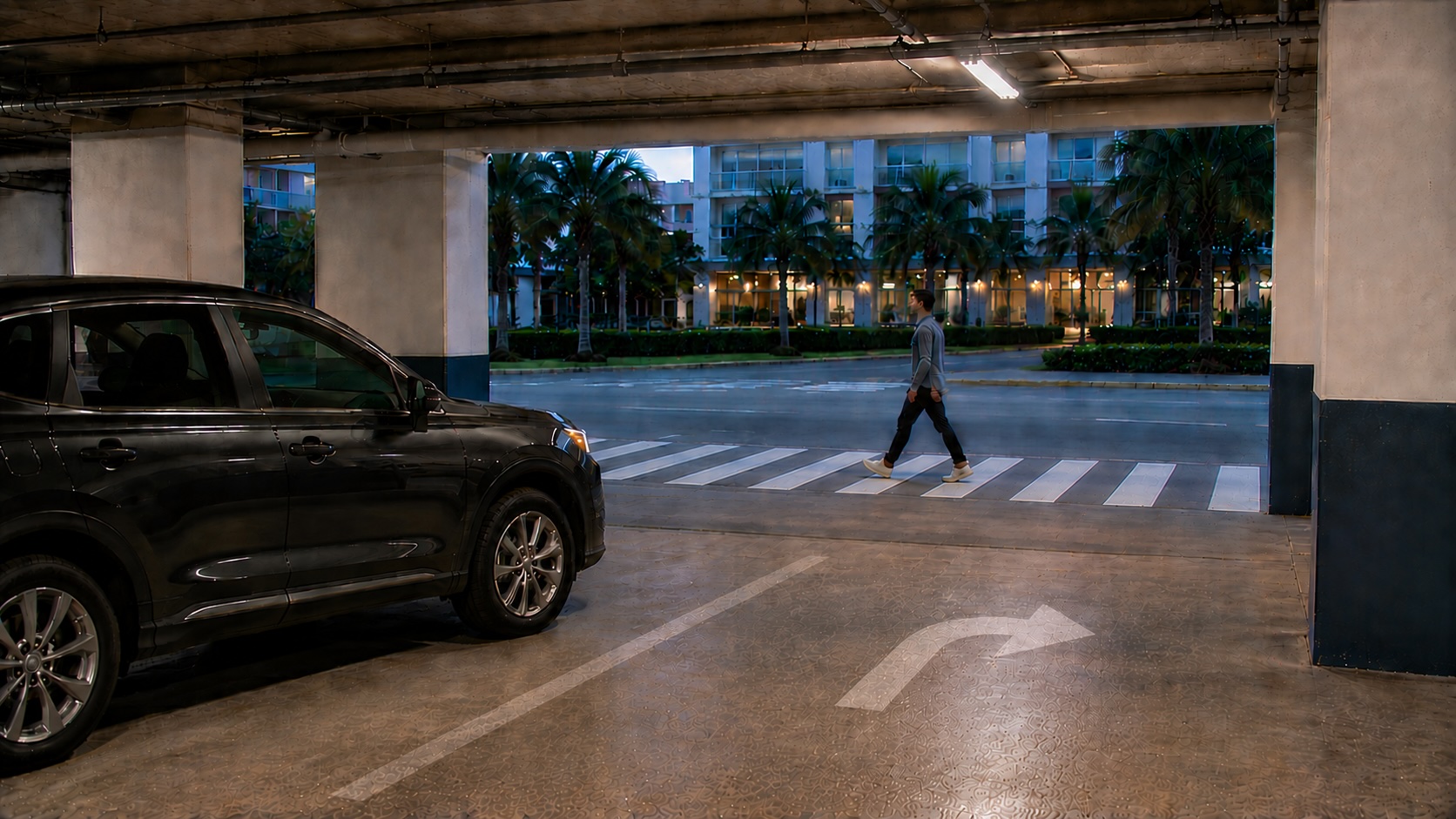
Garage exits, backing vehicles, limited sight lines, and poor lighting can create serious pedestrian hazards.
Parking lots and garages feel slower and safer than roads such as Dale Mabry Highway or Kennedy Boulevard, but pedestrians have no vehicle structure, air bag, or seat belt to absorb an impact. A backing vehicle or a driver accelerating toward a garage exit can cause fractures, traumatic brain injuries, spinal injuries, ligament damage, and long-term mobility problems.
These cases often require two investigations at the same time. The first asks whether the driver failed to use reasonable care. The second asks whether the property itself created or concealed a dangerous condition that contributed to the collision.
Why Can a Low-Speed Parking Lot Crash Cause Serious Injuries?
A pedestrian takes the direct force of the vehicle and may then strike the pavement, a curb, a wall, or another vehicle. That second impact can be as medically important as the initial contact. Older adults, children, and people with reduced bone density or balance limitations can be especially vulnerable.
The severity of an injury cannot be measured only by vehicle speed or visible vehicle damage. Medical records, diagnostic imaging, orthopedic findings, neurological symptoms, and functional limitations provide a more reliable picture of the harm.
What Duties Do Drivers Owe in Parking Lots and Garages?
Drivers must use reasonable care under the circumstances. In a parking facility, that usually includes maintaining a proper lookout, controlling speed, checking mirrors and blind spots, obeying signs and markings, and anticipating pedestrians near parked vehicles, store entrances, elevators, ramps, and sidewalks.
Florida Statute 316.125 specifically requires a driver emerging from an alley, building, private road, or driveway in a business or residence district to stop before entering the sidewalk area and yield to vehicles and pedestrians that are close enough to present an immediate hazard. That rule can be important when a garage ramp or driveway crosses a public sidewalk.
Other traffic statutes may apply depending on the exact location and how the facility is regulated. The safer legal approach is not to assume that every provision of Chapter 316 applies identically to every internal parking aisle. Even when a specific traffic statute does not control, the driver can still be liable under ordinary negligence principles.
What Types of Driver Negligence Commonly Cause These Crashes?
- Unsafe backing: Reversing without checking mirrors, camera blind spots, and the area behind the vehicle.
- Failure to yield at garage exits: Looking toward street traffic while crossing a sidewalk without first checking for pedestrians.
- Distracted driving: Using a phone, adjusting navigation, searching for a space, or focusing on passengers instead of the travel path.
- Excessive speed for conditions: Driving too fast for narrow aisles, limited visibility, congestion, ramps, or expected foot traffic.
- Cutting across parking spaces: Using empty spaces as a shortcut and entering pedestrian paths at an unexpected angle.
- Ignoring signs and markings: Failing to follow stop signs, directional arrows, crosswalks, yield markings, or garage-control signals.
Backup cameras and proximity sensors can help, but they do not replace a driver’s duty to look. Camera angle, glare, dirty lenses, parked vehicles, columns, and pedestrian movement can create blind spots.
When Can a Parking Lot or Garage Owner Be Liable?
Property-owner liability is not automatic merely because the crash happened on commercial property. The evidence must connect a property condition or management failure to the collision. The analysis generally considers the visitor’s status, the owner’s duty, the existence of a dangerous condition, actual or constructive notice when required, causation, and damages.
Florida Statute 768.0755 applies to slip-and-fall claims involving transitory foreign substances in business establishments. It is not the general legal basis for a vehicle-pedestrian collision caused by parking-facility design, lighting, or sight-line conditions. Those issues require analysis under the applicable premises-liability and negligence law.

Contact Armando Personal Injury Law if you have been injured in a crash that was not your fault.
What Property Conditions May Support a Claim?
- Inadequate lighting: Burned-out fixtures, dark ramps, or poorly lit pedestrian paths that made a person difficult to see.
- Obstructed sight lines: Columns, vegetation, signs, barriers, dumpsters, or parking configurations that blocked a driver’s or pedestrian’s view.
- Unsafe traffic layout: Confusing lanes, unmarked crossings, poor ramp geometry, or vehicle paths directed through expected pedestrian travel areas.
- Missing or damaged controls: Absent stop signs, worn markings, broken gates, missing mirrors, or nonfunctioning warning systems where those measures were reasonably necessary.
- Known recurring incidents: Prior complaints, crashes, or near-misses that gave the owner notice of a specific hazard and an opportunity to correct it.
- Negligent maintenance: Failure to repair a condition after reasonable inspection or notice when the condition contributed to the collision.
A claimant must do more than identify an imperfect feature. The investigation should show how the condition affected visibility or movement, what the owner knew or should have known, and how the condition contributed to the impact.
Are Broken Surveillance Cameras a Separate Basis for Liability?
Not usually by themselves. A nonfunctioning camera generally did not cause the vehicle to strike the pedestrian. Video-system issues are more often important to evidence preservation, notice, or a separate undertaking that must be evaluated under the facts.
The stronger question is whether relevant footage existed and whether the property owner had a duty to preserve it after receiving notice of a potential claim. A prompt preservation letter can identify the date, time, camera locations, incident reports, access-control logs, and third-party vendors that may possess evidence.
Why Is Surveillance Footage So Important?
Video may show where the pedestrian was walking, whether the vehicle stopped, the direction of travel, sight obstructions, lighting, speed, and what happened immediately before and after impact. It can also identify witnesses or additional camera angles.
Many systems overwrite footage on short retention cycles. The exact period varies and should not be assumed. Businesses, garages, hospitals, hotels, apartment properties, ATMs, neighboring stores, buses, and doorbell cameras may all hold relevant video. Early preservation efforts matter because lost footage often cannot be recreated.
How Does Florida Comparative Fault Affect the Claim?
Florida Statute 768.81 generally prevents recovery in a negligence action when the injured person is found more than 50 percent at fault for the person’s own harm. A claimant found 50 percent or less at fault may recover damages reduced by that percentage.
Insurers may argue that the pedestrian stepped from between vehicles, ignored markings, used a phone, wore dark clothing, or failed to watch for moving cars. Those allegations should be tested against video, lighting measurements, witness testimony, vehicle movement, site layout, and the driver’s opportunity to see and avoid the pedestrian.
A pedestrian’s possible carelessness does not erase the driver’s independent duty to use reasonable care. It also does not eliminate a property owner’s potential responsibility for a separate dangerous condition.
What Insurance Coverage May Apply?
The available coverage depends on the driver, the vehicle, the pedestrian’s household and vehicle ownership, and whether a property condition contributed to the crash. A complete coverage investigation may include:
- Bodily injury liability coverage: Coverage on the at-fault vehicle or applicable driver policy, if bodily injury coverage exists.
- PIP benefits: Florida PIP may provide benefits to an eligible pedestrian under the applicable priority rules. Initial care generally must be obtained within 14 days, and the emergency medical condition rules can affect the medical-benefit limit.
- UM/UIM coverage: A pedestrian’s own or household policy may provide coverage when the responsible driver is uninsured, underinsured, or unidentified, subject to insured status and policy terms.
- Commercial auto or employer coverage: Additional coverage may apply when the driver was working, making a delivery, or operating a business vehicle.
- Property liability coverage: A commercial general liability policy may respond if a legally actionable property condition contributed to the crash.
No settlement release should be signed until the responsible parties and available policies have been evaluated. A release directed to one driver, owner, employer, or insurer can affect additional recovery rights.
What Evidence Should Be Preserved?
- Request video immediately. Identify the property owner, manager, security company, garage operator, neighboring businesses, and other possible camera sources.
- Photograph the full environment. Document lighting, signs, mirrors, columns, vegetation, lane markings, ramps, pedestrian paths, vehicle positions, and sight lines from multiple viewpoints.
- Report the incident. Ask the property to create an incident report and obtain the report number or contact information for the person who took it.
- Identify witnesses. Collect names and contact information from shoppers, employees, security personnel, passengers, and nearby drivers.
- Preserve vehicle evidence. Photograph damage and consider inspection or electronic data preservation before repairs or disposal.
- Document medical effects. Keep emergency records, imaging, treatment plans, work restrictions, mobility limitations, and changes in daily activities.
How Armando Personal Injury Law Can Help
Armando Personal Injury Law can investigate both the driver’s conduct and the physical conditions of a Tampa parking facility. That work may include preservation notices, site inspections, video requests, witness interviews, insurance analysis, maintenance and incident-history discovery, and medical documentation.
If you were struck by a vehicle in a Tampa parking lot or garage, contact Armando Personal Injury Law at (813) 482-0355 before important evidence disappears. A consultation is free, and no result is guaranteed.

Frequently Asked Questions
Can I recover if the crash happened on private property?
Potentially. A negligent driver can be liable on private property, and a property owner may also be liable if a dangerous condition legally contributed to the collision. The specific duties depend on the location and facts.
Does a driver always have to yield to pedestrians in a parking lot?
Drivers must use reasonable care, but right-of-way rules depend on the exact location, markings, and applicable statutes. Florida Statute 316.125 specifically addresses vehicles emerging across sidewalk areas from buildings, private roads, and driveways.
Can the property owner be liable for poor lighting?
Potentially, when inadequate lighting created an unreasonable hazard, the owner had the required notice, and the lighting condition contributed to the crash. Evidence should include measurements, photographs, maintenance records, and witness accounts.
What if the pedestrian was partly at fault?
Florida’s modified comparative-fault rule may reduce recovery by the pedestrian’s percentage of fault. A person found more than 50 percent at fault generally cannot recover in a negligence action covered by the statute.
How long do parking garage cameras keep video?
There is no universal retention period. Some systems overwrite quickly, while others retain footage longer. A preservation request should be sent as soon as possible.
Does PIP cover a pedestrian hit by a vehicle?
It may. Eligibility and priority depend on vehicle ownership, the pedestrian’s own coverage, resident-relative coverage, and other facts. The 14-day treatment requirement can also affect benefits.
Click here for a printable PDF of this article, “What Tampa Pedestrians Should Know About Parking Lot and Garage Accidents.”

About the Author
Attorney Armando Edmiston is the founding attorney of Armando Personal Injury Law in Tampa and St. Pete, Florida. A U.S. Marine veteran and Hillsborough County native, he represents injured people and families in serious injury cases, including car accidents, truck accidents, motorcycle accidents, wrongful death, negligent security, premises liability, and nursing home abuse and neglect claims. Armando earned a B.S. in Biology from the University of South Florida and a J.D., cum laude, from Nova Southeastern University. He is also one of only six lawyers in Florida listed with the ACS Forensic Lawyer-Scientist designation.