
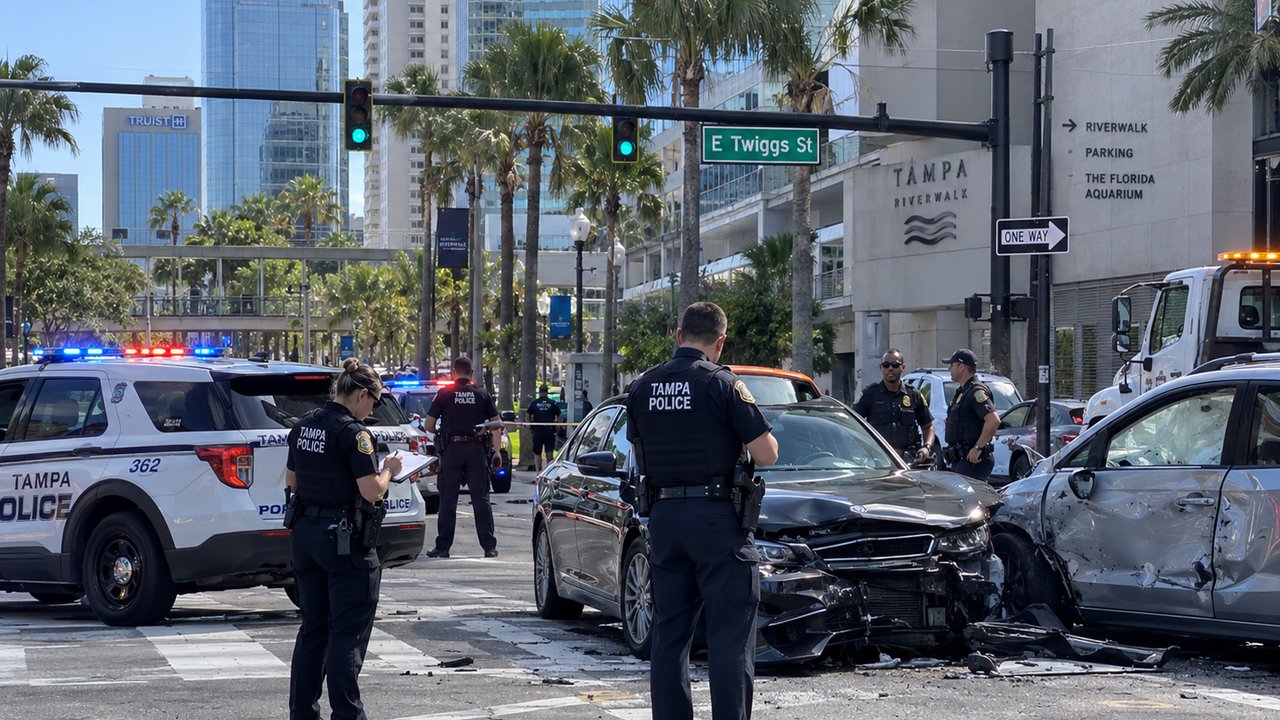
A Tampa Police call record shows when and where a crash was reported, but not who was hurt or who caused the collision.
Tampa Police Department records show 339 calls classified as “Traffic Crash” during October 15–20, 2026, averaging 56.5 per day. Monday, October 19, had the highest total, with 71 calls. Just over half of the records had occurrence times between noon and 6 p.m.
Those figures describe calls for service recorded in the Tampa Police traffic calls database. They do not establish that 339 people were injured or that every entry resulted in a completed crash report.
For someone injured in a collision, the immediate questions are more personal: How will I get medical care? What evidence should I save? Who can help with the insurance claim? A Tampa car accident lawyer can help evaluate those questions while the circumstances of the crash are still being documented.
How many traffic crash calls did Tampa Police record each day?
The six complete calendar days reviewed contained between 48 and 71 traffic crash calls per day.
| Date | Traffic crash calls |
|---|---|
| Thursday, October 15, 2026 | 58 |
| Friday, October 16, 2026 | 57 |
| Saturday, October 17, 2026 | 48 |
| Sunday, October 18, 2026 | 50 |
| Monday, October 19, 2026 | 71 |
| Tuesday, October 20, 2026 | 55 |
| Total | 339 |
Monday’s 71 calls averaged approximately three per hour across the day. That is an average, not a claim that calls arrived at regular intervals.
Using complete calendar days also avoids comparing a full day with only a few morning or afternoon hours.
When were traffic crash calls most concentrated?
Just over half of the 339 crash-call records, 172 or approximately 50.7%, had occurrence times from noon through 5:59 p.m.
Across the six days, the afternoon totals were:
| Occurrence hour | Traffic crash calls |
|---|---|
| Noon–12:59 p.m. | 28 |
| 1–1:59 p.m. | 27 |
| 2–2:59 p.m. | 22 |
| 3–3:59 p.m. | 28 |
| 4–4:59 p.m. | 30 |
| 5–5:59 p.m. | 37 |
The busiest single hourly interval was 5–5:59 p.m., with 37 records. Together, the hours from 3 p.m. through 5:59 p.m. accounted for 95 calls, approximately 28% of the total.
These are counts, not a measure of risk per trip. The records do not establish why calls clustered in those hours or whether afternoon travel was more dangerous after accounting for the number of vehicles on the road.
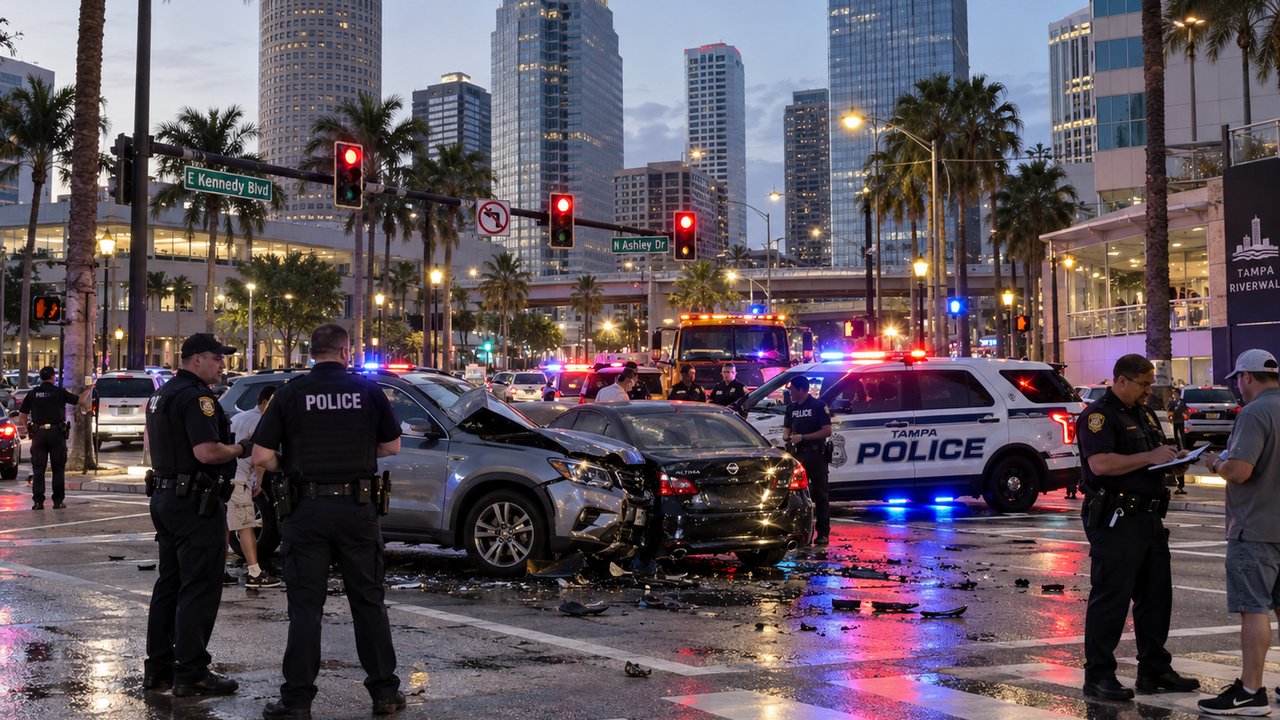
Two intersections along North Dale Mabry Highway each appeared three times in the six-day review of Tampa Police traffic crash calls.
Which Tampa intersections appeared repeatedly?
Two exact intersection entries each appeared three times during the six-day review:
- West Kennedy Boulevard and North Dale Mabry Highway
- West Dr. Martin Luther King Jr. Boulevard and North Dale Mabry Highway
Repeated entries also appeared at other locations, including South West Shore Boulevard and West Bay Way Drive.
These observations do not establish a ranking of Tampa’s most dangerous intersections. That would require a broader analysis, including a longer period, traffic volumes, and crash severity.
For an individual collision, the relevant questions concern what happened at that location: the vehicles’ paths, traffic signals, visibility, and available witnesses or recordings. Our resource on intersection accident claims explains how these cases can raise disputes about responsibility.
What can these police records tell us about injuries?
The calls-for-service export identifies occurrence and dispatch times, locations, descriptions, and report identifiers. It does not provide an injury-severity assessment for each entry.
The records therefore cannot establish:
- How many people were injured.
- How many injuries were serious or fatal.
- Which driver caused a collision.
- Whether every entry resulted in a completed crash report.
- The total number of crashes handled by every agency in Tampa or Hillsborough County.
The Florida Department of Highway Safety and Motor Vehicles maintains the state’s official crash reports and statewide crash data. The Florida Department of Transportation explains how to obtain official Florida crash records and data.
A calls-for-service entry is a starting point for identifying an event. It is not a substitute for investigating an injury claim.
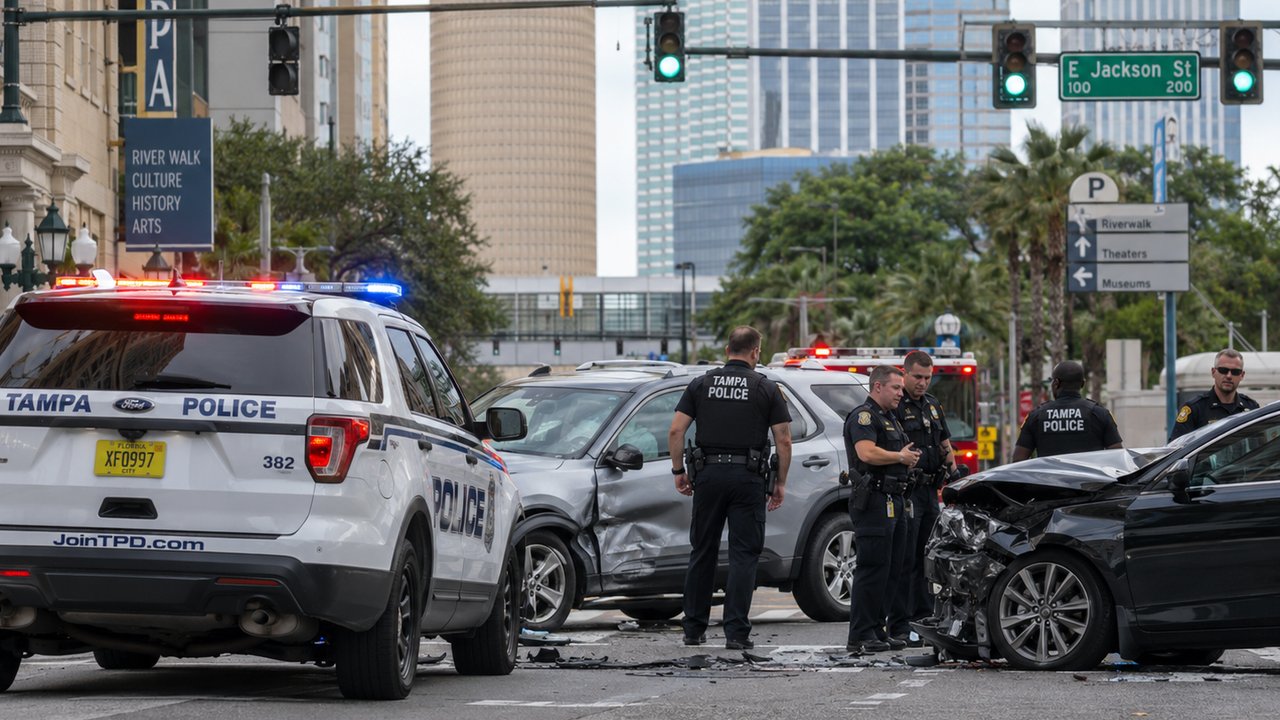
After a Tampa crash, photos, witness information, and the investigating agency’s report number can help document what happened.
What should you do after a Tampa car accident?
Start with safety and appropriate medical care. If anyone needs emergency assistance, call 911. Once it is safe, preserve information that can help document what happened.
Useful steps include:
- Document the scene. Photograph vehicle damage, roadway conditions, traffic controls, and visible injuries when you can do so safely.
- Collect identifying information. Exchange driver and insurance information, obtain witness contact details, and keep the investigating agency’s name and report number.
- Preserve available recordings. Save dashcam footage and identify nearby businesses that may have recorded the crash. Do not assume every traffic camera records or stores video.
- Keep medical and financial records. Save treatment records, bills, receipts, and documentation of missed work.
- Handle insurance communications carefully. Notify your insurer promptly and understand your policy’s cooperation requirements. Get advice before signing a release or agreeing to a settlement.
Tell your medical provider about any pain after a car accident, including when it began and how it affects your activities. A clinician should evaluate your symptoms; the police call classification cannot determine whether you were injured.
For a more detailed checklist, read our guide to what to do after a Tampa car accident.
How does Florida’s 14-day PIP rule apply?
For a person eligible for Florida Personal Injury Protection coverage, initial services and care must be received within 14 days after the crash to qualify for PIP medical benefits. The care must meet the statute’s provider requirements, and other coverage conditions apply.
This requirement comes from Florida Statutes §627.736. Timely care does not automatically guarantee payment of every medical bill.
The 14-day requirement concerns PIP medical benefits. It is not the deadline for filing a personal injury lawsuit, and it should not be treated as a reason to postpone needed care.
How this Tampa crash-call analysis was conducted
This analysis used a CSV export downloaded from the Tampa Police Department traffic calls-for-service website on October 21, 2026.
The review:
- Included records labeled exactly “TRAFFIC CRASH.”
- Selected October 15–20, 2026, using the occurrence date, rather than dispatch or clearance date.
- Counted 339 matching records with 339 distinct report identifiers.
- Grouped hourly findings using occurrence times as displayed by the source.
- Counted repeated locations using exact address entries, without combining alternate spellings or reversed intersection names.
The city’s website describes the feed as covering the past week and updating hourly. The figures here are a dated snapshot, not a live counter. The city also cautions that its feed is informational and should not be relied on for legal action.
Injured in a Tampa crash? Get help understanding your next steps
A police record cannot explain how an injury has affected your health, work, or family. Those details require attention to your medical records, the circumstances of the collision, and the insurance coverage that may apply.
Armando Personal Injury Law represents people injured in Tampa car accidents. Our team can discuss what happened, identify evidence worth preserving, and explain the next steps for evaluating your claim.
Call (813) 482-0355 or request a free consultation.

About the Author
Attorney Armando Edmiston is the founder of Armando Personal Injury Law in Tampa and St. Pete, Florida. A U.S. Marine veteran, Hillsborough County native, and ACS Forensic Lawyer-Scientist, he represents Floridians in serious personal injury and wrongful death cases.