A serious golf cart car crash in Wesley Chapel has sparked renewed concern about whether local roads, neighborhoods, and school-area traffic patterns are keeping up with how people actually travel in fast-growing communities like Epperson and Watergrass. According to local reporting and the Florida Highway Patrol, eight people were hospitalized with serious injuries after a golf cart overturned during a collision with a Honda sedan on Elam Road on March 14, 2026. The injured included a married couple, their five children, and a 16-year-old neighbor.
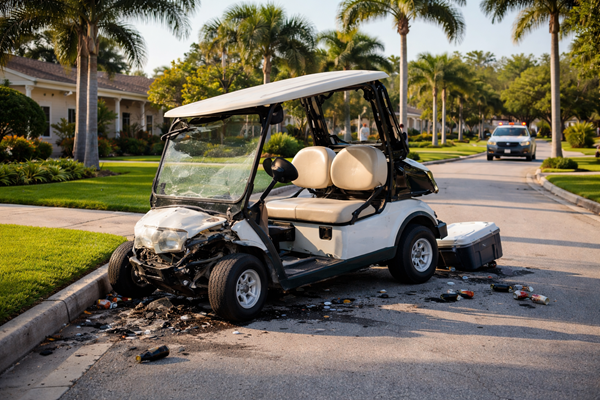
A serious Wesley Chapel golf cart crash on Elam Road has residents calling for better safety infrastructure in growing Pasco County communities.
A serious Wesley Chapel golf cart crash on Elam Road has residents calling for better safety infrastructure in growing Pasco County communities.
Residents say this was not an isolated concern. Neighbors interviewed after the crash described long-standing worries about golf cart traffic, limited dedicated lanes or paths, inconsistent signage, and heavy school-related congestion in the area. Those concerns deserve attention, because when golf carts share space with passenger vehicles on busy community roads, the consequences can be severe.
For injured families, this kind of crash also raises larger legal and safety questions: Was the roadway properly designed for golf cart use? Were traffic controls and signage adequate? Was the golf cart being operated in a reasonably safe manner? Did the community’s infrastructure match how residents were actually using the roads?
What Happened in the Wesley Chapel Golf Cart Crash?
According to FHP, the crash happened shortly before 6:30 p.m. on Elam Road, west of Callow Ford Drive, in Wesley Chapel. Troopers said a 43-year-old man was driving the golf cart eastbound in a golf cart lane when he attempted a U-turn into the path of a Honda sedan traveling behind him. The Honda, driven by a 17-year-old Wesley Chapel girl, struck the golf cart, which overturned. All eight occupants on the golf cart were ejected and hospitalized with serious injuries. The two teens in the Honda were not injured.
Subsequent local coverage reported that six of the seven members of the Guerrette family were hospitalized and that, as of Monday, Amy Guerrette, her husband, and their niece remained hospitalized recovering.
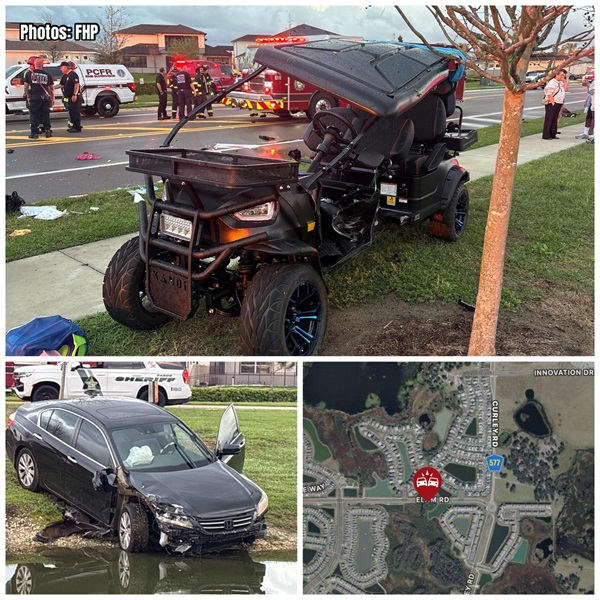
A devastating golf cart crash on Elam Road has left a Wesley Chapel family with serious injuries and raised urgent questions about whether local infrastructure is keeping pace with the rapid growth of communities like Watergrass and Epperson.
Why Neighbors Are Speaking Out
After the crash, Wesley Chapel residents publicly called for stronger golf cart safety measures. Tampa Bay 28 reported that Watergrass residents described the area as increasingly busy, especially during school drop-off and pickup windows, while also lacking clear golf-cart infrastructure in some places. One resident said Watergrass is marketed as a golf cart community but does not have dedicated golf cart lanes or paths, while signage about motorized vehicle use appears inconsistent.
That matters because road design, lane markings, designated crossings, posted signs, and predictable traffic flow all affect whether mixed-use traffic can operate safely. As communities grow, what may once have been a lightly traveled residential area can become a much more complex environment with family vehicles, teen drivers, school traffic, golf carts, bikes, and e-bikes all using overlapping space.
Florida Law Does Not Give Golf Carts Free Use of Public Roads
Florida law does allow golf carts on certain roads, but not everywhere and not without conditions. Under section 316.212, a golf cart may be operated only on a county road or municipal street that has been designated for golf cart use, or in other limited circumstances specifically authorized by law. Before making that designation, the responsible local government must determine that golf carts may safely travel on or cross that road, considering the speed, volume, and character of vehicle traffic. The law also says appropriate signs must be posted to indicate when golf cart operation is allowed.
Florida law also requires that golf carts operated on public roads be equipped with efficient brakes, reliable steering, safe tires, a rearview mirror, and red reflectorized warning devices in both the front and rear. Operators under 18 must have a valid learner’s license or driver’s license, and operators 18 or older must possess valid government-issued photo identification.
These rules matter because they show that golf cart safety is not just a matter of “being careful.” It is also a matter of lawful roadway designation, proper signage, safe equipment, and local government planning.
The Bigger Question: Is the Infrastructure Safe Enough?
A serious crash like this can involve more than one contributing factor. Driver behavior is one part of the analysis, but infrastructure and community design may also matter. In areas where golf carts are common, the real question is whether the roads are built and managed for that reality.
Potential safety concerns may include:
- lack of clearly marked golf cart lanes
- poor visibility at turns, crossings, or U-turn points
- inadequate signage warning motorists about golf cart traffic
- conflicting signs about whether golf carts or other motorized vehicles are permitted
- heavy school traffic mixed with neighborhood cart use
- roadway designs that encourage interaction between slow-moving carts and faster passenger vehicles
When residents repeatedly warn that an area feels unsafe, and a serious crash follows, those concerns should not be dismissed.
Golf Cart Crashes Can Cause Catastrophic Injuries
Even at relatively modest roadway speeds, golf cart crashes can produce devastating injuries. Unlike passenger vehicles, golf carts typically do not provide the same crash protection, enclosed cabin structure, restraint systems, or occupant safeguards. When a golf cart overturns or occupants are ejected, the risk of head trauma, spinal injury, fractures, internal injuries, and long-term disability can be extremely high.
In this Wesley Chapel crash, all eight occupants were ejected from the golf cart, which underscores just how violent these events can become.
Who May Be Liable After a Golf Cart Crash?
Every case depends on the facts, but several parties may need to be investigated after a serious golf cart collision.
The driver of the golf cart
If the golf cart was operated unsafely, turned unexpectedly, failed to yield, or was overloaded, that may be relevant to fault and liability. FHP reported that the golf cart driver attempted a U-turn into the path of the car behind him.
The driver of the passenger vehicle
Investigators may also look at speed, following distance, attentiveness, visibility, and whether the driver of the vehicle behind the golf cart had enough time and distance to respond safely.
Property owners, developers, HOAs, or local entities
In some cases, broader questions arise about whether roadway design, signage, permitted golf cart routes, or known hazardous traffic patterns contributed to the crash. That does not automatically mean a community or entity is liable, but those issues may deserve review when residents have voiced repeated safety complaints. The statute itself places importance on safe designation and appropriate signage.
Manufacturers or equipment providers
If braking, steering, lighting, restraint systems, or other equipment failed, product-related issues may also become relevant.
What Families Should Do After a Serious Golf Cart Crash
When a crash causes serious injuries, the steps taken in the hours and days afterward can matter.
Get immediate medical care
Follow-up care, imaging, specialist evaluation, and careful documentation are essential, especially when children are involved.
Preserve evidence
Keep photographs of the scene, the golf cart, the vehicle damage, road markings, signage, skid marks, and any visible injuries. Save helmet or restraint evidence if applicable. Preserve app messages, texts, and any community notices about golf cart traffic.
Identify witnesses
Neighbor complaints and prior warnings do not prove liability by themselves, but they may become important context if the area had known recurring hazards.
Request official reports
Obtain the traffic crash report and any available supplemental investigation materials.
Speak with a lawyer before giving detailed statements
Serious injury cases often involve insurance issues, comparative fault arguments, and disputes about how the crash occurred.
A Fast-Growing Community Needs Real Safety Planning
Wesley Chapel is growing quickly, and with that growth comes more cars, more young drivers, more community traffic, and more golf cart use. If neighborhoods are being marketed and used as golf cart-friendly communities, the safety infrastructure needs to match that reality. Residents are now openly saying that current conditions are not enough.
Families should not have to learn the hard way that roadway design, signage, and traffic planning fell behind local growth.
Talk to a Wesley Chapel Injury Lawyer After a Golf Cart Crash
If you or your child was hurt in a Wesley Chapel golf cart crash, you may have questions about medical bills, insurance coverage, fault, roadway safety, and whether more than one party may be responsible. Serious injury cases involving golf carts can be more complex than they first appear.
Armando Personal Injury Law investigates serious crashes in Wesley Chapel, Pasco County, Tampa Bay, and surrounding Florida communities. If a golf cart collision caused catastrophic injuries to your family, we can help you understand your legal options.
Call Armando Personal Injury Law at (813) 482-0355 or contact us through armandoinjurylaw.com/contact/ for a free consultation.
About the Author
 Attorney Armando Edmiston is the founding attorney of Armando Personal Injury Law in Tampa, Florida, a law firm dedicated to helping people harmed in car, truck, motorcycle, nursing home, and other serious injury cases. A U.S. Marine Corps veteran and personal injury lawyer, Armando draws on his real-world courtroom experience and years of representing injured Floridians to write and carefully review the legal content on this website. Every guide is written in clear, straightforward language so injured people and their families can better understand their rights, and is reviewed for legal accuracy before publication.
Client Testimonial
"Excellent service 👏 They were very attentive and, above all, very professional. They are definitely the lawyers who can truly help with your problems 😉. Thank you so much for your assistance."
– E.S. ⭐⭐⭐⭐⭐
Results vary; past results do not guarantee a similar outcome.