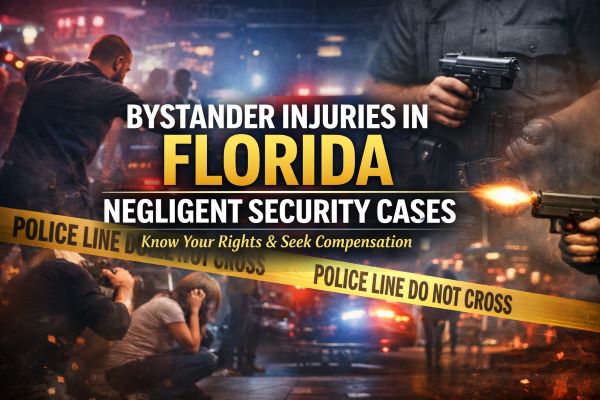
Bystander Injuries in Florida Negligent Security Cases
Property owners owe a duty of care to lawful visitors
When violence breaks out on commercial property, the people directly involved are not the only ones at risk. Innocent bystanders can be punched, shoved, trampled, cut, or even shot when a business, landlord, or event organizer fails to provide reasonable security.
Florida premises liability law does not require property owners to guarantee safety. It does require them to take reasonable steps to protect lawful visitors from foreseeable criminal harm. Broken locks, unmonitored cameras, inadequate lighting, understaffed security, and ignored threats can create dangerous conditions. When those failures contribute to someone being harmed, the injured person may have a negligent security claim.
In Tampa Bay, these cases often involve apartment complexes, bars, parking areas, and event venues where access control, staffing, and surveillance failures create predictable risks.
Key takeaways (fast answers)
- You can have a claim even if you were not the intended target.
- The legal focus is whether violence was foreseeable and whether security was reasonable for the circumstances.
- Video, incident reports, 911 calls, and prior similar incidents often determine case strength.
- Act quickly because surveillance footage can be overwritten within days.
If you were lawfully on the property and the owner failed to take reasonable precautions, you may be entitled to compensation for medical expenses, lost income, pain and suffering, and other losses.
What counts as a bystander injury in a negligent security claim?
A bystander is someone harmed during a violent or chaotic incident without being the intended target. You may have a claim if you were injured because a property owner's security failures allowed violence to erupt or escalate, or made it harder to prevent harm when danger was predictable.
Negligent security cases commonly involve places like:
- Bars and nightclubs
- Concert venues and festivals
- Sporting events
- Shopping centers and parking lots
- Hotels and resorts
- Apartment complexes and gated communities
- Garages, stairwells, hallways, and shared common areas
For a deeper explanation of negligent security claims, see our Premises Liability page.
Common scenarios where bystanders get hurt
Fights and assaults at bars, nightclubs, and parties
Violent altercations often erupt in nightlife venues, especially when alcohol is present, crowd control is weak, and aggressive patrons are not removed.
In many incidents, violence escalates after warning signs such as:
- Prior confrontations inside or outside the venue
- Known aggressive patrons who are not removed
- Inadequate screening or inconsistent weapon policies
- Understaffed entrances, exits, and high-conflict areas
- Delayed response to threats, harassment, or escalating disputes
When staff fail to de-escalate, eject aggressors, or intervene appropriately, a conflict can turn into a brawl where bystanders are injured. Common bystander injuries in this setting include head trauma from falls, broken bones, facial injuries, and lacerations from broken glass or thrown objects. In extreme events involving gunfire, bystanders may be struck by stray bullets.
Crowd surges and stampedes at concerts, festivals, and sporting events
Large gatherings are supposed to be fun. They become dangerous when too many people are packed into a small space and organizers fail to manage movement, entry points, barriers, and exits.
Crowd surge injuries are often linked to:
- Poor entry control at gates and checkpoints
- Inadequate barriers or unsafe layout
- Too few trained staff to manage crowd flow
- Lack of clear exit routes and emergency procedures
- Delays in responding when people begin to compress and panic
Common injuries include crushing injuries, fractures, internal injuries, puncture wounds from barriers, trampling injuries, and traumatic brain injuries. Children and smaller individuals are often at greater risk in dense crowd conditions.
Shootings and stabbings that harm innocent people
Shootings and stabbings can occur in nightclubs, apartment complexes, parking garages, shopping centers, and other shared spaces. While violence can feel random, negligent security claims often involve predictable risk factors.
Warning signs and security failures frequently include:
- Repeated prior incidents at the property or nearby
- Uncontrolled access points (broken gates, propped-open doors)
- Inadequate lighting and camera coverage
- Failure to enforce rules or remove aggressive individuals
- Inadequate staffing during peak hours
- Poor monitoring of entrances, exits, hallways, stairwells, or parking areas
In these incidents, bystanders may be injured by bullets, blades, or secondary chaos as people rush to escape. Negligent security claims focus on whether reasonable precautions could have prevented the harm or reduced the severity.
Other hazardous situations caused by poor security
Bystanders can also be injured when a property ignores obvious risks such as:
- Overzealous or untrained security guards: excessive force can injure nearby patrons or push someone down stairs.
- Thrown objects and flying debris: bottles, glassware, chairs, and other objects can become dangerous when security presence is weak.
- Poor maintenance during emergencies: broken railings, slippery floors, or inadequate lighting can cause falls when people are pushed or fleeing.
- Uncontrolled access points: broken locks, malfunctioning gates, and unmonitored entrances increase the likelihood of unauthorized entry and violence.
Typical injuries sustained by bystanders
Bystander injuries can be just as severe as those suffered by the direct target of violence. Common injuries include:
- Fractures and broken bones (arms, legs, ribs, hips)
- Head and brain injuries (concussions, skull fractures, brain bleeding)
- Lacerations and puncture wounds (glass, sharp debris, knives)
- Internal injuries (crushing injuries, organ damage)
- Asphyxiation and breathing compromise (crowd compression)
- Psychological trauma (anxiety, depression, PTSD symptoms)
Medical care is critical. Documentation also matters. The earlier you preserve evidence, the harder it is for a property owner to deny what happened.
What to do after a bystander injury
If you are physically able, these steps can protect your health and your legal rights:
- Get medical care immediately (ER, urgent care, or your physician).
- Call law enforcement and request an incident report number.
- Report the incident to property management and ask for a written incident report.
- Ask the business to preserve surveillance footage (many systems overwrite quickly).
- Photograph the scene, including:
- Entrances and exits
- Lighting conditions
- Cameras and camera placement
- Broken locks, gates, or barriers
- Stairwells, hallways, parking areas
- Any obvious hazards
- Collect witness contact information (names, phone numbers, emails).
- Write down what you remember as soon as possible (times, locations, who said what).
- Preserve physical evidence (clothing, shoes, torn items, anything with blood or damage).
- Do not give a recorded statement to insurers or property representatives before legal advice.
- Speak with an attorney promptly to evaluate liability and preserve evidence.
Building a negligent security case as a bystander
In Florida, negligent security cases generally require proof of four core elements:
- Duty: the property owner owed a duty of reasonable care to lawful visitors.
- Breach: the owner failed to take reasonable security measures under the circumstances.
- Causation: the security failure contributed to the injury.
- Damages: the victim suffered losses such as medical bills, lost wages, pain and suffering, and emotional distress.
If your case overlaps with broader property safety failures, see our Premises Liability page.
Evidence that often matters most
Negligent security cases are evidence-driven. Depending on the situation, key evidence may include:
- Surveillance video and retention logs
- Incident reports and 911 calls
- Witness statements
- Access logs, gate records, key fob logs, and visitor logs
- Security staffing schedules, training records, and post orders
- Prior similar incidents and documented complaints
- Lighting, camera placement, and maintenance records
- Contracts with security vendors and policies for weapons, conflicts, and removal of patrons
Timing and fault rules
Florida deadlines and fault rules can be case-specific, but two points come up often:
- Statute of limitations: Florida's negligence statute of limitations is generally two years. See [Fla. Stat. § 95.11].
- Comparative negligence: Florida uses a modified comparative negligence system in many cases. If a plaintiff is found more than 50% at fault, recovery may be barred. See [Fla. Stat. § 768.81].
Because footage can be overwritten and witnesses disappear, acting quickly often makes the difference.
How Armando Personal Injury Law helps injured bystanders
Armando Personal Injury Law focuses on high-severity, violence-related negligent security cases, including incidents involving shootings, stabbings, sexual assault, and severe beatings. The same legal principles apply when innocent bystanders are harmed.
Our approach is built around fast, thorough investigation, including:
- Sending preservation letters to secure surveillance footage
- Requesting incident reports and emergency call records
- Interviewing witnesses
- Examining access-control failures (gates, locks, key systems)
- Evaluating security staffing, training, and policies
- Identifying patterns of prior incidents that make violence foreseeable
If your case involves sexual violence, you may also want to review: What You Need to Know About Sexual Assault at Hotels. If a loved one died, see: Wrongful Death.
If you need immediate help, call (813) 482-0355 or visit armandoinjurylaw.com.
FAQ: Bystander injuries and negligent security in Florida
Can I file a claim if I was not the intended target?
Yes. If you were lawfully on the property and the owner's security failures contributed to the conditions that caused your injury, you may have a negligent security claim even if the attacker was targeting someone else.
What if the business says the attacker is solely responsible?
Criminals are responsible for their actions, but property owners can also be liable if foreseeable risks existed and reasonable security measures were not taken. These cases often turn on notice, patterns of prior incidents, and preventable security failures.
Do I need proof of prior crimes to win?
Not always. Prior similar incidents can be powerful evidence of foreseeability, but other facts can also show foreseeable risk, including repeated disturbances, known aggressive patrons, prior complaints, broken access controls, or predictable crowd hazards.
What compensation can a bystander recover?
Potential damages can include medical expenses, rehabilitation, lost income, reduced earning capacity, pain and suffering, and psychological harm. In severe cases, damages can include future care costs and other long-term impacts.
How long do businesses keep surveillance footage?
It varies. Many systems overwrite quickly, sometimes within days. That is why it is important to act fast and have an attorney send a preservation notice to help prevent loss of key evidence.
What if I was partially blamed for the incident?
Florida fault rules can reduce recovery if you are found partially responsible, and in many cases you may be barred if found more than 50% at fault. Each situation is fact-specific, and defense arguments can often be challenged with strong evidence.
Talk with a lawyer about your options
Bystanders injured in violent incidents are often overlooked, but Florida negligent security law can protect them. Whether you were knocked down in a bar fight, crushed in a crowd surge, struck by a stray bullet, or injured while fleeing a stabbing, you may have a claim if the property owner failed to provide reasonable security.
If you or someone you love was harmed due to poor security at a hotel, apartment complex, or commercial property in Tampa, Hillsborough County, or Pinellas County, you may have legal options. A confidential conversation can help you understand what happened, what records may exist, and what accountability could look like.
Call (813) 482-0355 or visit armandoinjurylaw.com for a free, confidential consultation.
Disclaimer: This article is for informational purposes only and does not constitute legal advice. Every case is different.
About the Author
 Attorney Armando Edmiston is the founding attorney of Armando Personal Injury Law in Tampa, Florida, a law firm dedicated to helping people harmed in car, truck, motorcycle, nursing home, and other serious injury cases. A U.S. Marine Corps veteran and personal injury lawyer, Armando draws on his real-world courtroom experience and years of representing injured Floridians to write and carefully review the legal content on this website. Every guide is written in clear, straightforward language so injured people and their families can better understand their rights, and is reviewed for legal accuracy before publication.
Client Testimonial
“Armando is the best! He makes everything easy, trustworthy and always has clients' best interests in mind. A lawyer you can trust!” – Heather W., ⭐⭐⭐⭐⭐
Actual client. Results may vary; each case is different.