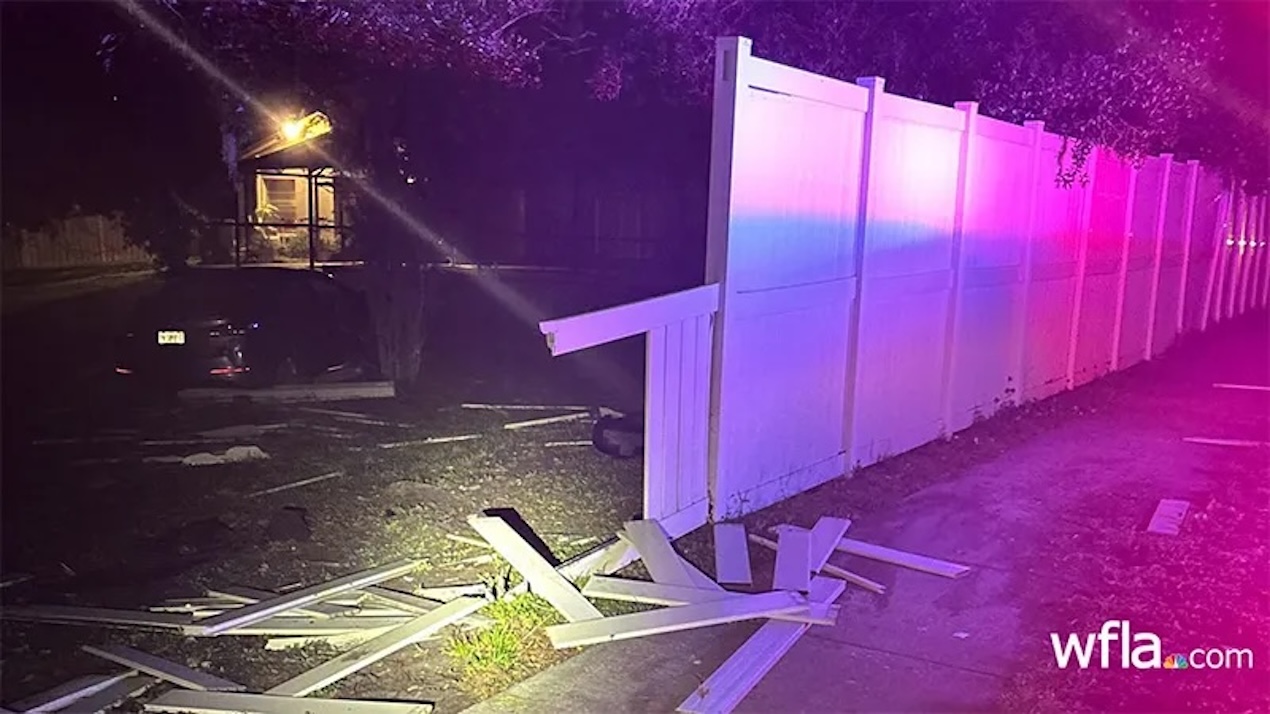
Hillsborough County deputies say this vehicle crashed through a fence and came to a stop in a backyard after an alleged drunk driver caused a serious multi-vehicle collision on Turner Road in Tampa.
Two people were hospitalized after a serious crash in Tampa that deputies say was caused by an alleged drunk driver who fled the scene on foot.
According to the Hillsborough County Sheriff’s Office, the crash happened on July 7, 2026, at about 11:42 p.m. on Turner Road in Tampa. Deputies said Kelly Castleman, 30, rear-ended a sedan, pushing it into an SUV and causing a head-on collision.
HCSO said Castleman’s vehicle continued north, crashed through a fence, and came to a stop in the backyard of a nearby home. Deputies said he then ran from the scene.
The driver of the sedan was taken to a local hospital in critical condition. The driver of the SUV was also hospitalized with serious injuries.
According to HCSO, accident investigators, the Drone Team, and the K-9 Unit responded to search for Castleman. Deputies said he was found about a mile away at his apartment and taken into custody. HCSO also reported that Castleman later provided breath samples of .287/.283.
The allegations remain under investigation, and Castleman is presumed innocent unless proven guilty in court.
A Serious Late-Night Crash on Turner Road
Based on the details released by deputies, this was not a simple two-car crash. It was a chain-reaction collision that began with a rear-end impact, pushed one vehicle into another, caused a head-on collision, and ended with a vehicle crashing through a fence into a backyard.
That sequence matters because each part of the crash may become important to investigators.
A serious DUI crash investigation may look at:
- Driver impairment
- Speed before impact
- Whether the driver braked before the collision
- Vehicle damage
- Crash scene debris
- Skid marks or gouge marks
- Witness statements
- Nearby surveillance video
- 911 calls
- Medical records
- Vehicle event data
- Breath or blood alcohol testing
- Whether the driver left the scene
Those details help investigators understand how the crash happened, how severe the impact was, and whether additional charges or civil claims may follow. Because yes, the legal system enjoys making one crash turn into seven different investigations. Very efficient, in the bleakest possible way.
Florida DUI Law and Serious Injury Crashes
Florida law makes it illegal to drive or be in actual physical control of a vehicle while impaired by alcohol, certain substances, or with a blood alcohol level or breath alcohol level of 0.08 or more.
Under Florida Statute § 316.193, DUI can carry enhanced consequences when a driver causes or contributes to property damage, injury, serious bodily injury, or death.
Deputies reported that one driver was critically injured and another suffered serious injuries. The full medical details have not been released. Still, the severity of the injuries may affect both the criminal investigation and any related civil injury claims.
In serious crash cases, the medical records, crash report, witness statements, and testing results can all become important pieces of evidence.
Leaving the Scene Can Add More Legal Questions
HCSO said Castleman fled on foot after his vehicle crashed through a fence and stopped in a backyard.
Florida law requires drivers involved in crashes causing injury or death to stop and remain at the scene. Under Florida Statute § 316.027, a driver involved in a crash resulting in injury, serious bodily injury, or death has specific legal duties.
Florida law also requires drivers involved in crashes to provide identifying information and render reasonable assistance when required. Those duties are addressed in Florida Statute § 316.062.
Leaving the area after a crash can affect several parts of an investigation. It may delay medical assistance, complicate evidence collection, and raise additional questions about the driver’s conduct after impact.
It may also become relevant in evaluating whether punitive damages could be considered in a civil case. Punitive damages are not available in every injury claim, but Florida law allows them in cases involving intentional misconduct or gross negligence under Florida Statute § 768.72.
Head-On Collisions Often Cause Severe Injuries
Head-on collisions are among the most dangerous types of crashes because the force of impact is concentrated into the front of the vehicles involved.
Even when a head-on collision happens as part of a chain reaction, the injuries can be severe. Victims may suffer traumatic brain injuries, spinal injuries, broken bones, internal injuries, chest trauma, facial injuries, leg injuries, and long-term physical limitations.
The sedan driver was reportedly taken to the hospital in critical condition. The SUV driver was also hospitalized with serious injuries. Those facts show why investigators may need time to review the crash scene, the vehicles, and the medical evidence before the full picture becomes clear.
Criminal Charges and Civil Claims Are Separate
When an alleged drunk driver causes a crash, there may be both a criminal case and a civil injury claim.
A criminal case focuses on whether the accused violated criminal law and what penalties may apply. A civil claim focuses on the harm suffered by injured people and whether compensation may be available for losses caused by the crash.
An injured person may have losses involving emergency treatment, hospital bills, surgery, rehabilitation, future care, lost income, reduced earning ability, pain and suffering, permanent injury, vehicle damage, and other out-of-pocket costs.
In serious motor vehicle cases, Florida’s injury threshold may also matter. Under Florida Statute § 627.737, certain claims for non-economic damages after a motor vehicle crash require serious injury, permanent injury, significant scarring or disfigurement, or death.
Even when a driver is arrested, insurance companies may still dispute injuries, causation, coverage, or fault. This is where paperwork starts breeding in the walls. Medical records, crash evidence, and witness information can become important quickly.
Insurance Issues May Still Come Up
Even in cases involving alleged drunk driving, insurance companies may still review whether any other factors contributed to the crash. They may examine speed, lane position, seatbelt use, prior injuries, medical history, and whether another driver could share any fault.
Florida’s modified comparative fault law can affect recovery in negligence cases. Under Florida Statute § 768.81, fault allocation may reduce damages and can bar recovery in many negligence cases if a party is found to be more than 50 percent at fault.
That does not mean the insurance company’s position is correct. It means evidence matters.
The crash report, medical records, photos, witness statements, vehicle damage, and testing results can all help determine what happened and what claims may be available.
For broader information about claims after a suspected impaired-driving crash, visit our guide on what rights you have if you are hit by a drunk driver in Florida.
Evidence That May Matter After a Serious DUI Crash
Evidence can disappear quickly after a serious crash. Vehicles can be moved or repaired. Video footage can be overwritten. Witnesses can become harder to find. Crash scenes change.
In a case like this, important evidence may include:
- HCSO crash investigation records
- Breath or blood alcohol testing records
- Body camera footage
- 911 calls
- Vehicle event data
- Crash scene photos
- Fence and property damage photos
- Hospital and EMS records
- Witness statements
- Nearby security camera footage
- K-9 or drone deployment records
- Insurance policy information
- Vehicle repair or storage records
The earlier evidence is preserved, the better chance injured victims have of understanding what happened and protecting any potential claim.
What Injured Victims Should Know After a Serious Tampa DUI Crash
After a serious crash, injured people and their families are usually focused on medical care first. That is how it should be. Hospital updates, surgeries, treatment plans, transportation, and missed work can become immediate concerns.
At the same time, crash-related documents should be saved when possible. That may include discharge papers, medical bills, prescriptions, insurance letters, photos, claim numbers, repair information, and any communication related to the crash.
Victims should also be careful with recorded statements or early settlement releases before the full extent of the injuries and insurance coverage is known.
A serious DUI crash can become a medical case, an insurance case, a criminal case, and a civil injury case at the same time. Normal people should not be expected to casually juggle all of that while recovering from a traumatic crash, but here we are.
For questions after a serious crash, call (813) 482-0355.

About the Author
Attorney Armando Edmiston is the founder of Armando Personal Injury Law in Tampa and St. Pete, Florida. A U.S. Marine veteran, Hillsborough County native, and ACS Forensic Lawyer-Scientist, he represents Floridians in serious personal injury and wrongful death cases.