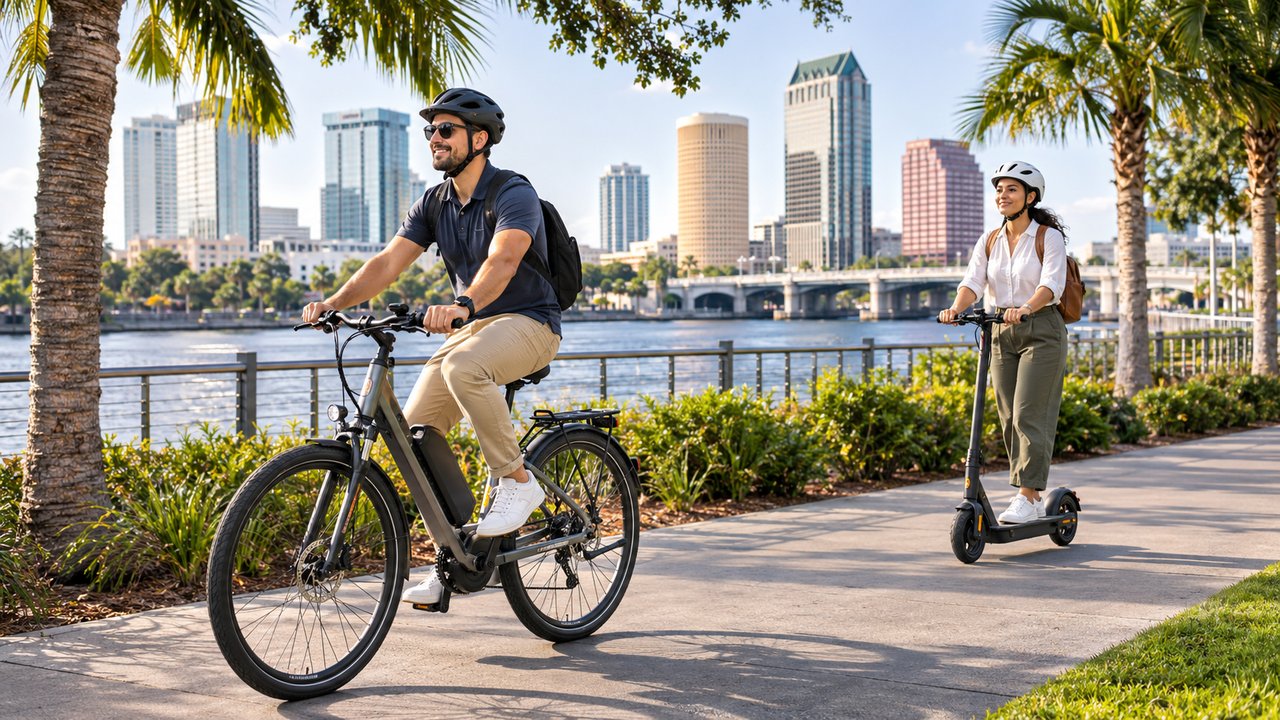
Hillsborough County’s new limits cap e-bikes, e-scooters, and bicycles at 10 mph on sidewalks, 15 mph on shared paths, and 28 mph on roads.
Hillsborough County commissioners approved new speed limits for e-bikes, e-scooters, and other micromobility devices on November 10, 2026. The approved limits vary by location: 10 mph on sidewalks, 15 mph on shared paths, and 28 mph on roads. Traditional bicycles are covered, too, according to Spectrum Bay News 9’s report.
For riders, the change makes it important to know which rules apply along each part of a trip. After a collision, the location, applicable speed limit, and evidence of how everyone was traveling may also matter when determining fault.
If you were injured in a crash, our Tampa e-bike and e-scooter accident lawyer page explains how Armando Personal Injury Law helps injured riders investigate their claims.
What speed limits did Hillsborough County approve?
The new limits reported in coverage of the commission’s vote are:
| Riding Location | Approved Maximum Speed |
|---|---|
| Sidewalks | 10 mph |
| Shared-use paths and trails | 15 mph |
| Roads and bicycle lanes | 28 mph |
Florida Politics reported that commissioners approved the ordinance unanimously, 7–0.
These categories deserve attention. Someone moving from a road onto a sidewalk cannot assume the same speed limit follows them. Riders should check the route’s designation, posted restrictions, and applicable local rules rather than relying on how fast their bike or scooter can travel.
The 28 mph figure should not be read as blanket permission to operate every type of electric device on every road or path.
Do the county rules apply inside Tampa?
According to Florida Politics’ coverage of the approval, the regulations apply throughout Hillsborough County, including Tampa, Temple Terrace, and Plant City, except where municipal ordinances regulate the same conduct.
That exception matters. A countywide announcement does not mean every city’s existing rules disappear.
For a crash investigation, “it happened in Tampa” may not provide enough detail. The precise location, whether the rider was on a sidewalk or another type of route, and the rules in effect on the crash date all need to be established.
What else is included in the new rules?
Bay News 9 reports that commissioners also approved restrictions on stunts and wheelies, along with requirements addressing yielding to pedestrians, signaling before passing, and compliance with existing safety and equipment rules.
The report describes warnings, fines, and possible impoundment for certain offenses. It also notes that the rules include civil and criminal penalties.
These provisions address more than top speed. How a rider passes someone, approaches a crossing, or shares a sidewalk can become important when reconstructing a collision.
Does a speeding allegation mean an injured rider caused the crash?
An allegation that a rider was speeding does not, by itself, establish responsibility for a collision.
Florida’s standard civil jury instruction on traffic-rule violations treats a violation as evidence of negligence to consider alongside the other facts. It is not conclusive proof. The investigation must also address whether the conduct contributed to the injury. See Florida Standard Jury Instruction 401.9, reproduced in the Florida Bar’s model instructions.
Consider a driver turning across an e-bike rider’s path. Relevant questions may include:
- Who had the right-of-way?
- How fast were the driver and rider actually traveling?
- Could they see each other before the collision?
- Did either person have an opportunity to avoid the impact?
A rider’s speed may be important, but so may a driver’s failure to look before turning. Both parties’ conduct needs to be examined.
The bike’s advertised maximum speed also does not establish its speed at the moment of impact. Available video, witness accounts, physical evidence, and reliable device records may help resolve that question.
Can an injured rider recover compensation if they share fault?
Sharing fault does not automatically prevent recovery.
Under Florida Statutes §768.81, a person found more than 50% at fault for their own harm cannot recover damages in a negligence action to which that rule applies. At 50% or less, recoverable damages are reduced by the person’s share of fault.
That makes accurate evidence important. An insurer’s assertion that a rider was traveling too fast should be examined against the facts, including whether the alleged speed contributed to the collision or injuries.
What evidence should you preserve after an e-bike or scooter crash?
Get medical attention first and call 911 if anyone needs emergency help. Once it is safe, preserve information that can help explain what happened.
Photograph the route. Capture signs, lane markings, crossings, driveways, path entrances, and obstructions. Include wider views showing how the sidewalk, path, and roadway connect.
Identify the device. Save its make, model, classification label, and rental identification number, if applicable. Photograph visible damage.
Save available trip information. Keep rental receipts, app screenshots, and communications with the rental company. Do not assume every device records speed or retains trip data.
Identify witnesses and possible video. Record witness contact information and the locations of nearby cameras. A camera’s presence does not guarantee that footage exists or will be retained.
Preserve the equipment and injury records. Get advice before repairing or discarding the bike or scooter. Keep medical records, bills, and documentation of missed work together.
The goal is to establish the actual circumstances of the crash while useful evidence is still available.
Get help after an e-bike or e-scooter injury in Tampa
When a collision leaves you dealing with medical treatment and time away from work, a dispute about riding rules can add another layer of uncertainty.
Armando Personal Injury Law can review the circumstances, investigate responsibility, and explain your options for pursuing compensation. Our Tampa e-bike and e-scooter accident attorneys help injured riders understand what evidence matters and how to move forward.
Call (813) 482-0355 or request a free consultation to discuss what happened.

About the Author
Attorney Armando Edmiston is the founder of Armando Personal Injury Law in Tampa and St. Pete, Florida. A U.S. Marine veteran, Hillsborough County native, and ACS Forensic Lawyer-Scientist, he represents Floridians in serious personal injury and wrongful death cases.