
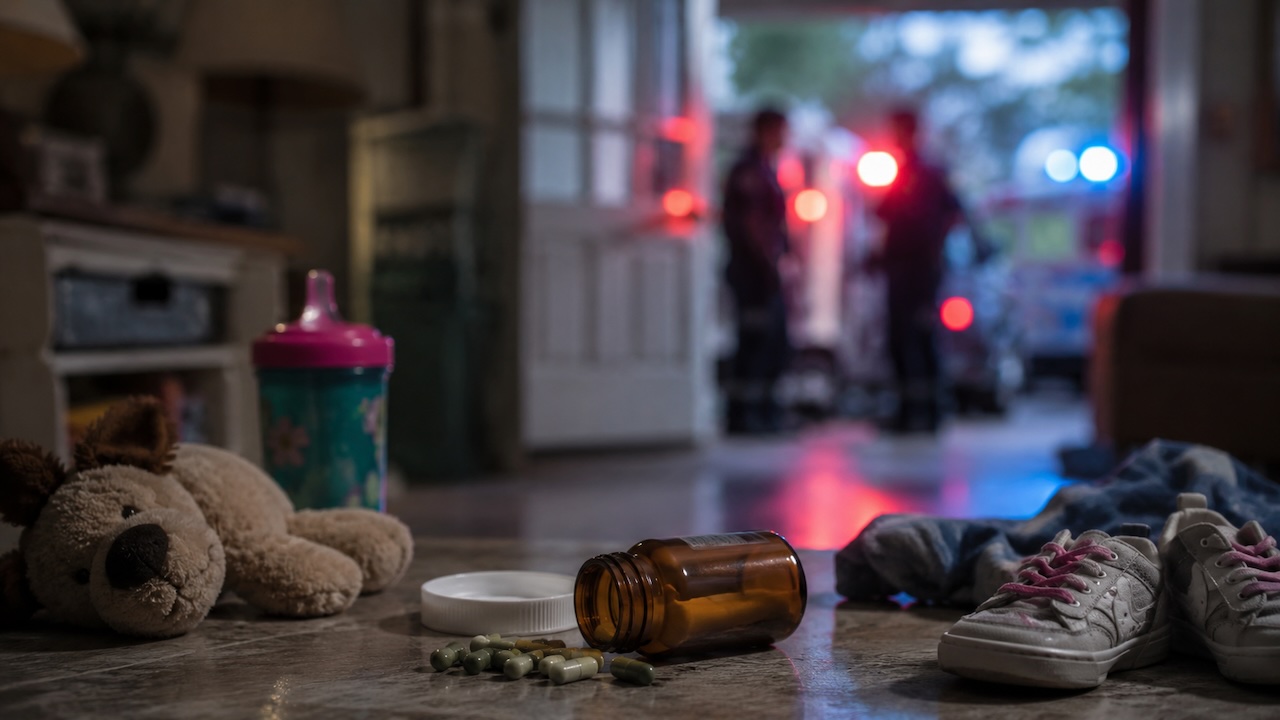
Two adults face felony charges of aggravated manslaughter and child neglect following the death of a Florida toddler who died after reportedly ingesting kratom pills.
Jonnie Jordan was two years old when she was brought to Holmes Regional Medical Center on May 18, 2026. She was unresponsive. Doctors could not save her.
More than two months later, West Melbourne police announced the arrests of two adults in connection with her death. According to WFLA News Channel 8, investigators believe Jonnie swallowed kratom pills while staying at a Palm Bay home.
Police say she became seriously ill afterward. They also allege the adults with her knew what had happened but did not immediately call 911 or take her to a hospital.
That is the heart of the criminal case. But it is not the only part of this story. The pills have not been publicly identified. Their strength, formulation, manufacturer, and seller are still unknown.
What Police Say Happened Before Jonnie Died
Investigators say Jonnie spent the evening of May 17 at a Palm Bay residence with her father, 35-year-old Jerome Jonathon Jordan, and 32-year-old Charlene Rea O’Connell.
At some point, police say, she got hold of kratom pills that belonged to the adults. Investigators believe she may have swallowed as many as two and a half pills.
Then came the symptoms. Blue lips. Abnormal breathing. Seizure-like activity. Police allege both adults knew she had taken the pills.
Still, investigators say, no one called 911 or sought immediate medical care. According to the West Melbourne Police Department’s arrest announcement, Jordan later took Jonnie to another residence and put her to bed.
She was found unresponsive the next morning and taken to the hospital.
Medical Examiner Reports Acute Mitragynine Intoxication
The Brevard County Medical Examiner’s Office conducted an autopsy and reportedly determined that Jonnie died from acute mitragynine intoxication.
Mitragynine is the main active alkaloid in kratom. It appears in products sold as powder, capsules, tablets, gummies, extracts, and liquid shots.
The medical examiner’s finding identifies the substance tied to the fatal intoxication. It does not tell the public which product Jonnie swallowed, how strong it was, who made it, where it was sold, or what else may have been in it.
Those details matter. “Kratom” is not one uniform product. Two pills that look almost identical can contain very different concentrations and formulations.
How Mitragynine Becomes 7-OH in the Body
One part of kratom toxicology is easy to misunderstand: finding 7-OH in the body does not automatically mean someone swallowed a concentrated 7-OH product.
After a person consumes mitragynine, the liver begins breaking it down through the cytochrome P450 enzyme system. Research available through the National Library of Medicine identifies CYP3A4 as the enzyme that does most of the work converting some mitragynine into 7-hydroxymitragynine, commonly called 7-OH.
Put more simply, the liver can make 7-OH from mitragynine.
So when 7-OH appears in a toxicology report, it may have been present in the original product, created as the body metabolized mitragynine, added or concentrated by the manufacturer, or produced through some combination of those pathways.
The amount found can also shift based on the dose, the strength of the product, liver function, individual metabolism, other substances in the body, when the sample was collected, what type of specimen was tested, and postmortem changes.
That is why toxicology results alone may not identify the product. Investigators may still need the remaining pills, the packaging, purchase records, laboratory testing, and the relative levels of mitragynine and its metabolites.
None of these changes the medical examiner’s reported conclusion in Jonnie’s case. It simply explains how mitragynine and 7-OH can appear together after kratom exposure.
Two Adults Charged in Jonnie’s Death
Police arrested Jerome Jordan and Charlene O’Connell on charges of aggravated manslaughter of a child and child neglect causing great bodily harm. Both were reportedly held without bond at the Brevard County Jail after their arrests.
The charges are allegations. Each defendant is presumed innocent unless proven guilty in court.
The criminal case will likely turn on what the adults knew, what they allegedly saw, and why emergency help was not requested. Even if prosecutors answer those questions, the case may still leave the pills themselves unexplained.
What Was Actually in the Pills?
Public reporting has not named the brand, dosage, manufacturer, retailer, purchase location, or full ingredient list. That is not a minor gap. It is central to understanding what happened.
A real product investigation should ask:
- How much mitragynine was in each pill?
- Was 7-OH concentrated or separately added?
- Were synthetic or semisynthetic compounds present?
- Did the label accurately state the ingredients and strength?
- Were the warnings clear enough for the product’s potency?
- Was the packaging child-resistant?
- Which companies made, distributed, and sold it?
Until the pills are identified and tested, no one can responsibly say whether Jonnie swallowed traditional kratom, a concentrated mitragynine extract, an enhanced 7-OH product, or something else. The evidence has to answer that.
Kratom Products Can Look Deceptively Ordinary
A small tablet, gummy, capsule, or bottle sitting on a store shelf can look routine. The packaging may be bright. The label may use the word “natural.” None of that proves the product was reviewed for safety or that the dose is predictable.
People often assume that anything sold openly at a smoke shop, gas station, convenience store, specialty retailer, or online marketplace went through some meaningful approval process. With kratom products, that assumption can be dangerously wrong.
The U.S. Food and Drug Administration has not approved kratom or its compounds for any medical use. The agency has also issued a separate consumer warning about concentrated 7-OH products, including tablets, gummies, drink mixes, and liquid shots.
The FDA has warned about addiction, seizures, withdrawal symptoms, gastrointestinal distress, and other serious effects tied to concentrated 7-OH products. It has also made clear that those concentrated products are different from natural kratom leaf.
Federal Authorities Target Concentrated 7-OH Products
On July 1, 2026, the U.S. Drug Enforcement Administration announced its intent to temporarily schedule certain 7-OH substances and related compounds under Schedule I of the federal Controlled Substances Act.
The announcement covers 7-OH above a specified threshold and several related substances, including mitragynine pseudoindoxyl, MGM-15, and MGM-16. Its focus is concentrated, synthetic, and semisynthetic products.
That federal action does not tell us what was in the pills connected to Jonnie’s death. Neither does the presence of 7-OH in a toxicology report, because the body can create 7-OH while metabolizing mitragynine.
The actual product still matters. So does testing it.
Signs of Poisoning Require Immediate Help
Blue lips are not a wait-and-see symptom. Neither are seizures, slow or irregular breathing, extreme sedation, loss of consciousness, or an inability to wake someone.
Anyone who believes a child or adult swallowed kratom, 7-OH, medication, or another potentially toxic substance should call 911 immediately.
For poisoning questions that are not immediately life-threatening, Poison Control is available online or by phone at 1-800-222-1222.
Do not put the person to bed and hope it passes. Do not assume a product is harmless because it was sold legally, called a supplement, or marketed as natural.
With poisoning or overdose, lost time can become the difference between treatment and tragedy.
Families May Have Legal Options After a Fatal Kratom Exposure
Families who lost someone after using kratom, a mitragynine extract, or a concentrated 7-OH product may be left with questions that the packaging and toxicology report do not answer. Our kratom and 7-OH death lawsuit page explains the cases Armando Personal Injury Law is reviewing, the evidence that may need to be preserved, and how a product investigation can begin.
Depending on the facts, surviving relatives may also be able to bring a wrongful death claim against a manufacturer, distributor, retailer, or another party whose conduct contributed to the death.
Armando Personal Injury Law reviews fatal kratom and 7-OH cases in Florida and across the United States. Families can contact the firm for a free and confidential case evaluation.
About Armando Personal Injury Law
Armando Personal Injury Law represents people and families harmed by dangerous products, negligence, and wrongful conduct. The firm investigates complex product-liability and wrongful-death cases involving kratom, mitragynine extracts, and concentrated 7-OH products.

About the Author
Attorney Armando Edmiston is the founder of Armando Personal Injury Law in Tampa and St. Pete, Florida. A U.S. Marine veteran, Hillsborough County native, and ACS Forensic Lawyer-Scientist, he represents Floridians in serious personal injury and wrongful death cases.