Strong evidence can play a critical role in proving negligence and recovering compensation after a Florida slip and fall accident.
A Florida slip and fall claim may be proven with photographs or video of the hazard, surveillance footage, witness statements, incident reports, inspection and maintenance records, employee testimony, medical records, and documentation of financial losses. The strongest evidence helps show what caused the fall, whether the property owner knew or should have known about the danger, how the fall caused your injuries, and what those injuries have cost you.
Slip and fall accidents happen quickly. A cracked sidewalk outside a St. Petersburg storefront or an unmarked spill in a Tampa grocery aisle can turn an ordinary day into an emergency room visit.
Falls are also a serious public-safety issue. The National Safety Council (NSC) reports that 48,308 people died in falls at home and at work in 2024. Most slip and fall injuries are not fatal, but the number underscores how serious falls can be.
After the immediate shock wears off, another problem often appears: proving what happened.
The dangerous condition may be cleaned up. Security footage can be overwritten. Witnesses leave. Employees change shifts. The property owner or its insurance company may later argue that the hazard never existed, was there only briefly, or should have been avoided.
That is why evidence matters so much in a Florida premises liability claim. The sooner important evidence is identified and preserved, the harder it may be for an insurer to rewrite what happened.
What Does Florida Law Require You to Prove After a Slip and Fall?
A property owner is not automatically responsible simply because someone falls and gets hurt. Liability depends on the type of hazard, what the property owner or business knew about it, and whether reasonable steps were taken to correct the danger or warn people about it.
For falls involving a transitory foreign substance inside a business establishment, Florida Statute § 768.0755 requires the injured person to prove that the business had actual or constructive knowledge of the dangerous condition and should have taken action to remedy it.
Actual knowledge may exist when an employee saw the spill, created the condition, or was told about it.
Constructive knowledge is different. It can be established through circumstantial evidence showing that:
- the dangerous condition existed long enough that the business should have discovered it through ordinary care, or
- the dangerous condition occurred regularly enough that it was foreseeable.
This is one reason small details can become important. Dirty footprints through a spill, dried edges, cart tracks, employee inspection records, previous complaints, or repeated leaks in the same area may help establish how long a condition existed or whether it happened before.
Does Florida Statute § 768.0755 Apply to Every Slip and Fall?
No. Section 768.0755 specifically addresses falls involving transitory foreign substances in business establishments, such as spilled liquids, dropped food, grease, or tracked-in water.
Not every premises liability case involves that type of condition.
A fall caused by a broken stair, uneven pavement, defective flooring, poor lighting, or another structural condition may involve different questions about the property owner's duty, notice, maintenance practices, and reasonable care.
That distinction matters because the evidence needed to prove a spilled-liquid case may be different from the evidence needed to prove a fall caused by a long-standing property defect.
What Physical Evidence Should You Collect at the Scene?
The scene of a fall can change within minutes. A puddle gets mopped. Debris gets picked up. A warning cone suddenly appears. A broken area may be blocked off or repaired.
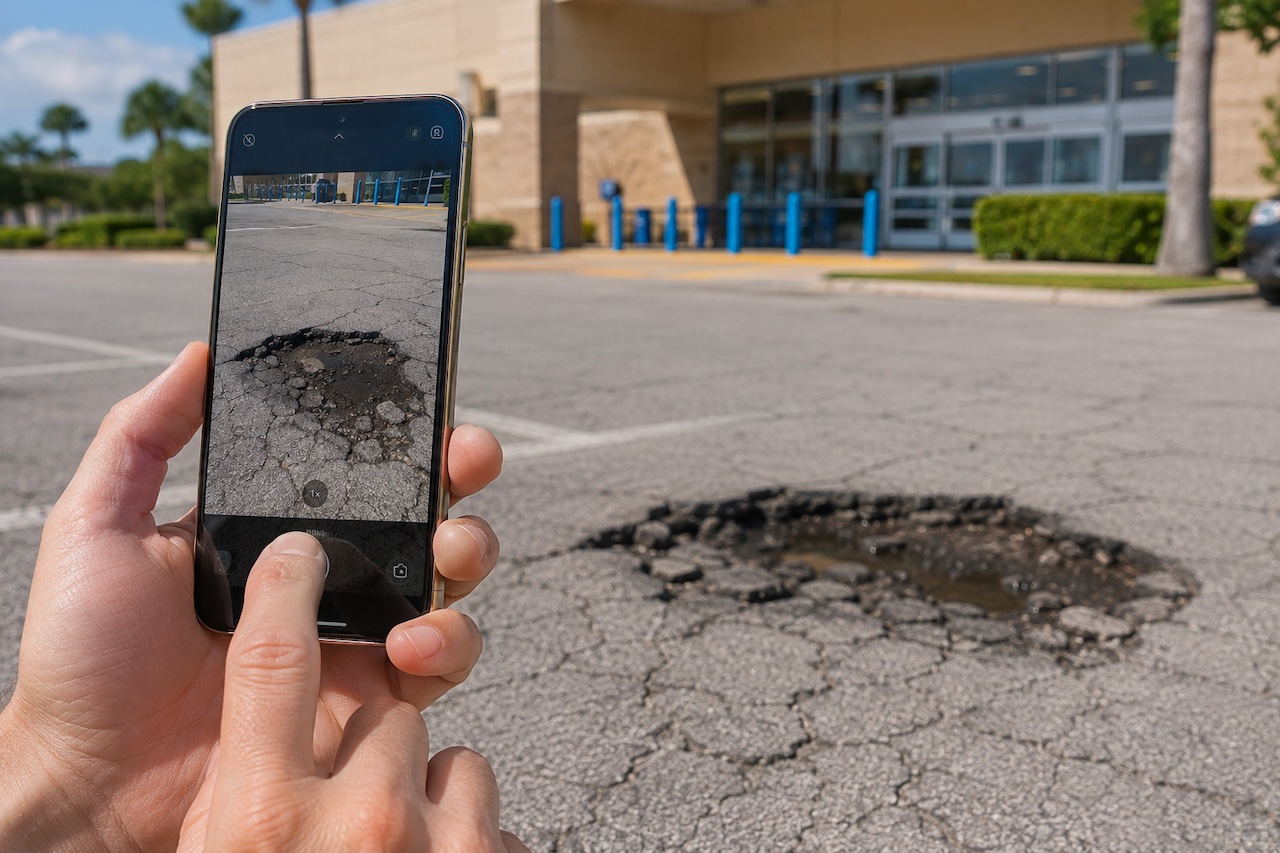
If you are physically able to do so, document the scene before it changes.
Useful evidence can include:
- Photos and video of the hazard: Capture the spill, crack, loose flooring, debris, defective stair, or other condition from several angles.
- The surrounding area: Wider photographs can show lighting, sightlines, nearby displays, entrances, floor mats, or anything else that affected your ability to see the danger.
- The exact location: Record the aisle number, entrance, parking area, stairwell, sidewalk, or other landmark.
- Warning signs or the lack of them: Photograph cones, barricades, wet-floor signs, or the area where a warning should have been placed.
- Weather conditions: Rain can be important in cases involving entrances, sidewalks, parking lots, or tracked-in water.
- Shoes and clothing: Keep the shoes and clothing you were wearing. Do not throw them away simply because they were damaged or dirty.
You do not need professional-quality photographs. A few clear phone pictures taken shortly after a fall may preserve details that no one can recreate later.
How Do Witness Statements Help Prove a Slip and Fall Claim?
An independent witness can help confirm what happened before, during, or immediately after a fall.
Someone may have seen the spill before you entered the aisle. Another customer may have watched you fall. A person nearby may have heard an employee say that a cooler had been leaking all morning.
Even witnesses who did not see the actual fall may have useful information.
Employees can matter too. A cashier, maintenance worker, server, manager, or security employee may know when an area was last inspected, whether anyone complained about the hazard, or whether the same problem had happened before.
If possible, get the names and contact information of people who witnessed the incident or the condition.
Once everyone leaves, finding those people again can become much more difficult.
Why Do Surveillance Footage and Incident Reports Matter?
Surveillance footage can sometimes become some of the most important evidence in a slip and fall case.
Video may show:
- when the hazard first appeared
- how long it remained there
- whether employees walked past it
- whether another customer reported it
- whether warning signs were present
- the fall itself
- what employees did immediately afterward
The problem is that surveillance footage is not necessarily kept forever. Retention policies vary, and some systems automatically overwrite older recordings.
That is why a prompt preservation request can be important. An attorney can send a written preservation letter identifying potentially relevant video and other evidence before it is lost through routine business practices.
An incident report can also help establish when and where the fall occurred. If you report the accident to a manager or employee, make sure the business documents it. Ask for a copy or report number if the business is willing to provide one.
If they refuse to give you a copy, make your own notes about who took the report, when you reported the fall, and what was said.
What Can Medical Records Prove About Your Injuries?
Evidence must show more than the existence of a dangerous condition. A claim also needs evidence connecting the fall to your injuries and damages.
Slip and fall accidents can cause injuries such as:
- fractures
- ankle and knee injuries
- hip injuries
- back and neck injuries
- shoulder and wrist injuries
- torn ligaments
- traumatic brain injuries and concussions
Seeking appropriate medical care creates documentation of your symptoms, diagnosis, treatment, and limitations.
Timing can matter. If symptoms develop or worsen after the fall, tell the medical provider when the injury happened and how it occurred. Follow recommended treatment and attend follow-up appointments when medically appropriate.
Insurance companies often examine gaps in treatment or inconsistent medical histories when evaluating a claim. Clear, consistent medical documentation can help establish causation and show how an injury has affected your daily life.
Medical bills, diagnostic imaging, therapy records, physician notes, prescriptions, and records of future treatment recommendations may also help document damages.
How Can Maintenance and Inspection Records Reveal Negligence?
Businesses often have procedures for inspecting floors, cleaning common areas, repairing defects, and responding to reported hazards.
Their own records can show whether those procedures were actually followed.
Depending on the case, relevant evidence may include:
- inspection logs
- cleaning schedules
- maintenance records
- repair requests
- prior complaints
- employee schedules
- work orders
- safety policies
- reports of similar incidents
For example, an inspection log showing that no one checked a busy grocery aisle for several hours may become relevant if a customer slips on a spill.
Records showing repeated complaints about the same leaking refrigerator, broken stair, or uneven walking surface may also help establish notice.
Businesses do not normally hand over unfavorable internal documents simply because someone asks for them. Identifying and preserving these records may require formal legal requests once a claim or lawsuit moves forward.
Can Being Partly at Fault Affect a Florida Slip and Fall Claim?
Yes. Florida's comparative fault law can make evidence about the injured person's actions important too.
An insurance company may argue that you were distracted, failed to watch where you were walking, ignored a warning sign, or otherwise contributed to the fall.
Under Florida's current comparative fault statute, compensation in a negligence action can be reduced according to the percentage of fault assigned to the injured person. In covered negligence actions, a person found more than 50 percent at fault for their own harm may be barred from recovering damages.
That makes photographs, surveillance video, witness testimony, warning signs, lighting conditions, and the placement of the hazard important for more than proving negligence. The same evidence may help answer an insurer's attempt to shift blame onto you.
Do not assume that an accusation of partial fault ends your case. Fault depends on the evidence and the specific circumstances surrounding the fall.
What Compensation Can Strong Evidence Help Establish?
The value of a Florida personal injury claim depends on the facts of the case, including the nature of the injury, available evidence, insurance coverage, liability issues, medical treatment, and the effect the injury has on the person's life.
Depending on the circumstances, damages may include:
- Medical expenses: Emergency care, hospitalization, surgery, physical therapy, diagnostic testing, medication, and other treatment related to the injury.
- Future medical care: Treatment, rehabilitation, assistive devices, or home modifications that may reasonably be needed later.
- Lost income: Wages or other income lost while recovering.
- Reduced earning capacity: Losses caused by an injury that limits a person's ability to work or earn income in the future.
- Pain and suffering: The physical pain and emotional impact associated with the injury.
- Property damage: Items such as glasses, a phone, clothing, or a mobility device damaged in the fall.
No single formula determines what a slip and fall case is worth. Two people can suffer similar falls and have very different claims because their injuries, evidence, treatment, fault issues, and long-term consequences are different.
How Can a Tampa Slip and Fall Lawyer Help Preserve Evidence?
A slip and fall claim can become difficult quickly once a business and its insurance company begin investigating.
While you are focused on medical treatment, important evidence may already be disappearing.
A Tampa slip and fall lawyer can investigate the circumstances of the fall and take steps to preserve evidence that may be difficult for an injured person to obtain alone. Depending on the case, that can include:
- sending preservation letters for surveillance footage
- identifying witnesses
- requesting inspection and maintenance records
- examining prior complaints or similar incidents
- reviewing photographs and video
- analyzing medical records
- investigating whether the property owner had notice of the hazard
- responding to attempts to unfairly place blame on the injured person
At Armando Personal Injury Law, we approach these cases with the understanding that evidence matters from the beginning. We look at what caused the fall, who knew about the danger, what should have been done to prevent it, and how the injury has affected our client's life.
If you were hurt in a fall on someone else's property in Tampa, St. Petersburg, or elsewhere in the Tampa Bay area, contact Armando Personal Injury Law for a free case evaluation. We can review what happened, explain what Florida law may require, and help determine what evidence should be preserved before it disappears.