March 2026 crash data shows that several intersections and corridors in the greater Tampa area experienced repeated collision activity, with E Fletcher Avenue and Bruce B Downs Boulevard leading the list at 14 crashes. For a Tampa car accident lawyer, that pattern matters because recurring crash clusters often point to the same underlying hazards: turning conflicts, commuter congestion, following-too-closely behavior, and heavy commercial traffic.
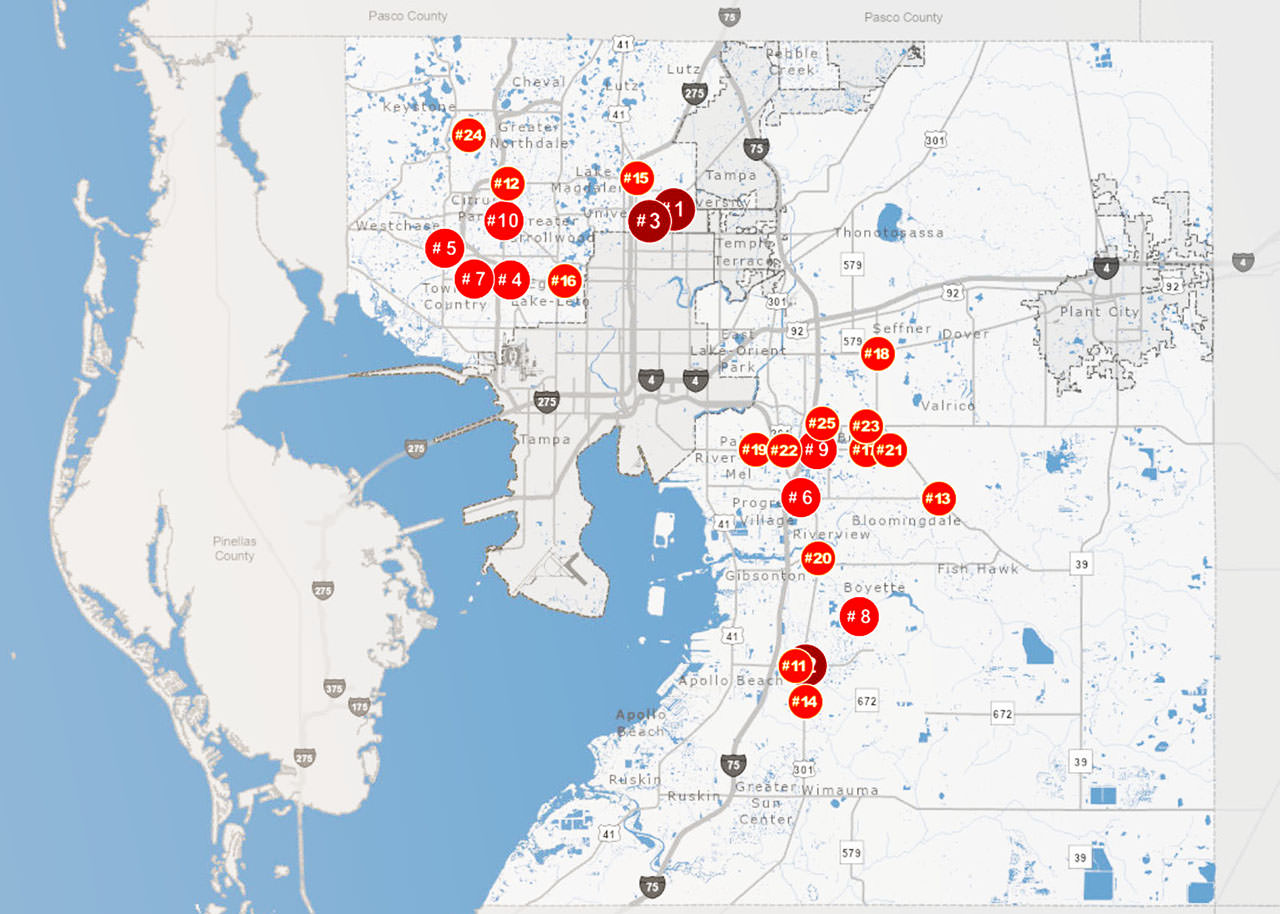
March 2026 crash data identified several Tampa-area intersections and corridors with elevated collision volume.
It is also important to note that this data reflects the broader Tampa-area driving market, not only intersections within the City of Tampa. That distinction matters because many Tampa drivers travel daily through Temple Terrace, Brandon, Riverview, Town ’n’ Country, and other Hillsborough County corridors that connect directly to Tampa traffic patterns.
If you were injured in a crash at one of these locations, contact an attorney right away. Still, crash volume can provide valuable context. Roads that consistently appear in monthly rankings often share the same risk factors: high-speed approach traffic, limited decision time, frequent lane changes, turning movements, and stop-and-go congestion.
The Top Crash Areas in the March 2026 Tampa-Area Data
Based on the Hillsborough County Sheriff's Office crash reports, these were the highest-ranked crash locations for March 2026.
1. E Fletcher Avenue and Bruce B Downs Boulevard - 14 crashes
This was the highest-ranked location in the data by a clear margin. It is a major north Tampa corridor influenced by university traffic, commuter volume, retail activity, frequent turning movements, and heavy signal cycling.
2. S US Highway 301 and Big Bend Road - 10 crashes
This intersection ranked second overall and reflects the risks that emerge when suburban growth, freight movement, commuter traffic, and retail access all converge at a single signalized location.
3. E 127th Avenue and N 15th Street - 9 crashes
This location posted one of the highest totals in the report and highlights how north Tampa surface streets can produce repeated collision clusters when local access traffic and through traffic compete for space.
4. Anderson Road and W Waters Avenue - 9 crashes
Waters Avenue appears repeatedly in the March 2026 data, which suggests a broader corridor issue rather than an isolated intersection problem.
5. W Linebaugh Avenue and Sheldon Road - 9 crashes
This west Tampa-area intersection ranked among the highest-volume locations in the data. Corridors like this often see rear-end and turning crashes tied to congestion, lane changes, and abrupt braking. These collisions often lead to whiplash, cervical strain, back pain, and other neck or spine complaints that may worsen in the hours after a crash.
6. S US Highway 301 and Bloomingdale Avenue - 9 crashes
US 301 appears several times in the reports, and this intersection is one of several along that corridor with elevated crash volume during March 2026.
7. Hanley Road and W Waters Avenue - 9 crashes
This is another indication that Waters Avenue deserves attention as a recurring crash corridor in the greater Tampa area.
8. Balm Riverview Road and Rhodine Road - 8 crashes
This location shows that some of the highest-risk roads in the Tampa area are tied to suburban growth corridors, not just urban intersections.
9. Causeway Boulevard and Providence Lakes Boulevard - 8 crashes
Causeway Boulevard also appears multiple times in the ranked data, making it one of the more notable recurring roadways in the March 2026 list.
10. Gunn Highway and Lynn Road - 8 crashes
This corridor reflects a familiar Tampa-area risk pattern: fast through traffic mixed with neighborhood access, turning movements, and steady daily congestion.

Contact Armando Personal Injury Law if you have been injured in a crash that was not your fault.
The data tells a story
The most important takeaway from the data is that crashes are clustering along corridors, not just at isolated intersections.
When the same street names continue appearing in the crash rankings, the better question becomes: which roads are generating the most conflict points?
- S US Highway 301 accounted for 42 crashes
- E Fletcher Avenue accounted for 37 crashes
- W Waters Avenue accounted for 35 crashes
- Bruce B Downs Boulevard accounted for 28 crashes
- Big Bend Road accounted for 27 crashes
- Bloomingdale Avenue accounted for 20 crashes
- Causeway Boulevard accounted for 20 crashes
Why These Roads Keep Seeing Crashes
Every crash is different, but the corridors in this March 2026 ranking share several common characteristics.
Heavy commuter traffic
Many of these roads serve as major travel routes with sustained pressure during morning, evening, and midday peaks.
Turning conflicts
Large intersections with multiple turn lanes, shopping center entrances, gas station access points, and side-street traffic create repeated opportunities for angle and side-impact crashes.
Rear-end crash conditions
Stop-and-go traffic, long signal queues, late braking, and distracted driving often lead to rear-end collisions on roads like Fletcher, Waters, Causeway, Big Bend, and US 301.
Growth-corridor pressure
Several of these locations are in fast-growing areas where residential expansion, school traffic, and commercial development all add demand to already busy roads.
Lane changes and speed differences
When local turning traffic mixes with faster through traffic, the chances of merging crashes, sudden braking, and delayed reaction times increase.
Why This Matters Under Florida Law
These crash rankings are not just local traffic statistics. They also reflect the kinds of roadway conflicts addressed by Florida traffic laws, including rules governing traffic signals, left-turn yielding, following too closely, and a driver’s duties after a crash. In serious injury cases, those legal duties often shape both liability analysis and evidence preservation.
That legal framework matters because the crash patterns in the spreadsheet line up with common claims seen in Tampa-area injury cases.
Signalized intersection crashes
Disputes often center on who had the right of way, who followed the signal, and whether a driver entered too late or too fast.
Left-turn crashes
At busy intersections, one of the main questions is whether a turning driver failed to yield to oncoming traffic.
Rear-end crashes
In stop-and-go traffic, following too closely becomes a frequent issue.
Post-crash conduct
After a crash involving injury or property damage, drivers are required to exchange identifying information and provide reasonable assistance when needed.
Think in Terms of Corridors, Not Just Intersections
A common mistake is to think about crash risk as a single-intersection problem. The March 2026 data suggests something broader: entire travel corridors are producing repeated crash counts.
That is especially true for:
- Fletcher Avenue
- Bruce B Downs Boulevard
- US Highway 301
- Waters Avenue
- Big Bend Road
- Causeway Boulevard
- Bloomingdale Avenue
For Tampa drivers, that means extra caution is warranted before reaching a single bad intersection. More following distance, lower approach speed, better left-turn judgment, and less distraction can matter across an entire corridor, not just at one signal.
What To Do After a Crash in One of These Areas
If you are involved in a crash at one of these intersections or corridors, the steps you take immediately afterward can affect both your health and your injury claim.
Get medical attention promptly
Some injuries do not fully present at the scene, and symptoms like neck pain, headaches, back pain, and concussion-related issues can worsen later.
Document the roadway
Take photographs of vehicle positions, lane markings, signal placement, debris, skid marks, shoulder conditions, and nearby businesses or access points that may help explain how the crash occurred.
Identify witnesses
Busy intersections often mean neutral witnesses are nearby, and their statements can become important in disputed-fault cases.
Be careful with insurance adjusters
Do not minimize your injuries or discuss fault before the full facts are known.
Speak with a Tampa car accident lawyer
High-volume intersections and major commuter corridors often involve more complicated liability, medical, and insurance issues than many people expect.
Hurt in a Crash at a High-Risk Tampa Intersection?
If you were injured on Fletcher Avenue, Bruce B Downs Boulevard, Waters Avenue, Causeway Boulevard, Big Bend Road, or US 301, it is important to speak with a Tampa car accident lawyer as soon as possible. Early investigation can help preserve photos, witness statements, vehicle damage evidence, roadway context, and the post-crash information needed to support your claim.
If the insurance company is already disputing fault or narrowing the claim, a Tampa trial attorney can step in, protect key evidence, and prepare the case for negotiation or litigation.
To learn more, visit our Tampa car accident lawyer page. You can also explore our Florida car accident lawyer page for broader statewide information.
If you need help after a crash, contact Armando Personal Injury Law at (813) 482-0355 or visit armandoinjurylaw.com/contact/.