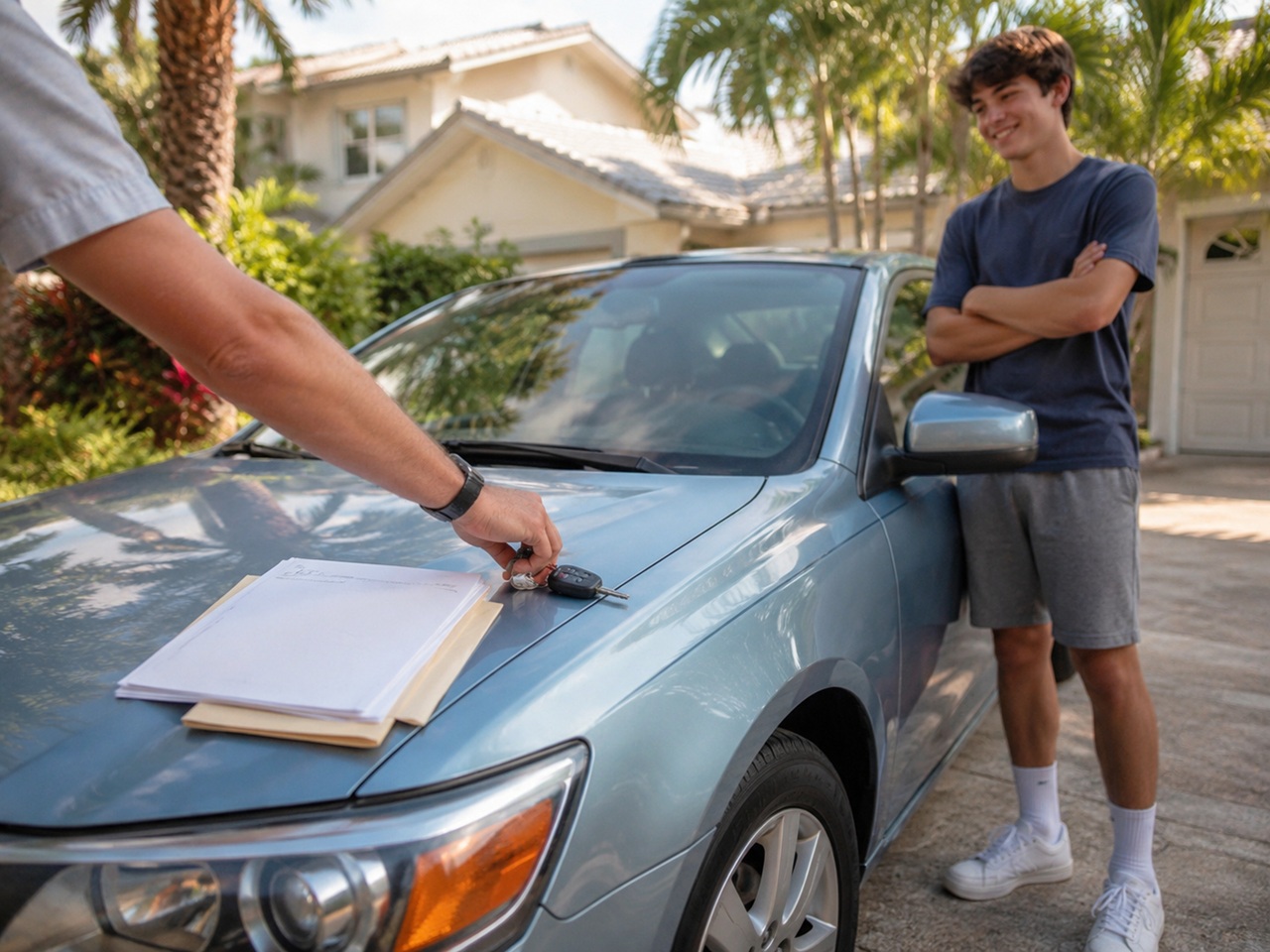
Crash ratings, safety technology, vehicle condition, and insurance all matter when choosing a teen’s first car.
The 2026 IIHS and Consumer Reports recommendations can help families compare crash protection, safety technology, vehicle size, and price. A safer vehicle is only one part of the decision. Florida parents should also verify recalls, inspect the exact vehicle, understand teen licensing restrictions, and review insurance before a new driver gets the keys.
A safe first car should be protective, predictable, and manageable for an inexperienced driver. It should have strong crash-test performance, electronic stability control, useful crash-avoidance technology, good headlights, moderate power, and no unresolved safety recalls. The exact model year, build date, trim, maintenance history, and condition still matter.
No rating can prevent every crash. A teen can follow the rules and still be injured by a distracted, impaired, or speeding driver. Families in Tampa Bay also have to account for congested roads such as I-4 and I-275, heavy rain, unfamiliar tourists, school traffic, and busy urban intersections.
What Does the 2026 IIHS Teen Vehicle List Tell Parents?
The list is a screening tool, not a guarantee. The Insurance Institute for Highway Safety and Consumer Reports updated their joint teen-vehicle recommendations on May 27, 2026. The update identifies 45 used vehicles starting below $10,000, 29 additional used vehicles below $20,000 with stronger headlights and pedestrian-detecting automatic emergency braking, and 22 recommended new 2026 vehicles.
Review the current IIHS safe vehicles for teens list before buying because model-year ranges, build-date exceptions, prices, and recommendations can change.
How the used vehicles qualified
For the 2026 list, recommended used vehicles had to meet several baseline criteria:
- A curb weight above 2,750 pounds.
- A good rating in the IIHS driver-side small overlap front crash test.
- Average or better Consumer Reports scores for braking, emergency handling, and routine handling.
- Acceptable usability scores for controls and displays.
Best Choices meet additional standards. They include qualifying automatic emergency braking with pedestrian detection and headlights rated acceptable or good by IIHS.
What the list intentionally leaves out
More size and power are not always better for a new driver. The recommendations exclude minicars, vehicles below the weight threshold, sports cars, and models with excessive horsepower relative to weight. IIHS also cautions that large SUVs and large pickups can be difficult for inexperienced drivers to handle and may take longer to stop.
Examples From the 2026 Best Choices List
The following examples are drawn from the IIHS Best Choices used-vehicle tier. They are starting points for comparison, not endorsements of a specific vehicle for every teen or family.
| Vehicle | Qualifying Model Years | IIHS Reference Price |
|---|---|---|
| Mazda 3 | Hatchback 2019–2025; sedan 2020–2025 | $13,200 |
| Toyota Camry | 2019–2025, including hybrid | $17,300 |
| Subaru Forester | 2019–2025 | $15,900 |
| Hyundai Tucson | 2022–2025, including hybrid | $19,100 |
| Ford Explorer | 2020–2024 | $18,400 |
Price note: IIHS reports median retail prices obtained from Black Book in April 2026, rounded to the nearest $100, for the earliest applicable model year. Actual prices vary by trim, mileage, condition, location, and market changes.
Check the Exact Year, Trim, and Build Date
A model name alone is not enough. Some recommendations apply only to particular model years or vehicles built after a stated month. Safety systems can also be standard on one trim and optional or unavailable on another.
- Match the vehicle identification number to the exact model year, trim, and production date.
- Check whether automatic emergency braking, blind-spot warning, and other features are actually installed and working.
- Look for warning lights, disabled airbags, mismatched tires, poor repairs, or evidence of flood or collision damage.
- Arrange an independent pre-purchase inspection by a qualified mechanic.
- Search the VIN for open recalls and confirm that recall repairs were completed.
Use the NHTSA recall lookup and check again periodically after purchase.
What Safety Features Matter Most for a Teen Driver?
Prioritize systems that prevent common mistakes and reduce injury risk without making the vehicle confusing to operate. The most useful features include:
- Automatic emergency braking with pedestrian detection: may warn the driver and apply braking when a frontal collision is imminent.
- Electronic stability control: helps reduce loss-of-control crashes during abrupt steering or slippery conditions.
- Good headlights: improve visibility on dark, wet, or poorly lit roads.
- Blind-spot warning and rear cross-traffic alert: can help with lane changes and backing, although they do not replace a visual check.
- Strong seat-belt reminders: encourage the driver and passengers to buckle up.
- Moderate power and predictable controls: reduce temptation and make the vehicle easier to manage.
Florida Licensing Rules Still Apply in a Safer Car
Vehicle technology does not replace graduated licensing, supervision, or family rules. Florida learner-license holders must follow supervision and time-of-day restrictions. Licensed 16- and 17-year-old drivers also have age-based driving curfews, with limited exceptions.
As of August 1, 2025, a person under 18 who has never held a driver license must complete Florida’s six-hour Driver Education Traffic Safety course before applying for a learner license. Parents should verify current requirements directly with FLHSMV before scheduling testing or allowing a teen to drive.
- Set a written family rule against handheld phone use and other distractions.
- Limit passengers and nighttime driving while the teen gains experience.
- Practice in rain, heavy traffic, parking lots, and highway merging with a qualified adult.
- Require seat belts for every occupant on every trip.
- Discuss what to do after a crash before an emergency occurs.
Review Insurance Before the Teen Drives Regularly
Do not assume the existing policy automatically handles every new-driver situation. Tell the insurer or agent that the teen will be driving, identify the vehicle the teen will use, and ask for written confirmation of the applicable drivers, vehicles, limits, exclusions, deductibles, and effective date.
Florida minimum coverage is not the same as full protection
Florida generally requires personal injury protection and property damage liability for registered four-wheel vehicles, but it does not require every private driver to carry bodily injury liability coverage. That means a family can be hit by a negligent driver who has little or no liability insurance available for bodily injuries.
Ask the insurance professional to explain:
- Bodily injury liability limits if the teen causes a crash.
- Uninsured and underinsured motorist coverage if another driver causes the crash and lacks sufficient bodily injury coverage.
- Whether UM coverage is stacked or non-stacked and which household members and vehicles it covers.
- Collision, comprehensive, rental, towing, and gap coverage for vehicle-related losses.
- Whether a personal umbrella policy is available and what underlying limits it requires.
Under Florida law, UM coverage is generally offered with bodily injury liability coverage, but a named insured may reject it or select lower limits in writing. Review any rejection form carefully before signing.
PIP has important limits and deadlines
Florida PIP may pay part of covered medical expenses and disability losses regardless of fault, depending on the policy and the injured person’s household and vehicle status. Initial medical services and care generally must be received within 14 days of the crash. Medical benefits may reach $10,000 when an authorized provider determines that the injured person had an emergency medical condition, but may be limited to $2,500 when no emergency medical condition is found.
What Should a Family Do After a Teen Is Hurt in a Crash?
Start with safety and medical care, then preserve information before vehicles, video, and memories change. The appropriate steps depend on the severity of the collision, but families should generally:
- Call 911 and report injuries, hazards, and the crash location.
- Seek prompt medical evaluation. Do not wait for pain to become severe, and remember the 14-day PIP timing rule.
- Photograph vehicles, damage, debris, road conditions, traffic controls, visible injuries, and insurance information when it is safe to do so.
- Collect names and contact information for witnesses.
- Save dashcam files, phone photographs, messages, towing records, and repair estimates.
- Notify the family’s own insurer promptly and provide accurate information required by the policy.
- Avoid giving a detailed recorded statement to another driver’s insurer before understanding the purpose of the request and the family’s rights.
- In a serious or disputed crash, preserve the vehicle before destructive inspection, repair, salvage, or sale.
- Track medical care, school absences, missed activities, out-of-pocket costs, and changes in the teen’s physical or emotional functioning.
Evidence of distraction may include phone records, vehicle data, dashcam video, witness accounts, surveillance footage, and lawful discovery from apps or service providers. Families usually cannot obtain all of that information on their own, and some evidence may be overwritten or lost.
How Armando Personal Injury Law Helps After a Teen Driver Crash
A serious teen-driver crash can involve PIP, liability coverage, UM/UIM, medical causation, disputed fault, vehicle evidence, and long-term effects on school or daily life. Armando Personal Injury Law investigates how the collision happened, identifies potentially responsible parties and insurance policies, preserves available evidence, and explains the claim in plain English.
If your teen was injured in a Tampa Bay crash, speak with a Tampa car accident lawyer before signing a release or accepting a settlement that may not account for ongoing treatment. Contact Armando Personal Injury Law to discuss what happened and what insurance may apply.
Frequently Asked Questions
Is a vehicle on the IIHS teen list guaranteed to be safe?
No. The list identifies vehicles that meet defined crashworthiness, handling, weight, and safety-feature criteria. Injury outcomes still depend on crash forces, impact direction, seat-belt use, vehicle condition, and many other factors.
Is the smallest car the best choice for a new driver?
Not necessarily. IIHS excludes vehicles under 2,750 pounds because lighter vehicles may provide less protection in crashes with larger vehicles. At the same time, very large SUVs and pickups can be harder for an inexperienced driver to handle.
Should parents notify the insurer before a teen starts driving?
Yes. Parents should tell the insurer or agent that the teen will be driving and ask how the policy treats household drivers, occasional use, the teen’s primary vehicle, exclusions, premiums, and effective dates. Policy terms vary.
What if the driver who hit the teen has no bodily injury insurance?
Available compensation may depend on the at-fault driver’s assets, other responsible parties, and the family’s uninsured or underinsured motorist coverage. Florida does not require every private driver to carry bodily injury liability insurance.
How soon should a teen see a doctor after a Florida crash?
A teen with pain, head symptoms, breathing problems, loss of consciousness, or other concerning signs should receive prompt medical attention. For Florida PIP benefits, initial services and care generally must occur within 14 days of the crash.
Does a safer car eliminate the need for family driving rules?
No. Driver-assistance technology can reduce some risks, but it does not replace supervision, seat belts, safe speed, passenger limits, phone rules, and gradual practice in difficult conditions.
Official Resources for Parents
- IIHS safe vehicles for teens
- IIHS young-driver safety guide
- NHTSA vehicle recall lookup
- FLHSMV teen licensing requirements
- Florida Statute 627.736, PIP benefits
- Florida Statute 627.727, UM/UIM coverage
About the Author
Attorney Armando Edmiston is the founder of Armando Personal Injury Law in Tampa and St. Pete, Florida. A U.S. Marine veteran, Hillsborough County native, and ACS Forensic Lawyer-Scientist, he represents Floridians in serious personal injury and wrongful death cases.