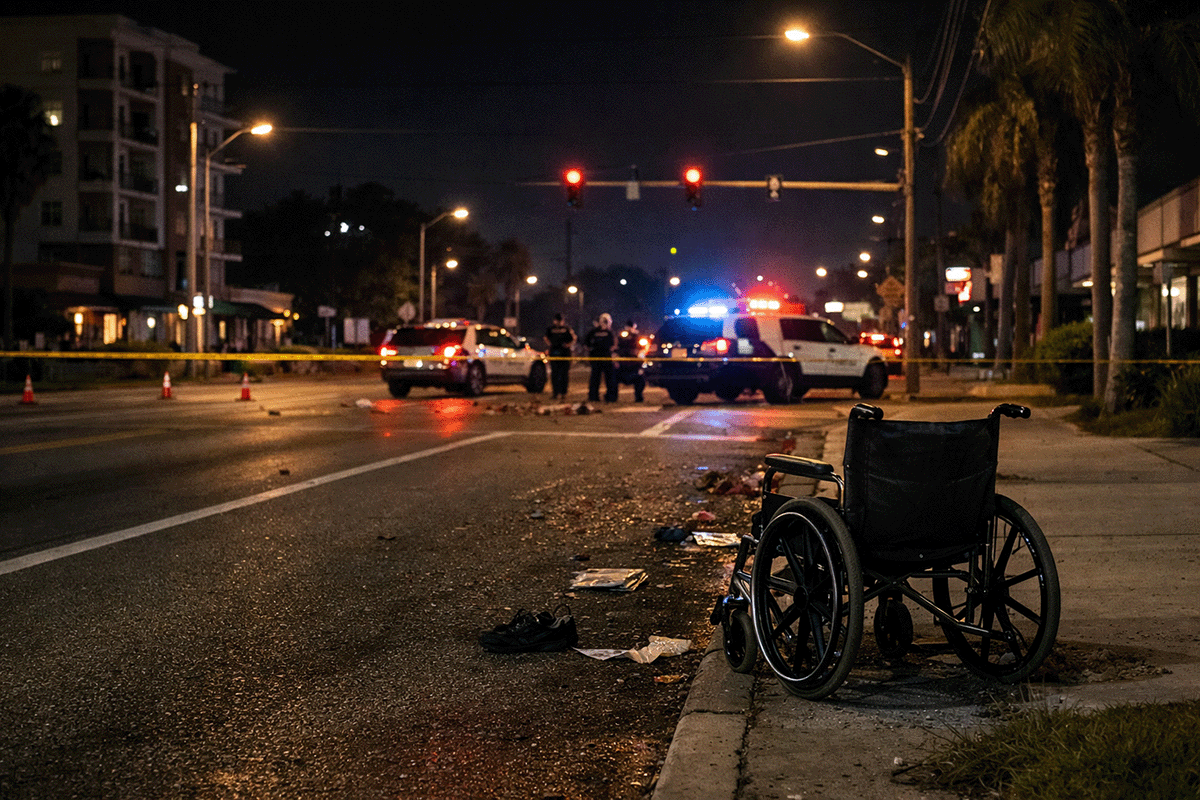
A late-night Tampa collision on North Florida Avenue highlights the dangers pedestrians face on poorly lit roads.
A tragic late-night pedestrian accident in Tampa is another reminder that serious roadway injuries are not always tied to speeding, DUI, or a hit-and-run. Sometimes, the danger comes from a mix of darkness, roadway design, visibility issues, and the simple fact that a person on foot is far more vulnerable than a person inside a vehicle.
According to the Tampa Police Department, the crash happened around 9:49 p.m. on March 29, 2026, near North Florida Avenue and East Ohio Avenue. Police say a man in his mid-60s was helping a woman in her early 50s by pushing her wheelchair across the street from east to west when they were struck by a 2005 Volvo traveling northbound. The man later died at the hospital, and the woman remained in critical condition. Tampa Police also said the pair were crossing in a poorly lit section of the roadway and outside of a designated crosswalk.
Police stated that the driver, a woman in her early 30s, remained at the scene and cooperated with investigators. At this stage, Tampa Police said speed was not a factor, there were no signs of driver impairment, no citations had been issued, and no criminal charges were currently expected.
Why this Tampa crash matters
This case matters because it highlights how deadly pedestrian crashes can be even when the facts do not point to intoxication or obvious reckless driving. A person walking, helping someone in a wheelchair, or crossing at night has very little protection in a collision. When lighting is poor and a crossing point is not clearly marked, the risk rises fast. That is exactly why pedestrian safety remains such an urgent issue in Tampa. The City of Tampa’s Vision Zero program states that even one deadly crash is too many and describes its goal as eliminating roadway deaths and life-altering injuries.
This story also fits a broader pattern. Hillsborough County traffic safety meeting minutes from June 2024 state that, through April 9, 2024, pedestrians had the highest number of fatal crashes among tracked fatal crash categories, and eight of the 12 new fatal crashes discussed at that meeting occurred at night.
A fatal crash outside a marked crosswalk does not automatically end the legal analysis
One of the most important points in a case like this is that being outside a designated crosswalk does not automatically answer every question about fault.
Florida law says that pedestrians crossing at a point other than within a marked crosswalk or an unmarked crosswalk at an intersection generally must yield the right-of-way to vehicles. But Florida also applies a modified comparative fault system in negligence cases, which means liability can still depend on the full facts, including roadway lighting, visibility, speed, driver attention, line of sight, and whether reasonable care was used by everyone involved. A party found to be greater than 50% at fault generally cannot recover damages in a negligence action.
That matters in serious pedestrian injury and wrongful death cases. Early headlines often focus on whether someone was in a crosswalk, but the real legal analysis is usually much more detailed than that.
Pedestrian crashes involving wheelchairs raise additional safety concerns
This incident is also a reminder that roadway safety affects more than just drivers. People using wheelchairs, walkers, or mobility devices often face added risks at night, especially on corridors where lighting is poor or pedestrian infrastructure is limited. A crossing that may already be dangerous for a fully mobile adult can be even more hazardous for someone moving slowly or relying on assistance.
That does not make this only a traffic story. It makes it a human story about visibility, accessibility, and whether the roadway environment was reasonably safe for vulnerable people trying to cross.
What families should do after a serious Tampa pedestrian crash
Get immediate medical care and preserve records
Medical treatment comes first. In catastrophic injury cases, records from EMS, the hospital, trauma providers, and follow-up care often become central evidence later.
Preserve photos, witness information, and scene details
In a fatal or critical pedestrian crash, roadway conditions can matter enormously. Poor lighting, sight lines, crosswalk placement, traffic flow, and surveillance footage may all become important.
Do not assume the initial police update is the final word
Early police statements are important, but they are not the same as a full civil case evaluation. Additional evidence can change how a crash is understood.
Be careful with insurance communications
Insurers may begin evaluating exposure quickly, even when no criminal charges are expected. That does not mean the claim has been fully or fairly valued.
Get legal guidance early in fatal and catastrophic injury cases
Wrongful death and severe pedestrian injury cases often involve complicated questions about fault, damages, future care, and available insurance coverage. Acting early can help preserve evidence and protect the family’s options.
What Tampa and St. Pete readers should take from this story
The key lesson is not just that a terrible crash happened. It is that serious injury and fatal crashes can happen in ordinary moments, on familiar streets, and under circumstances that are more complex than a simple criminal narrative.
According to Tampa Police, this crash happened at night, in a poorly lit area, outside a designated crosswalk, and without signs of speed or impairment by the driver. Those facts do not make the loss any less devastating. They show why pedestrian crash cases often require careful investigation instead of quick assumptions.
For families in Tampa and St. Petersburg, this is another reminder that roadway safety, visibility, and pedestrian infrastructure matter. So does knowing what to do when a crash leaves someone critically injured or takes a life.
FAQs
Does crossing outside a marked crosswalk automatically prevent a claim in Florida?
Not necessarily. Florida law does place duties on pedestrians crossing outside marked or unmarked crosswalks, but a civil claim can still depend on the full facts, including driver attention, lighting, visibility, roadway conditions, and comparative fault.
Can there still be a civil injury or wrongful death case if no criminal charges are expected?
Yes. A civil case and a criminal case are separate. Even when police do not expect criminal charges, families may still need to evaluate insurance coverage, negligence issues, damages, and whether a civil claim exists.
Why are nighttime pedestrian crashes so dangerous in Tampa?
Nighttime visibility is a major issue in pedestrian crashes. Hillsborough County traffic safety minutes in 2024 noted that pedestrians had the highest number of fatal crashes among tracked fatal crash categories and that many of the newly discussed fatal crashes occurred at night.
What should families do after a fatal pedestrian crash in Tampa?
They should preserve evidence, gather medical and scene records, avoid making assumptions based only on the first public report, and get legal guidance quickly so important evidence is not lost.
Contact an attorney today
If your family is dealing with a serious pedestrian crash, wrongful death case, or catastrophic car accident in Tampa or St. Petersburg, speak with an attorney as soon as possible. Armando Personal Injury Law helps families investigate serious injury and fatal crash cases, deal with insurance issues, and pursue accountability when a preventable collision changes lives.
Call (813) 482-0355 or visit armandoinjurylaw.com/contact/ to request a free consultation.