
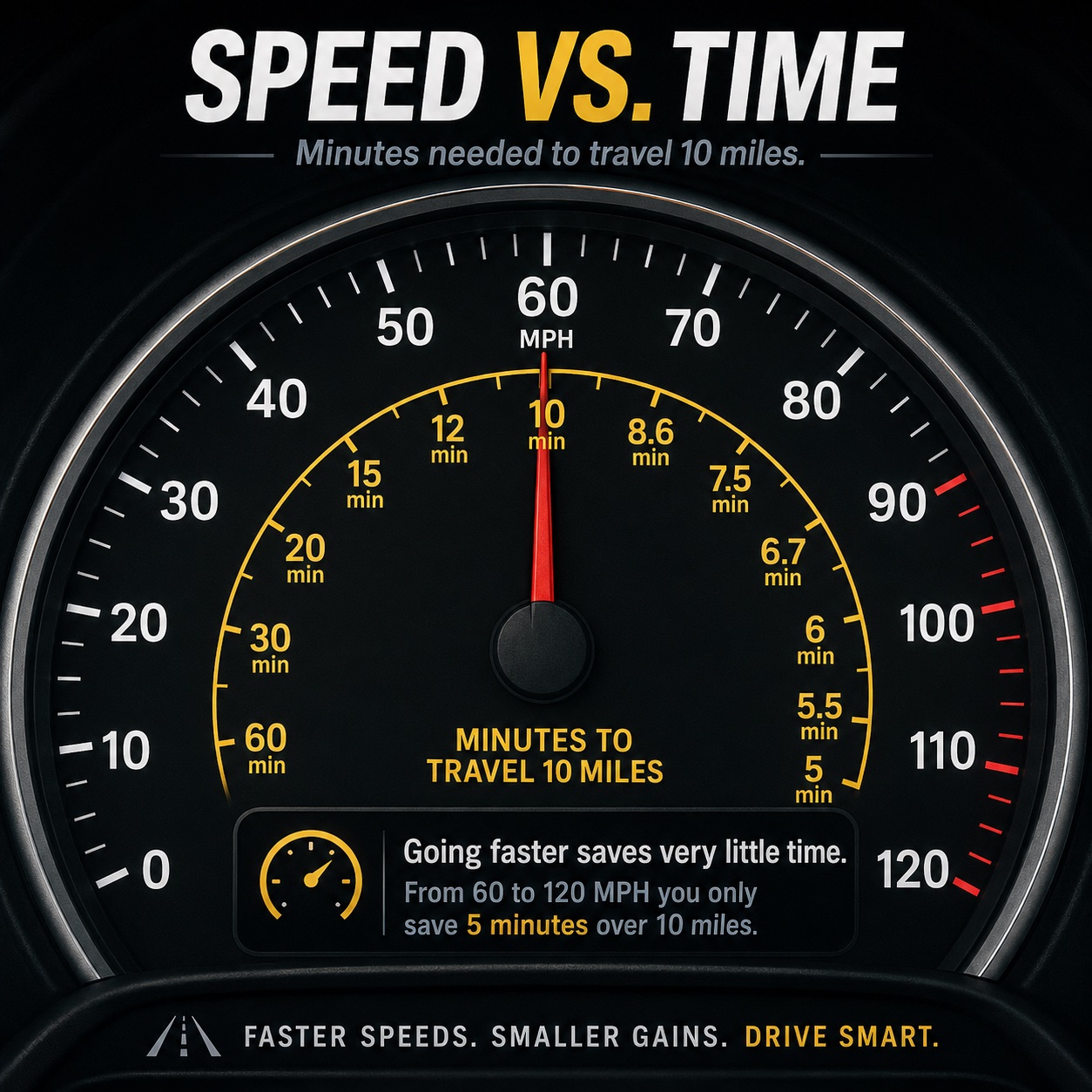
Higher speeds don’t save drivers many minutes, but they can leave less time to react when something goes wrong.
Ten miles an hour over the speed limit barely feels like speeding anymore.
Drive I-275 through Tampa for any length of time and you see it. Someone doing the actual speed limit can look like the slowest person on the road. Cars pass. Traffic bunches up. People speed up because everyone around them is moving faster.
After a while, 10 over starts to feel normal.
That is one of the more interesting points in a recent Tampa Bay 28 report about research from the AAA Foundation for Traffic Safety. Drivers know speeding can be dangerous. A lot of them just do not seem to think the speeds they drive every day really count.
The problem usually shows up when traffic does something unexpected.
Brake lights come on. Somebody pulls out of a driveway. A light changes. A car drifts into another lane. Someone steps into the road.
The faster vehicle has less room to fix it.
When that ends in a crash, speed can become an important part of determining what happened and who may be responsible in a Florida car accident claim.
Apparently, 10 MPH Over Does Not Feel Like Speeding to a Lot of People
The AAA Foundation for Traffic Safety study used focus groups along with a national survey of more than 16,000 licensed drivers.
Nobody needed a study to prove that people speed. Spend five minutes on almost any Florida highway and that part becomes obvious.
What AAA was trying to understand was how drivers think about it.
Ten miles per hour above the posted limit repeatedly showed up as a speed many drivers considered acceptable. Some people in the focus groups thought considerably higher speeds could still be reasonable depending on the road and the traffic around them.
Then there were the survey results.
About 49% of drivers said they believed traveling with the flow of traffic was safer than following the posted limit. The same percentage agreed that going a little over did not really count as speeding.
Three in ten drivers said speeding has simply become normal.
That sounds about right if you watch the way people actually drive.
The concern is what happens after a behavior becomes routine. People stop treating it like a decision. It is just how they drive.
Speeding Was Involved in More Than 11,000 Traffic Deaths in 2024
There is another side to that normalcy.
According to the National Highway Traffic Safety Administration, 11,288 people were killed in speeding-related crashes in 2024. Speeding was involved in roughly 29% of traffic deaths that year, and NHTSA estimates that more than 316,000 people were injured in speeding-related crashes.
That does not mean every person driving 5 or 10 miles per hour over the limit is about to cause a wreck.
It does show why speed matters once something goes wrong.
A driver going faster has less time to recognize a problem and usually needs more room to slow down. If there is not enough room, the vehicle reaches the point of impact carrying more speed.
That can matter in a rear-end accident, at an intersection, in a head-on crash or when a car strikes somebody walking or riding a bicycle.
Most drivers probably understand that.
What is strange is how easily we separate that fact from our own driving.
Drivers Said Avoiding a Ticket Was a Bigger Reason to Slow Down Than Avoiding a Crash
One part of the AAA research stood out for a different reason.
When drivers were asked what kept them from speeding, 79% identified avoiding a speeding ticket. Seventy-two percent said avoiding an accident.
Only half mentioned the danger speeding creates for other people.
That says something about how people tend to view speeding. For many drivers, it seems to live in the same mental category as rolling through a stop or parking somewhere you probably should not. It is a rule you might get caught breaking.
The risk is there, but it feels distant.
Most people also believe they are pretty good drivers. That confidence has a way of surviving right up until the moment another car does something they did not expect.
Florida Law Does Not Give Drivers a Free 10 MPH
Drivers talk about a 5 or 10 mph cushion as though it is written somewhere in Florida law.
It is not.
Florida Statute § 316.183 requires drivers to operate at a reasonable and prudent speed under the conditions.
The posted limit is part of that. So are the actual conditions on the road.
A driver may need to slow down because traffic is heavy, visibility is poor, pedestrians are nearby or an intersection is coming up. The statute also addresses reducing speed around curves, hills and other areas where conditions call for it.
So “everyone else was doing it” may describe what was happening.
It does not create an exception to the law.
That becomes important when lawyers and insurance companies start looking at fault after a Florida auto accident. The issue is not always whether the driver was technically above the posted limit. Sometimes the question is whether the speed made sense for the traffic and conditions at that moment.
Florida Now Has a Separate Law for Dangerous Excessive Speeding
Florida has also created tougher consequences for the far end of the speeding problem.
Under Florida Statute § 316.1922, dangerous excessive speeding can include driving 50 mph or more above the posted limit or traveling 100 mph or faster in a way that threatens people or property or interferes with another vehicle.
A first conviction can bring up to 30 days in jail, a fine of up to $500, or both.
Those cases are obviously different from someone driving 10 over on Dale Mabry.
Still, a crash does not require triple-digit speeds to become serious. A driver can run out of stopping distance at 50 mph just as easily as someone else can at 100 if traffic ahead stops and there is not enough room.
The circumstances decide it.
Figuring Out Speed After a Crash Is Not Always Simple
People usually want the crash report to answer everything.
Sometimes it does not.
A ticket tells you what the investigating officer decided based on the information available at the scene. It does not necessarily tell you exactly how fast each vehicle was moving several seconds before the collision.
That can matter.
Suppose one driver pulled into an intersection when they should not have. On the surface, fault may look obvious. But if the approaching vehicle was traveling well above the speed limit, that speed may have affected whether the crash could have been avoided or how severe the impact became.
A speeding case can end up depending on evidence most people never think about in the first few hours after a wreck.
Depending on what happened, that may include vehicle event data, dashcam footage, nearby surveillance cameras, witness statements, tire marks, photographs, damage patterns and electronic information from the vehicles. Serious crashes may require accident reconstruction.
The official report still matters, and our guide to Florida car accident reports explains what may be included in it.
The problem is that some of the other evidence does not stick around.
A convenience store camera may record the crash and overwrite the footage a week later. A wrecked vehicle may be moved to a salvage yard. People who saw what happened go back to work and get harder to find.
By the time someone realizes a piece of evidence matters, it may already be gone.
Tampa Traffic Can Go From Moving to Stopped Fast
Tampa is a pretty good place to understand why ordinary speeding matters.
I-275 can move quickly for miles and then stack up with little warning. Anyone who drives I-4 regularly already knows what that road can be like. Dale Mabry Highway, Fowler Avenue and Hillsborough Avenue mix higher traffic volumes with intersections, businesses, buses, turning vehicles and people crossing the road.
There is not much room for inattention when several things happen at the same time.
Add speed and the room gets smaller.
In a serious crash, a Tampa car accident lawyer may need to look at what the cars were doing before the actual impact. How fast was the approaching vehicle? When did the driver brake? Was there enough distance to stop? Would a slower speed have given the driver time to avoid the crash?
Those questions come up often in Tampa intersection accidents. Sometimes one driver clearly makes the first mistake, but the speed of another vehicle determines whether that mistake turns into a close call or a major collision.
Speeding in St. Petersburg and Pinellas County Can Look Different
Pinellas County has a different traffic layout.
Drivers can come off I-275 or US-19 and fairly quickly find themselves on local roads with traffic lights, cyclists, pedestrians, driveways and cars turning across several lanes. Gandy Boulevard, 4th Street and Central Avenue each have their own mix of traffic and surrounding development.
A driver who was comfortable traveling fast a few blocks earlier may suddenly be in a place where that speed no longer makes much sense.
That is one reason speed becomes relevant in a St. Petersburg car accident case.
In some crashes, it helps explain why the wreck happened. In others, the bigger issue is why the driver could not avoid it.
Speed can also affect the force involved in serious St. Petersburg head-on crashes and T-bone accidents, where vehicle occupants may have limited protection from the direction of the impact.
Fault Is Not Always as Clean as People Expect
One driver can be speeding while another driver makes a bad turn.
Both can matter.
Someone might change lanes without enough room while the other vehicle is coming up much faster than expected. A driver may pull into an intersection too early, but the approaching driver may also be traveling too fast to stop.
Real crashes often have more than one bad decision in them.
Florida’s comparative-fault law is designed to deal with those situations.
Under Florida Statute § 768.81, damages in many negligence claims can be reduced based on the injured person’s percentage of fault.
A person found more than 50% responsible for his or her own harm generally cannot recover damages in negligence cases covered by the statute.
That gives insurers plenty of reason to argue over the details.
If they can shift part of the blame, they may be able to reduce what they have to pay. In a serious injury case, a 10% or 20% difference in fault is not an abstract number.
When a Speeding Crash Kills Someone
Some crashes do not end with months of treatment and a return to normal life.
A person dies, and the questions about what happened are now being asked by a family that was not there when it happened.
A fatal speeding crash may lead to a claim under Florida’s Wrongful Death Act. It can also make the investigation itself more important because the person who was hit cannot give their version of what happened.
Families can read more about fatal Tampa car accident claims and Florida wrongful death cases.
Florida Statute § 768.21 addresses the damages that may be available in a wrongful death case.
What can be recovered depends on who survived the person who died and the circumstances of the case. Damages may include lost support and services, certain medical and funeral expenses and qualifying losses involving companionship or parental guidance. The estate may have separate damages as well.
In a fatal crash, details such as vehicle speed, braking and the sequence of events before impact can end up carrying even more weight.
The Insurance Company Will Look at Speed Too
Once an insurance claim starts, the questions tend to spread quickly.
How serious are the injuries? Can the person return to work? Will more treatment be needed? How much insurance coverage is available? Was anybody else partly responsible?
Speed can become part of those arguments.
An insurer may accept that its driver was involved in the crash but dispute how much of the fault belongs to that driver. It may argue that another vehicle pulled out unexpectedly, changed lanes or otherwise contributed to what happened.
Our Florida car accident compensation guide explains the types of damages that may be available after a serious collision.
We also have a separate guide to the Florida car accident insurance claims process for people trying to understand what happens once adjusters and insurance carriers get involved.
There is rarely one fact that decides everything.
Speed is just one of the facts that can matter a lot.
Drivers Have Basically Created Their Own Speed Limits
That may be the clearest takeaway from the AAA study.
There is the number on the sign, and then there is the number drivers seem to have agreed among themselves is acceptable.
Five over barely counts. Ten over is keeping up with traffic. Go too slowly and somebody is riding your bumper.
Those unwritten rules are familiar because people use them every day.
The crash data does not disappear because we have gotten comfortable with them.
More than 11,000 people were killed in speeding-related crashes in 2024.
Most drives still end without anything happening. That is probably why speeding is so easy to normalize.
But when traffic stops suddenly or somebody makes a mistake, the driver does not get those few seconds back.
Frequently Asked Questions About Speeding Accidents in Florida
Is it legal to drive 10 mph over the speed limit in Florida?
Florida does not have a general rule allowing drivers to go 5 or 10 mph above the posted limit. Florida Statute § 316.183 requires drivers to follow applicable speed limits and drive at a reasonable speed for the conditions.
Does speeding automatically make a driver responsible for a crash?
No. Speeding can be important evidence, but fault depends on what actually happened. Right-of-way, traffic lights, braking, lane changes, distraction and the conduct of the other drivers may all be relevant.
What if both drivers made mistakes?
Florida law allows fault to be divided in many negligence cases. An injured person’s recovery may be reduced based on his or her percentage of responsibility. The more-than-50% threshold can also become important under Florida’s modified comparative-fault law.
How can anyone prove how fast another vehicle was going?
There may be several sources of evidence. Depending on the crash, lawyers and investigators can look at vehicle data, video, witnesses, damage patterns, roadway evidence and accident reconstruction.
Can a family bring a wrongful death claim when speeding causes a fatal crash?
Potentially. If negligent driving causes a death, Florida’s Wrongful Death Act may allow a civil claim. The damages depend on the survivors, the estate and the circumstances of the crash.
Serious or Fatal Speeding Accidents in Florida
A speeding case often comes down to evidence that goes beyond the traffic citation. Video, vehicle data, witnesses, crash-scene evidence and available insurance coverage can all become important.
Armando Personal Injury Law handles serious and fatal car accident cases throughout Florida, including Tampa, St. Petersburg, Hillsborough County and Pinellas County.
If you were seriously injured or lost a family member in a Florida motor vehicle crash, contact Armando Personal Injury Law at (813) 482-0355 for a free case evaluation.
There is no attorney fee unless we obtain a recovery for you.

About the Author
Attorney Armando Edmiston is the founder of Armando Personal Injury Law in Tampa and St. Pete, Florida. A U.S. Marine veteran, Hillsborough County native, and ACS Forensic Lawyer-Scientist, he represents Floridians in serious personal injury and wrongful death cases.