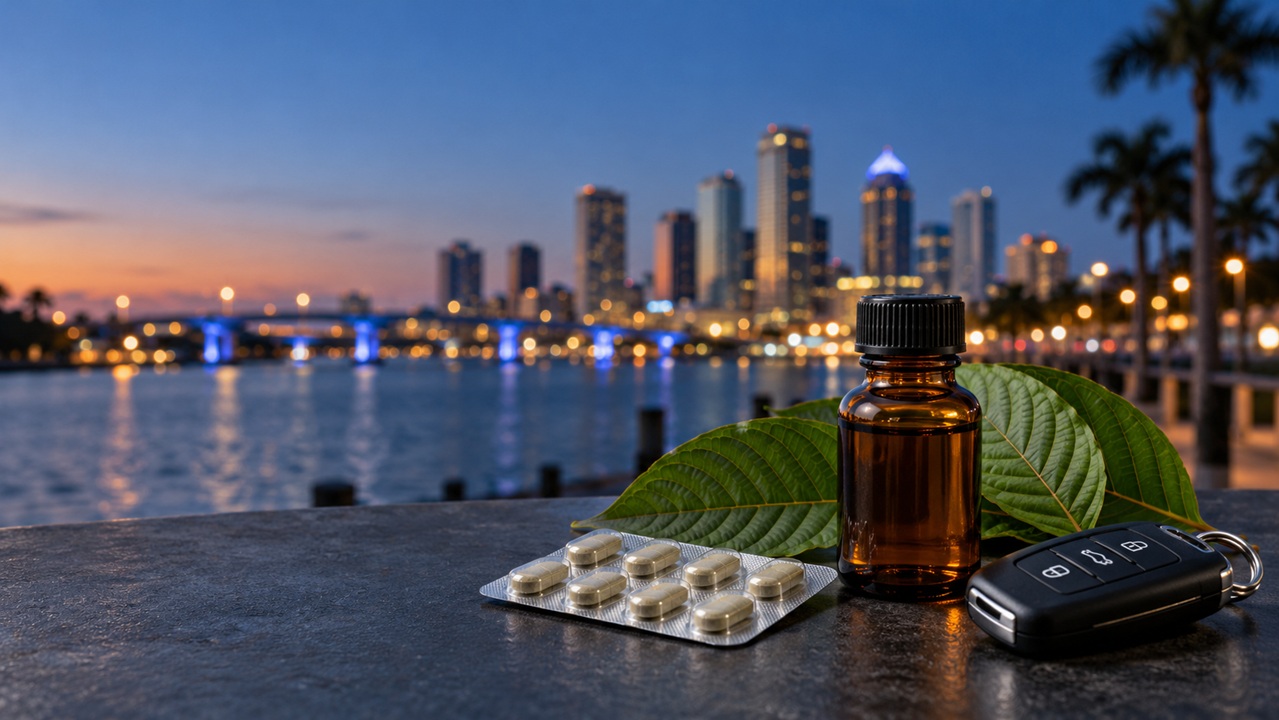
A fatal crash near Tampa’s Marion Transit Center has raised questions about kratom extracts and driving impairment.
A fatal crash near Tampa’s Marion Transit Center has drawn attention to a danger consumers may underestimate: kratom extracts can cause drowsiness and dizziness, with potentially serious consequences behind the wheel.
The concern goes beyond driving. Concentrated kratom extracts and products containing enhanced levels of 7-hydroxymitragynine, known as 7-OH, can expose users to powerful substances in small bottles or tablets. Packaging that looks familiar may give consumers little sense of the product’s strength.
For families dealing with a serious injury or death, understanding what someone took, what warnings they received, and how the product affected them can be central to investigating a kratom or 7-OH wrongful death claim.
What Happened in the Tampa Case?
The Tampa Bay Times reported on October 7, 2026, that Robert Joseph Best faced a vehicular homicide charge following a March 19 crash near the Marion Transit Center. Authorities alleged that Best drove onto a raised median and struck two people. One of them, 44-year-old Jessica Barr, later died.
According to the report, investigators found a package labeled “Heat Full Spectrum Kratom Extract” inside the vehicle. Prosecutors alleged that Best was impaired and cited chatbot searches about kratom’s strength and effects. The report also described alcohol in his system. These accounts reflect allegations in the criminal case, not a finding of guilt. Read the syndicated Tampa Bay Times report.
The article identified a kratom extract. It did not establish that the product contained enhanced levels of 7-OH. Any discussion of this case should preserve that distinction rather than assume all products sold under the kratom name are the same.
A Small Package Can Contain a Concentrated Product
Kratom comes from the plant Mitragyna speciosa. Its main active compound is mitragynine. Traditional leaf preparations contain a mixture of plant compounds, while extracts concentrate those compounds into smaller amounts of liquid, powder, or tablet material.
Some products go further by adding or increasing 7-OH. The FDA distinguishes these products from the trace amounts of 7-OH naturally present in kratom and advises consumers to avoid products containing added or enhanced levels. FDA guidance on 7-OH products.
That leaves consumers facing a difficult comparison. Two tablets may look similar but contain very different ingredients or concentrations. A small shot bottle may hold several suggested servings.
Labels may not always resolve that uncertainty. The American College of Medical Toxicology reports that testing of some commercial 7-OH products found amounts above those listed on the packaging. When a serious injury or death occurs, testing the actual product may help establish what the person consumed. ACMT position statement.
How Kratom Can Affect Someone Behind the Wheel
The University of Florida identifies drowsiness and dizziness among kratom’s reported adverse effects. How a person responds can vary with the preparation and amount consumed. University of Florida kratom resources.
Those effects matter on the road. A driver needs to remain alert, follow traffic signals, notice pedestrians, and respond when something changes. Feeling sleepy or dizzy can interfere with those demands.
Alcohol and other substances add another concern. The National Highway Traffic Safety Administration warns that combining substances can amplify impairment and that drugs can affect coordination, judgment, and reaction time. This is general guidance about drug-impaired driving, not proof of what caused a particular crash. NHTSA guidance on drug-impaired driving.
Consumers should not assume a product is safe to take before driving because it is marketed as natural or sold in a store. A chatbot’s dosing suggestion cannot establish that someone is fit to drive, either.
With Concentrated 7-OH, the Risks Extend Beyond Impairment
Concentrated 7-OH products raise concerns about breathing, seizures, and dependence as well as sedation.
In June 2026, the Florida Department of Health warned that these products act on the same receptors as opioids and have been associated with respiratory depression, seizures, and addiction. Respiratory depression means breathing becomes dangerously slow or inadequate. Florida Department of Health warning.
America’s Poison Centers has also reported serious health effects involving kratom and its derivatives, with greater concerns when multiple substances are involved. America’s Poison Centers health advisory.
For a grieving family, these warnings may help explain why an investigation is warranted. Determining the cause of an individual death still requires a careful review of the medical evidence. Toxicology results, other substances, underlying health conditions, and the product itself all matter. Finding a compound in someone’s system does not, by itself, explain its role in the death.
Consumers Need Clear Warnings and Understandable Serving Instructions
In our responses to WFLA reporters, we raised a practical concern: a product can look like one serving even when its label directs the customer to take only a fraction.
Consider a chewable tablet. If the suggested serving is a small portion of that tablet, how clearly does the packaging explain that? Can a customer easily identify the amount of each active ingredient? Are warnings about driving, sedation, and interactions prominent and understandable?
These are questions worth examining after a serious adverse event. The investigation should also consider whether advertising or statements made during the sale downplayed the risks.
Even clear serving instructions have limits. A manufacturer’s suggested amount is not a medically established safe dose. The FDA has not approved kratom or 7-OH products to treat any medical condition. FDA information on kratom and 7-OH products.
When a Death May Support a Product Liability Claim
After a death involving a kratom extract or 7-OH product, an attorney may examine the conduct of the manufacturer, distributor, and retailer. The central questions include whether the product was defective, whether its warnings were adequate, and whether a defect or failure to warn contributed to the death.
Under Florida’s failure-to-warn framework, a product may be defective when reasonable instructions or warnings could have reduced foreseeable harm and their absence made the product unreasonably dangerous. A claim also requires evidence connecting that failure to the injury or death. Florida Supreme Court product liability instructions.
A death following product use does not automatically establish liability. Nor does a criminal charge against a driver establish that a product manufacturer caused a crash. Each potential claim needs its own factual and legal foundation.
When Florida’s wrongful death requirements are met, the deceased person’s personal representative brings the action for the benefit of eligible survivors and the estate. Florida Statutes §§ 768.19 and 768.20.
What Families Can Do to Preserve Evidence
Families are often left with unanswered questions and little information about the product their loved one used. You do not need to know its exact chemical composition before speaking with an attorney.
If available, keep:
- The original packaging and any remaining product.
- Receipts, online orders, and purchase confirmations.
- Photographs showing labels, ingredients, and lot numbers.
- Advertisements and communications with the seller.
- Medical records, toxicology reports, and medical examiner findings.
Do not consume or alter the remaining product. An attorney can help arrange its preservation and testing.
At Armando Personal Injury Law, we help families examine whether a kratom extract or 7-OH product may have contributed to a loved one’s death. Our kratom and 7-OH wrongful death page explains the product, warning, and medical evidence these investigations can involve.
If you have concerns about a loved one’s death after using one of these products, call (813) 482-0355 or request a free, confidential case review. We can discuss what you know, what remains unanswered, and whether there is a basis to investigate further.
About the Author
Attorney Armando Edmiston is the founder of Armando Personal Injury Law in Tampa and St. Pete, Florida. A U.S. Marine veteran, Hillsborough County native, and ACS Forensic Lawyer-Scientist, he represents Floridians in serious personal injury and wrongful death cases.