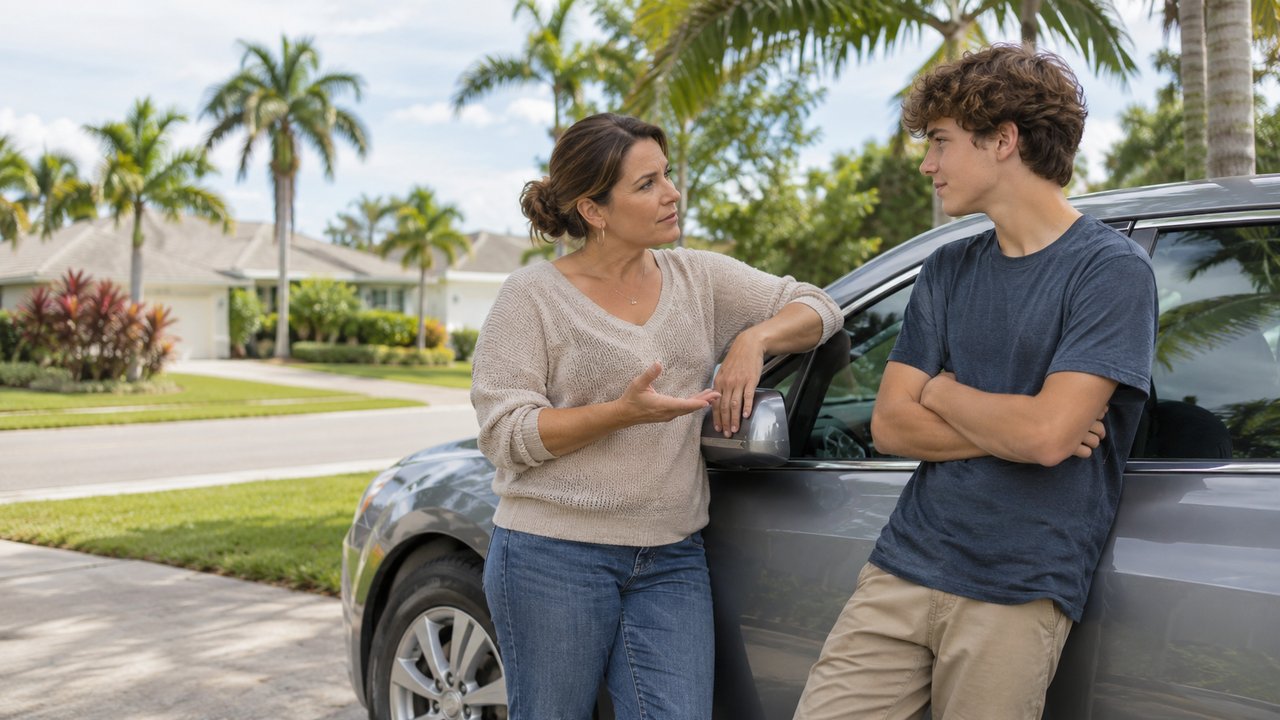
A parent's signature on a teen's license application or ownership of the family car can shape who is responsible after a Florida crash.
Florida parents are not liable for a teen driver’s crash simply because they are the parents. Liability may arise from signing a minor’s license application, owning a vehicle entrusted to the driver, or negligently allowing an unsafe driver to use it. Under Florida Statutes § 322.09, the license-signing rule generally concerns drivers under 18 whose negligence or willful misconduct occurs while driving on a highway, subject to statutory exceptions.
If a teen driver injured you, identifying the license signer, vehicle owner, and applicable insurance policies can help determine whom your claim may involve. A Florida car accident lawyer can review those records alongside the evidence of fault and your injuries.
Common Florida Teen Driver Liability Scenarios
These examples compare potential claims after a Florida crash. Liability depends on proof of the required facts and resulting damages. Insurance coverage is a separate question.
| Scenario | Potentially liable people | What determines liability |
|---|---|---|
| A 17-year-old causes a crash in a borrowed car. | Teen driver and the adult who signed the permit or license application. | For highway driving, § 322.09 can impose signer liability for the minor’s negligence or willful misconduct, subject to statutory exceptions. The signer need not own the car. |
| One parent signed the application; the other owns and lends the car. | Teen driver and potentially both parents. | Each parent needs a separate basis: license-signing liability or owner liability. Certain individual-owner limits may apply. Parenthood alone is insufficient. |
| An 18- or 19-year-old causes a crash in a parent’s car. | Driver and potentially the parent as vehicle owner. | The under-18 signing rule does not apply when the driver is 18 or older at the time of the crash. Vehicle ownership or the parent’s own negligence may still support a claim. |
| An adult supplies a vehicle despite a known risk that the teen will drive unsafely. | Teen driver and potentially the adult who supplied the vehicle. | Negligent entrustment requires evidence that the adult knew or should have known of the danger and that the entrustment contributed to the injury. |
| A teen breaks household driving rules after receiving the car. | Driver and potentially the vehicle owner. | Breaking restrictions does not necessarily end consent for owner liability. An actual taking amounting to conversion or theft requires separate analysis. |
| A parent did not sign, has no qualifying vehicle interest, and committed no independent negligence. | No liability based solely on being the parent. | A claim against that parent requires another recognized legal basis supported by facts. Family relationship alone does not establish liability. |
How Signing a License Application Can Create Liability
Under Florida Statutes § 322.09, negligence or willful misconduct by a driver under 18 while operating a motor vehicle on a highway is attributed to the person who signed the minor’s permit or license application. The signer is jointly and severally liable with the minor for resulting damages. The adult can therefore face a claim without having caused the crash personally, ridden in the car, or owned it.
The law focuses on who signed the application. It does not automatically make both parents liable. A separate basis must support a claim against each person.
Section 322.09 exempts minors emancipated by marriage and provides limited signing exceptions for specified caregivers and other authorized people in out-of-home-care arrangements, as well as qualifying foster-care caseworkers. Those exceptions depend on the signer’s role and the application involved.
What Changes When the Driver Turns 18
The license-signing provision applies to drivers under 18. For a new crash involving an 18- or 19-year-old driver, a claim against a parent must rest on another basis, such as vehicle ownership or the parent’s own negligence.
When Vehicle Ownership Can Create Liability
Florida’s dangerous instrumentality doctrine can hold a vehicle owner responsible for another person’s negligent driving when the owner permitted the vehicle’s use. An owner may face liability regardless of who signed the teenager’s license application. Certain other legally recognized property interests in the vehicle can also matter.
In Emerson v. Lambert, the Florida Supreme Court rejected additional vicarious liability against a nonowner mother where the father owned the family car, was already vicariously liable, and had permitted their son to drive it. The driver was 21, so the case illustrates ownership liability rather than the under-18 license-signing rule.
If one adult owns the car and another signed the minor’s application, both relationships need to be examined. Family membership or giving permission alone does not establish every element of a claim against a nonowner.
What If the Teen Took the Car Without Permission
Lack of permission requires a closer look at how the teenager obtained the car. Once an owner voluntarily entrusts a vehicle, violating restrictions on its use does not necessarily end owner liability. In Chandler v. GEICO Indemnity Co., the Florida Supreme Court distinguished such restrictions from a loss of custody amounting to conversion or theft.
Preserve messages, evidence of prior authorized use, and information about access to the keys. Initial consent, a later violation of household rules, and an actual unauthorized taking may present different legal questions. Any separate claim against the license signer also needs its own analysis.
When Negligent Entrustment Can Make an Adult Liable
A negligent entrustment claim may arise when someone supplies a vehicle to a person they know, or have reason to know, is likely to use it dangerously because of youth, inexperience, or unfitness. The claim concerns the supplier’s own conduct and its connection to the injury.
In Fina v. Hennarichs, a case involving an ATV, a Florida appellate court addressed entrustment, training, and supervision claims involving a young operator. The court upheld liability based on the evidence, including disregarded age warnings. The decision does not make every parent of a teenage driver negligent.
What the adult knew, what happened before the crash, and how the decision contributed to the injury all matter. A teenager’s age alone does not resolve those questions.
What to Investigate If a Teen Driver Injured You
The driver’s age and insurance card may leave important questions unanswered. An injury investigation should connect each potential claim to specific evidence:
- How did the crash happen? Photographs, witnesses, video, and available electronic evidence can help establish fault. Preserve what is available promptly because recordings and other evidence may not remain accessible.
- Who owned the car? Title and registration records help identify ownership. Messages, prior vehicle use, and witness accounts may help establish permission or entrustment.
- Who signed the license application? For a driver under 18, the permit or license application may identify a potentially responsible adult who does not appear on the vehicle title.
- Which policies could apply? Review automobile policies, declarations, endorsements, and any applicable excess or umbrella coverage. The driver, owner, and license signer may be different people.
- How has the injury affected your life? Medical records, lost earnings, future treatment needs, and lasting limitations help document the loss.
The Florida crash report is a useful starting point. It may not identify the license signer or every applicable policy, and the investigation must establish the facts supporting liability and damages.
How to Request Insurance Information
Florida Statutes § 627.4137 requires a liability insurer that does or may provide coverage to respond within 30 days to a claimant’s written request for specified information. The sworn disclosure must identify the insurer and insureds, liability limits, known coverage defenses, and provide a policy copy for each known policy, including excess or umbrella insurance.
The statute also requires the insured or insurance agent, upon the required written request, to identify known insurers and forward the request to affected insurers. This process helps investigate available coverage. The 30-day requirement concerns disclosure, not a deadline to settle the injury claim.
How Much an Individual Vehicle Owner May Owe
Florida Statutes § 324.021(9)(b)3 limits certain claims against an individual owner who lends a motor vehicle to a permissive driver. These limits concern that owner’s vicarious liability and are subject to the statute’s conditions and exceptions.
| Type of damage | Base statutory limit |
|---|---|
| Bodily injury to one person | $100,000 |
| Bodily injury in one incident | $300,000 |
| Property damage | $50,000 |
The law also provides for up to an additional $500,000 in economic damages when the permissive driver is uninsured or has less than $500,000 in combined property-damage and bodily-injury liability coverage. That additional amount is reduced by sums actually recovered from the driver and insurance or self-insurance covering that driver.
The statute preserves liability based on the owner’s own negligence and contains other exceptions, including certain commercial uses. These figures are not a blanket cap on every claim against a parent. Section 322.09 states no dollar cap of its own, so a license-signer claim requires separate analysis.
Will Insurance Cover a Crash Caused by a Teen Driver
Whether the family’s insurance covers the crash depends on the policy, the driver’s status, the vehicle involved, and any applicable exclusions. An adult can be legally responsible for damages the policy does not fully cover.
For an injured person investigating compensation, the coverage review should answer these questions:
- Was the teenager covered while driving the vehicle involved?
- What bodily injury liability limits apply?
- Does the policy exclude any drivers or restrict their coverage?
- Does an excess or umbrella policy cover the driver and vehicle?
- Were any required underlying insurance limits in place?
Unlisted and Excluded Drivers Are Different
An insurer may question coverage because a teenager was not listed on the policy. That fact alone does not answer every coverage question.
Florida Statutes § 627.747 permits specified driver exclusions when its requirements are met, including identifying the excluded individual on the declarations page or by endorsement and obtaining the named insured’s written consent. The statute limits which exclusions are permitted, and their effect depends on the coverage and circumstances.
Information supplied when the policy was purchased can also matter. Under Florida Statutes § 627.409, certain material misrepresentations or omissions in an application can affect recovery. If coverage is denied, obtain the policy, application, endorsements, and written denial so the insurer’s position can be evaluated.
When Injury Damages Exceed the Policy Limit
Suppose a crash causes $250,000 in legally recoverable injury damages, but only $100,000 in bodily injury liability coverage applies. If the insurer pays its full limit, $150,000 remains uncovered.
Whether a parent owes any of that balance depends on the legal basis for the claim, available defenses, applicable liability limits, other coverage, and any settlement. A policy limit does not automatically set the maximum amount a person can owe.
Collecting an unpaid judgment is a separate issue. Asset exemptions and collection rules may affect recovery, so an uncovered loss should not be assumed to be collectible.
How Your Own Insurance May Help After the Crash
PIP and the Deadline for Initial Treatment
Under Florida’s PIP statute, qualifying initial medical care must occur within 14 days of the crash for medical PIP benefits. Separate requirements, including whether an emergency medical condition is established, affect the availability of $2,500 versus up to $10,000 in medical benefits.
Missing the treatment deadline does not simply leave you with $2,500 in coverage. PIP eligibility is also separate from a liability claim against the people responsible for the crash.
Uninsured and Underinsured Motorist Coverage
If the at-fault driver has no applicable liability insurance or insufficient coverage, an injured person may have a claim under applicable uninsured or underinsured motorist coverage. Eligibility depends on the policy and Florida Statutes § 627.727.
This coverage protects qualifying insured people injured by uninsured or underinsured motorists. It does not pay liability claims for injuries their teenager causes to someone else. Underinsurance means available coverage is insufficient, not necessarily that no coverage exists.
Before accepting a liability settlement and signing a release, have any potential UM/UIM claim reviewed. Section 627.727(6) provides a notice and response process for certain settlements involving an underinsured motorist claim.
Filing Deadlines and Shared Fault in Florida
The Deadline for a Negligence Lawsuit
Florida generally provides two years to file a negligence lawsuit under § 95.11. The 2023 law changing the deadline applies the shorter period to causes of action accruing after March 24, 2023. Earlier claims may fall under the prior four-year period. Claim type and applicable exceptions can affect the deadline.
Do not wait to investigate because the other driver is a minor. Identifying the proper parties and preserving evidence can take time. The 14-day PIP treatment requirement and the 30-day insurance-disclosure requirement serve different purposes from the lawsuit filing deadline.
How Shared Fault Can Affect Compensation
Under Florida Statutes § 768.81, an injured person’s share of fault reduces compensation in covered negligence actions. A person found more than 50% responsible for their own harm cannot recover damages under that rule. Being exactly 50% at fault does not trigger the bar, although damages are reduced proportionately.
For older cases, the 2023 law also makes the filing date relevant to the comparative-fault rules. The negligence filing deadline uses a different transition based on when the legal claim arose.
Steps Parents and Guardians Can Take
Parents should identify who signed the license application, who owns each vehicle the teenager drives, and what the insurance policies cover. Tell the insurer or agent in writing about the teenager’s permit or license and vehicle use. Ask when the teenager must be added and request written confirmation of coverage.
Review bodily injury limits and any umbrella policy, including its underlying coverage requirements. Respond to unsafe driving and control access to the vehicle when necessary. If a crash has occurred, promptly notify the insurer and forward demand letters or lawsuit papers. Parents facing a claim should consult their insurer and appropriate defense or insurance coverage counsel about their own interests.
How to Withdraw Consent for a Minor to Drive
Florida Statutes § 322.10 allows the person who signed the application to submit a verified written cancellation request to the Florida Department of Highway Safety and Motor Vehicles (FLHSMV). The statute directs the department to cancel the license and relieves the signer of liability under Chapter 322 for subsequent negligence or willful misconduct.
Taking away the keys or grounding the teenager does not complete this process. Confirm the cancellation and its effective date with FLHSMV. Cancellation does not erase responsibility for a crash that already happened, and separate ownership or direct-negligence claims may remain.
Frequently Asked Questions About Florida Teen Driver Liability
Can I sue both parents if only one signed the license application?
Possibly. In Florida, § 322.09 can make the signer liable for a driver under 18 whose negligence or willful misconduct occurs on a highway, subject to statutory exceptions. A claim against the other parent needs a separate basis, such as vehicle ownership or that parent’s own negligence. Parenthood alone is insufficient.
Can a parent be liable when a teen drives a friend’s car?
Yes, in some circumstances. Under Florida Statutes § 322.09, the adult who signed a minor’s permit or license application can be liable for the under-18 driver’s negligence or willful misconduct while driving on a highway, subject to statutory exceptions. The signer does not have to own the borrowed car. Liability of the car’s owner requires separate analysis.
Does the teen’s own insurance prevent a claim against a parent?
No. In Florida, insurance coverage and legal responsibility are different questions. A teen’s separate policy does not by itself eliminate a valid license-signer, owner, or negligent entrustment claim. Which insurer may pay depends on the insured people, covered vehicle, policy limits, and applicable exclusions, including any valid named-driver exclusion.
What if the teen turns 18 after the crash?
Turning 18 after a Florida crash does not by itself erase liability that arose when it occurred. For the § 322.09 license-signing rule, the relevant age is the driver’s age when the negligence or willful misconduct occurred while driving on a highway. A crash at age 18 or older requires another basis for holding a parent liable.
Does Florida’s license-signing rule cover learner’s permits?
Yes. Florida Statutes § 322.09(2) expressly covers a minor’s permit or license application. For a driver under 18, negligence or willful misconduct while operating a motor vehicle on a highway can be attributed to the signer, subject to the statute’s exceptions. The permit does not make both parents automatically liable.
How can I find insurance that may cover a teen driver’s crash?
A written request under Florida Statutes § 627.4137 requires an insurer that does or may provide liability coverage to disclose specified information within 30 days, including known excess or umbrella policies. The insured or agent must also identify known insurers and forward the request as required. Disclosure identifies potential coverage; it does not guarantee payment or settlement within 30 days.
Get Help After a Crash Caused by a Teen Driver
Armando Personal Injury Law represents injured people in Tampa Bay and across Florida. If a teen driver injured you, contact the firm for a free consultation about the crash, your injuries, and the people or insurance policies your claim may involve.
Bring the crash report, available photographs, insurance correspondence, and medical records you already have. You do not need to identify every potentially responsible party before reaching out. Call (813) 482-0355 to discuss what happened.
About the Author
Attorney Armando Edmiston is the founder of Armando Personal Injury Law in Tampa and St. Pete, Florida. A U.S. Marine veteran, Hillsborough County native, and ACS Forensic Lawyer-Scientist, he represents Floridians in serious personal injury and wrongful death cases.