
Is a Personal Injury Settlement Marital Property in Florida?
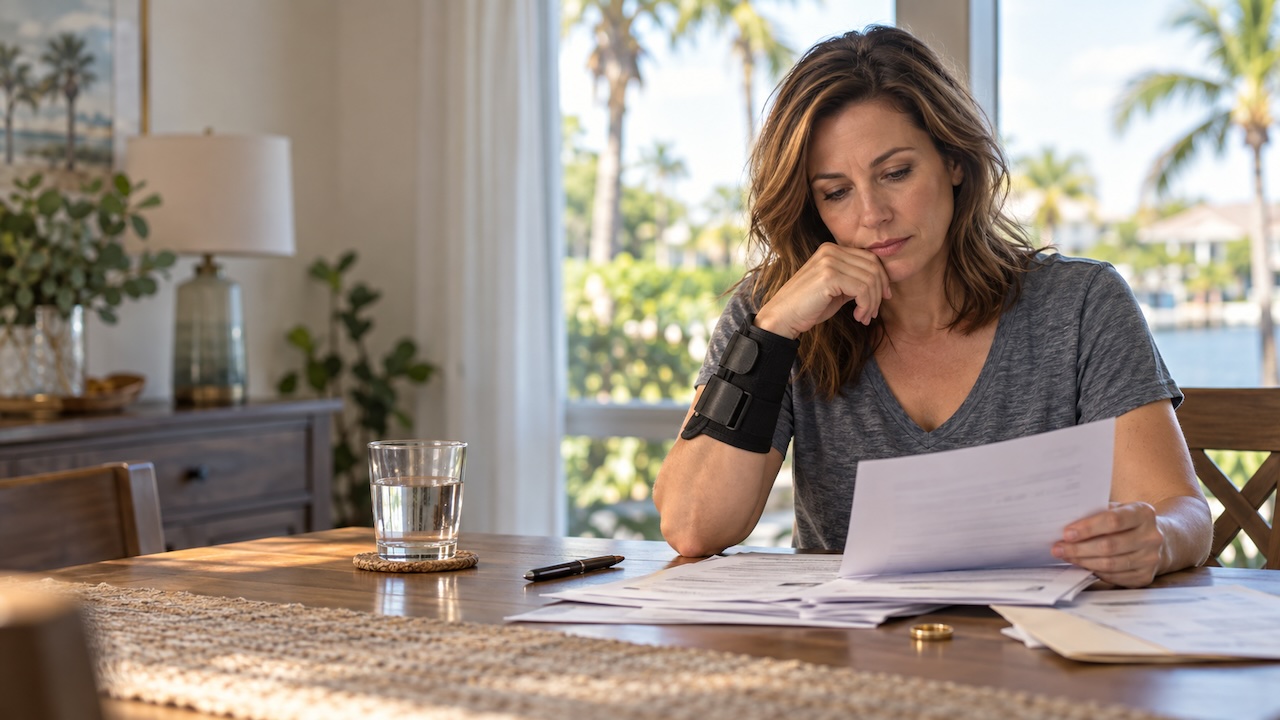
A Florida personal injury settlement may include both marital and nonmarital funds, making it important to understand what each part of the recovery compensates for during a divorce.
Part of a Florida personal injury settlement may belong to the marriage. Part may belong to the injured spouse alone. Money for pain and suffering is generally nonmarital. Money replacing wages lost during the marriage, or medical bills paid with marital funds, is generally marital. A court needs evidence showing what each part of the payment covers.
That can be hard to hear when you’re still dealing with the injury. You may need another surgery. You may not be able to return to the work you did before. The settlement has to stretch. If you’re also getting divorced, find out how the money may be treated before you count on keeping all of it.
These Florida rules apply whether you live in Tampa and Hillsborough County or St Petersburg and Pinellas County. At Armando Personal Injury Law, we handle personal injury claims across Florida. Your divorce lawyer handles the property and support questions. If the two cases overlap, both lawyers need to know.
Which parts of an injury settlement may be marital property?
Florida courts look at what the money pays for. In Weisfeld v Weisfeld, 545 So. 2d 1341 (Fla. 1989), the Florida Supreme Court adopted that approach for injury-related recoveries. Weisfeld involved workers’ compensation. Later cases used the same reasoning for personal injury settlements.
Marital property goes into the property division. Nonmarital property generally stays with the spouse who owns it. Here’s how common parts of an injury recovery are usually treated. You still need proof of the amount and the losses it covers, and what happened to the money afterward can matter.
Be careful with the words “future damages.” Future from when? A settlement can pay for losses you’ll have next year while you’re still married. Under Weisfeld, economic losses during the marriage and losses after it ends can be treated differently. The records need to show which period the payment covers.
| What the recovery compensates for | General treatment in a Florida divorce |
|---|---|
| The injured spouse’s pain, suffering, disability, or loss of normal life | Generally the injured spouse’s nonmarital property |
| Wages or earning capacity lost during the marriage | Generally marital property |
| Medical expenses paid with marital funds during the marriage | Generally marital property |
| Earnings losses and medical expenses attributable to the period after the marriage ends | Generally the injured spouse’s nonmarital property |
| A separately established loss of consortium recovery for the other spouse, such as compensation for lost companionship | Generally that spouse’s nonmarital property |
| Amounts whose purpose cannot be established | Generally treated as marital when a claimed nonmarital portion cannot be established |
Does your spouse automatically get half of your injury settlement?
No, your spouse doesn’t automatically get half of the check. Florida Statutes section 61.075 starts with equal division of marital property, unless there’s a reason for an unequal division. The court first sets aside each spouse’s nonmarital property. So the question is how much of the settlement belongs in the marital-property calculation.
Here’s a hypothetical example, not a real case or firm result. Assume a $200,000 settlement with reliable evidence supporting $120,000 for your pain and suffering, $50,000 for earnings you’ll lose after the marriage ends, and $30,000 for wages lost during the marriage. The potential marital portion is $30,000. How that amount gets divided depends on the rest of the divorce.
That’s a simplified example, not a calculation of what you would receive. It leaves out fees, costs, and liens. In an actual settlement, the amounts may be disputed, or the paperwork may not break them down at all.
What if the settlement does not allocate damages?
A single payment can be a problem when nobody has documented what it covers. It doesn’t automatically make every dollar marital or nonmarital. If you claim part of it is yours alone, you need evidence. That might come from the release, testimony, wage records, or records of medical payments.
In Roth v Roth, 312 So. 3d 1021 (Fla. 2d DCA 2021), neither spouse presented evidence showing the parts of an injury recovery received during the marriage. The injured spouse failed to overcome the statutory presumption that the money was marital. The appellate court rejected the trial court’s decision to treat it as his nonmarital property. The court also directed that the already-spent funds be excluded from the property division because there was no evidence or finding of intentional misconduct in spending them.
But a missing breakdown isn’t always the end of the argument. In White v White, 705 So. 2d 123 (Fla. 2d DCA 1998), the injured spouse’s testimony, which wasn’t rebutted, and the release supported treating the proceeds as his separate property. The court didn’t require a dollar-by-dollar allocation in the agreement to reach that result.
Those cases are a reason to take the paperwork seriously. If you say a particular amount is nonmarital, what supports that amount? Your lawyer needs something the court can evaluate.
Does a separate or joint bank account decide who owns the money?
A separate account can make the money easier to trace. It won’t turn compensation for marital wage losses into nonmarital property. A joint account brings other questions: did the money get mixed with marital funds, can it still be traced, and was any of it given to the other spouse? The account name alone doesn’t answer all of that.
In Valentine v Van Sickle, 42 So. 3d 267 (Fla. 2d DCA 2010), settlement proceeds had gone into a joint account and some had paid family expenses. Those facts alone did not settle the classification. The trial court also hadn’t made the necessary findings about alleged mixing with marital funds. The appellate court sent the issue back for further consideration.
Keep the statements from the original deposit and any later transfers or withdrawals. If you used settlement money to buy a jointly titled home, your lawyer needs to examine that purchase too. The treatment of the original recovery doesn’t settle who owns everything bought with it.
What if the injury happened before divorce but payment comes later?
A check arriving after the divorce doesn’t automatically belong to you alone. The injury claim can still include losses from the marriage. In White, the divorce judgment expressly reserved jurisdiction to address the unresolved injury claim later. The payment date didn’t decide ownership by itself. Ask your family law attorney whether a pending claim needs to be addressed in the judgment.
Section 61.075(7) sets the cutoff for identifying or classifying marital assets and liabilities at the earliest of three dates: the date the parties enter into a valid separation agreement, another date expressly established in that agreement, or the date the divorce petition is filed. Moving out isn’t that statutory cutoff. The court may use a different date to value an asset.
Write down the timeline for your lawyers. Include when you married, when you were injured, when you missed work, and when medical bills were paid. Add any separation agreement, the divorce filing, the settlement, and the payment. Don’t delay your injury claim or try to time a settlement around the divorce without advice on both cases.
Your injury case also has a filing deadline. Under section 95.11, most Florida negligence claims accruing after March 24, 2023, generally have a two-year filing period. Some claims have different rules or exceptions. Ask your injury lawyer to confirm your deadline. Don’t assume the divorce puts it on hold.
Records to gather before signing an injury settlement
Tell your injury lawyer about a pending or likely divorce before you accept an offer. Ask what the payment resolves and how the supported damages can be documented. Your demand says what you asked for. It doesn’t, on its own, prove what the insurer’s final payment covers.
- Keep the settlement agreement and release, along with correspondence about any allocation. Save any verdict form or judgment. Ask your lawyer whether the negotiations can accurately document the parts of the recovery.
- Save wage statements, tax records, and employer records. You’ll need to show when you missed work or your ability to earn changed.
- Keep medical bills and proof of payment. Who paid the bill, when, and from which account? A charge on a medical bill isn’t proof that marital money paid it.
- Hold onto the closing statement. It shows the gross recovery, fees, costs, medical or insurance reimbursements, and what was left for you. The settlement amount and the deposit in your account may be very different.
- Keep deposit confirmations and bank statements. Include transfers into other accounts and records of purchases made with the proceeds.
An allocation has to match the actual claim and evidence. Calling lost wages “pain and suffering” won’t fix the ownership question. Neither will inventing a breakdown later. Even wording agreed to in the injury case doesn’t necessarily bind the divorce court.
If your injury came from a crash, a Tampa car accident lawyer or St Petersburg car accident attorney can review the injury evidence and settlement terms. Bring up the divorce early. Your family law attorney will need to address how those terms affect property division.
Must you disclose an injury settlement during divorce?
Tell your divorce lawyer about the settlement even if you believe all of it belongs to you. Florida Family Law Rule of Procedure 12.285 governs mandatory financial disclosure in covered cases, including requests to divide marital property. Your lawyer should address the rule’s requirements, exceptions, and any allowed changes to disclosure.
An unresolved injury claim belongs in that conversation too. Give your lawyer the settlement and financial records requested. If a confidentiality clause, privilege issue, or court order affects a document, ask how to handle it. Don’t hide the money or move it to someone else to keep it out of the divorce.
Questions injured spouses often ask
Can my spouse have a separate claim in my injury case?
Possibly. A spouse may have a loss of consortium claim for harm to the marital relationship, including lost companionship. The facts determine whether there’s a claim and what can be proved. Under Weisfeld, a separately established recovery for that spouse is generally their nonmarital property. Before either of you signs a release, ask which claims it would settle.
Can nonmarital settlement money still matter for alimony?
Yes. Money can be nonmarital and still matter to the support discussion. Section 61.08 directs courts to consider the spouses’ resources and income, including income from marital and nonmarital assets. Having money set aside as yours doesn’t answer the alimony question.
Should my injury lawyer and divorce lawyer communicate?
Yes, with your authorization and attention to confidentiality. Ask who will get the settlement records and who will assess the marital-property issue. Get that sorted before you sign a release or move the money. Otherwise, one lawyer may be working without information the other already has.
Discuss your injury claim with Armando Personal Injury Law
If someone else’s negligence injured you in a car accident or another incident, we can review the injury claim. We work with injured people in Tampa, St Petersburg, and elsewhere in Florida. Tell us if you’re also getting divorced so we can discuss the settlement records your family law attorney may need.
You can contact Armando Personal Injury Law for a free injury consultation or call (813) 482-0355. Bring any settlement offer or release you have, and tell us whether the claim is pending or already settled. We’ll also need to know whether you have a family law attorney. That attorney should advise you on divorce, property division, and support.
Click here for a printable PDF of this article, “Is a Personal Injury Settlement Marital Property in Florida?"

About the Author
Attorney Armando Edmiston is the founding attorney of Armando Personal Injury Law in Tampa and St. Pete, Florida. A U.S. Marine veteran and Hillsborough County native, he represents injured people and families in serious injury cases, including car accidents, truck accidents, motorcycle accidents, wrongful death, negligent security, premises liability, and nursing home abuse and neglect claims. Armando earned a B.S. in Biology from the University of South Florida and a J.D., cum laude, from Nova Southeastern University. He is also one of only six lawyers in Florida listed with the ACS Forensic Lawyer-Scientist designation.