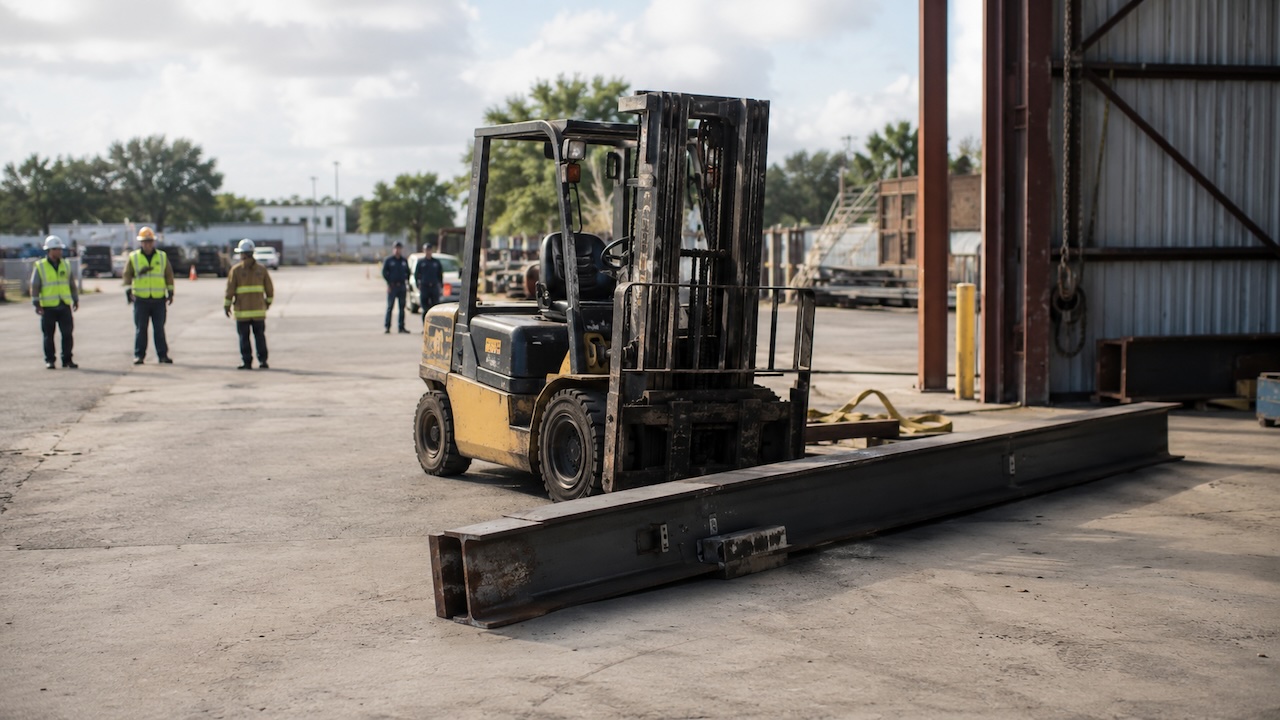
A fatal workplace accident involving a forklift and steel beam is under investigation in Pinellas County.
A worker died Thursday morning after a large steel beam fell from a forklift at an industrial property in Pinellas County.
According to WFLA News Channel 8, deputies were called to the property at about 10:11 a.m. on August 27, 2026, after reports that a steel beam had fallen on a man.
Firefighters got the beam off him and freed him. He was taken to a hospital but did not survive.
Another worker, described in early reports as the forklift operator, was also taken to the hospital.
That is about as far as the public facts go right now.
Investigators have not said why the beam fell. They had not released the name of the worker who died in the initial reporting either.
And there are some pretty obvious questions that still need answers.
How was the beam being carried? Was it secured? Was the forklift rated for the load? Who was running the job? Who owned the equipment? Were other companies working at the property?
Those are not minor details.
They may end up deciding whether this stays strictly a workers’ compensation case or whether somebody else may also be legally responsible.
What Happens When Someone Dies at Work in Florida?
For most families, workers’ compensation is where the legal process starts after a workplace death.
Florida Statute 440.16 provides death benefits when a worker dies from a qualifying job-related injury. The Florida Department of Financial Services also explains the basic death benefits available through the state workers’ compensation system.
Those benefits can include:
- Up to $7,500 for funeral expenses
- Benefits for certain dependents
- Educational benefits for a qualifying surviving spouse
Florida generally limits total workers’ compensation death benefits to $150,000.
That money can matter, especially when a family suddenly loses someone who was helping support the household.
Still, workers’ comp has limits.
A wrongful death claim is something different.
And depending on what happened at the job site, a family may need to look at both.
Can There Be a Wrongful Death Claim Too?
Yes, sometimes.
Florida workers’ compensation law usually prevents an employee from suing an employer for ordinary negligence. That is one of the basic tradeoffs built into the workers’ comp system.
But the employer is not always the only company involved.
That matters.
Florida Statute 440.39 allows claims against negligent third parties even when workers’ compensation benefits are available.
On industrial and construction sites, there may be several companies involved in the same job. One company owns the property. Another owns the equipment. Somebody else maintains it. A contractor may be moving materials. A subcontractor may be directing part of the work.
Suddenly the question is not simply, “Did this happen at work?”
It becomes, “Who actually caused it?”
In a case involving a forklift and a steel beam, that could mean looking at:
- Whether something failed on the forklift
- Whether an attachment was defective, which could raise a product liability issue
- Whether the equipment had been properly maintained
- Who loaded or secured the beam
- Who controlled the work area
- Whether another contractor or company created the dangerous condition
None of that has been established in this Pinellas County accident.
Maybe none of it applies.
But nobody should assume this is only a workers’ compensation matter until those questions are answered.
The Forklift Itself May Tell Investigators a Lot
After a serious equipment accident, the machine becomes evidence.
Not metaphorically. Literally.
The forklift may need to be inspected before it is repaired, altered or put back into service.
Investigators could look at its lifting capacity, maintenance history, inspection records, repairs and any attachments being used at the time.
Then there is the beam.
How much did it weigh?
How long was it?
Where was it sitting on the forks?
Was it strapped, chained or otherwise secured?
Was the load stable before anyone started moving it?
Those details may sound technical, but this is usually where these cases are figured out.
Training matters too.
OSHA has specific rules for powered industrial trucks, including forklifts. Operators are supposed to be trained, and the equipment has to be used safely.
OSHA rules also prohibit allowing someone to stand or pass beneath the elevated portion of a powered industrial truck, whether it is loaded or not.
That does not mean an OSHA violation happened here.
We simply do not know yet.
There is not enough public information about where the worker was standing, where the beam was positioned or what the forklift operator was doing in the moments before it fell.
OSHA May Look Into What Happened
The Sheriff’s Office may not be the only agency that investigates.
A work-related fatality generally has to be reported to OSHA within eight hours.
If OSHA opens an investigation, inspectors could look at the forklift, training records, maintenance, workplace procedures and how the beam was being handled.
That investigation has a different purpose than a lawsuit.
OSHA is looking at workplace safety rules.
A wrongful death case is asking whether another person or company was negligent and whether that negligence caused the death.
There can be overlap between the two, but they are not the same thing.
And a family does not need an OSHA citation before investigating whether a third party may be responsible.
When Workers’ Comp Is Not the Whole Case
Workers’ compensation is limited by law.
The benefits are spelled out. The limits are spelled out too.
A third-party wrongful death case is much broader.
Under Florida’s Wrongful Death Act, a personal representative can pursue a claim on behalf of qualifying survivors and the estate when another party’s negligence or wrongful conduct causes someone’s death. Florida Statute 768.19 sets out the right of action, while Florida Statute 768.21 addresses damages.
Depending on the family and the facts, damages may include lost support, lost services, medical or funeral expenses, lost earnings and other damages allowed under Florida law.
That is why figuring out who was involved at the work site matters so much.
Maybe the employer owned the forklift and controlled everything.
Maybe not.
Maybe another company maintained the machine.
Maybe somebody else loaded the beam.
Maybe several companies had people working in the same area.
Those details change the case.
Evidence at a Work Site Does Not Sit Around Forever
This part gets overlooked.
Work sites keep operating.
A serious accident happens, investigators arrive, and eventually the business still has to run.
Equipment gets moved.
A forklift gets repaired.
A damaged part gets replaced.
Video gets recorded over.
People go back to work.
Months later, everyone is trying to reconstruct what happened from paperwork and memory.
That is a lousy way to investigate a fatal accident.
In a serious work injury case involving a forklift and a steel beam, evidence could include:
- The forklift and any attachments
- Inspection and maintenance records
- Operator training records
- Equipment manuals and load-capacity information
- Photographs and video
- Surveillance footage
- Witness statements
- Records showing how the beam was being moved
- Contracts showing which companies controlled different parts of the work
Sometimes that paperwork ends up being just as important as the machine itself.
What We Know About the Pinellas County Accident Right Now
The August 27 accident is still being investigated by the Pinellas County Sheriff’s Office.
Authorities had not publicly identified the worker who died in the initial reports, and they had not announced what caused the steel beam to fall.
So there is no reason to pretend we know who was at fault.
We do not.
What we do know is that a worker went to work that morning and died after a steel beam fell from a forklift.
Now investigators have to figure out why.
For the family, that answer matters for more than one reason.
Workers’ compensation may provide death benefits. But if another contractor, equipment company, property owner or other third party helped cause the accident, the family may have rights outside the workers’ compensation system too.
Armando Personal Injury Law’s Pinellas County injury team handles serious workplace injury, workers’ compensation and wrongful death matters in Pinellas County and throughout Florida. The firm also serves injured clients from its St. Petersburg office.
After a fatal job-site accident, we want to know who owned the equipment, who maintained it, who was supervising the job, who employed the people involved and what actually happened before anything was moved or repaired.
That is where the case starts.
Not with assumptions.
About the Author
Attorney Armando Edmiston is the founder of Armando Personal Injury Law in Tampa and St. Pete, Florida. A U.S. Marine veteran, Hillsborough County native, and ACS Forensic Lawyer-Scientist, he represents Floridians in serious personal injury and wrongful death cases.