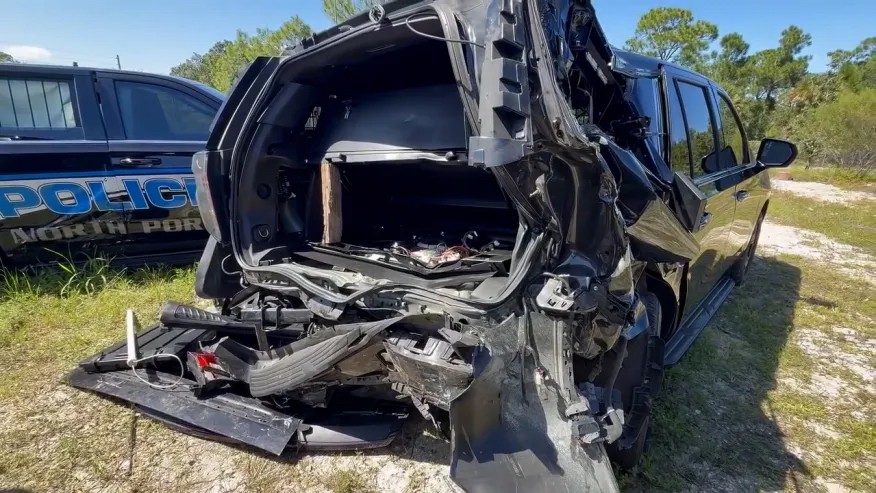
WFLA reported that a crash on Interstate 75 near North Port did not stay one crash for long. By the time it was over, one man was dead, another vehicle had been involved, and a North Port police cruiser had been hit hard enough to be totaled.
That is the ugly part of interstate crashes. The first impact may be over in seconds, but the road is still live. Cars are still coming. People get out. Debris is in the lanes. Then somebody farther back realizes what is happening a second too late.
According to local reporting on the crash, the first collision happened when a truck rear-ended an SUV. The SUV made it into the emergency lane. The truck stayed in the roadway.
The truck driver got out.
A Honda Civic coming up on the scene reportedly swerved toward the emergency lane while trying to avoid the stopped vehicles. The Civic struck the truck driver. He was taken to a hospital in critical condition and later died.
And it still was not over.
A North Port police officer arrived and positioned a patrol vehicle across the left and center lanes to protect the scene and steer traffic away from debris. Another vehicle then hit the back of the cruiser hard enough to total it. The officer was not injured.
Florida Highway Patrol said the collisions were being handled as separate crashes. Charges were reportedly pending against the driver who hit the police vehicle.
FHP is treating them as separate crashes, which makes sense. What happened in the first impact may explain part of the story, but it does not answer what each later driver saw or had time to do.
The Second Crash Is Sometimes the One That Kills
A vehicle stopped in an interstate lane is dangerous on its own. Add scattered debris, people outside their cars and traffic still moving at highway speed, and the margin for error gets very small.
Drivers coming up from behind may not know what they are looking at right away. Brake lights blend together. Someone changes lanes. Another driver follows too closely. A person looks down for a moment. By the time the stopped traffic actually registers, there may not be much road left to work with.
Rear-end crashes on an interstate can get ugly fast. The first hit may be over, but traffic behind it has not stopped.
Here, the sequence matters. First came the rear-end crash. Then the truck driver was struck after getting out. Later, a police cruiser protecting the scene was hit. Those crashes happened close together, but that does not mean one person automatically caused all of them.
Sorting Out Fault in a Chain-Reaction Crash
Multi-vehicle car accident claims get messy because the timeline matters. A driver may be responsible for starting the situation and still not be legally responsible for every collision that follows. Another driver may have had time to slow down or move over. Or several people may have contributed in different ways.
You cannot answer that by looking at the final pileup and pointing to the last damaged car. Investigators have to work backward.
- How fast each vehicle was moving before impact
- How much time and distance each driver had to react
- Where the vehicles stopped after the first crash
- Whether hazard lights, brake lights or emergency lights were visible
- Whether a driver was distracted or following too closely
- What witnesses saw before the later impacts
- What dash cameras, body cameras or vehicle cameras recorded
Vehicle data can matter too. So can skid marks, debris, damage patterns and where the vehicles finally came to rest. Investigators piece those things together because the scene does not always match what people remember afterward.
A Fatal Crash Can Also Become a Wrongful Death Case
The truck driver’s death creates a separate civil issue. Florida Statute 768.19 is the starting point for a wrongful death claim in Florida. In a crash case, the basic question is whether another person’s wrongful act or negligence caused a death that would have supported a claim if the person had survived.
A fatal crash is not automatically a wrongful death case. There still has to be proof that someone else caused the death through negligence or another wrongful act. With several collisions close together, that investigation may not stop with the driver involved in the final impact.
Investigators would likely have to look at the first crash, where the truck stopped, what happened after the driver got out, and what the Civic driver could see as it approached. Depending on the evidence, responsibility may not fall in only one place.
Florida Statute 768.20 puts the claim in the hands of the personal representative, who brings it for the estate and qualifying survivors. Florida Statute 768.21 deals with damages, which vary based on the survivors and the facts of the case.
A traffic ticket or criminal charge can be important, but it is not the same thing as a Florida wrongful death claim. The civil case has its own investigation and its own burden of proof.
Getting Out on I-75 Is a Decision You Sometimes Have to Make Fast
There is no neat rule for what a driver should do after every highway crash. Sometimes a vehicle will still move. Sometimes it will not. Someone may be hurt. There may be smoke, leaking fluid or another reason it is unsafe to stay inside.
But standing in or next to a live interstate lane is dangerous. Drivers coming from behind are moving fast, and they may be focused on the damaged vehicles before they ever see the person beside them.
If a vehicle can be moved safely out of the travel lanes, getting it farther from active traffic can reduce the chance of another impact. If you have to get out, the goal is the same: put as much safe distance as you reasonably can between yourself and moving traffic.
This crash shows how little room for error there is once someone is on foot near interstate traffic.
Emergency Lights Mean Slow Down Now, Not 200 Feet Later
Florida’s Move Over law applies when drivers approach certain stopped emergency, law-enforcement, utility, sanitation, road-maintenance, construction and towing vehicles, along with certain disabled vehicles. When a driver cannot safely move over, the law requires a reduction in speed.
The facts here are a little different because the officer reportedly used the cruiser to block lanes and protect an existing crash scene. Even so, flashing lights ahead should be enough to make a driver slow down and start looking for trouble in the roadway.
- Come off the accelerator.
- Open up more space in front of you.
- Look past the vehicle directly ahead, not just at its bumper.
- Expect debris, stopped cars and people in places you would not normally expect them to be.
This is not about being polite to an officer on the shoulder. It is about not driving into a scene that is already dangerous.
What If the Officer Had Been Hurt?
The North Port officer was not injured. So there is no work-injury claim to discuss for that officer based on the reporting available.
If the facts were different and an officer, tow operator, utility worker or delivery driver were hurt by another driver while working, workers’ comp might not be the only claim. Florida law can also allow work injuries caused by negligent third parties to be pursued against the outside person or company that caused them.
Florida Statute 440.39 addresses exactly that situation. An employee hurt or killed in the course of work by a negligent third party can receive workers’ compensation benefits and still pursue the third party.
That comes up in ordinary jobs more often than people think:
- A road worker hit by a passing driver
- A tow-truck operator struck while loading a disabled vehicle
- A delivery driver hurt when another motorist runs a light
- A utility worker hit on the shoulder
- An employee traveling between job sites who is hit by another driver
- A firefighter or first responder struck at a crash scene
Workers’ compensation and a third-party injury case do different jobs. Workers’ comp is tied to the work injury. The third-party case focuses on the outside person or company whose negligence caused it.
That can matter a lot in a serious injury case.
Workers’ Comp Does Not Automatically End the Conversation
A lot of injured workers hear “workers’ comp” and assume that is the only system available to them. Sometimes it is. Sometimes it is not.
Section 440.39 also explains how the two claims interact, including reimbursement and subrogation rights when the workers’ comp carrier has paid benefits and money is later recovered from the third party.
Those rules get technical quickly. For an injured worker, the immediate question is whether somebody outside the employer helped cause the injury.
The Crash Report Is Only the Starting Point
With three impacts, several drivers and a police response in the middle of it, a basic crash report may only get you so far.
Dash-camera footage matters. Body-camera footage may matter. Traffic cameras, witness videos, phone records, vehicle data and photographs can all fill in pieces that people either missed or remember differently.
If a business vehicle was involved, there can be another layer. Who owned it? Was the driver working? Was the driver acting within the job at the time? What insurance applies? Those are not paperwork questions. They can change where compensation may come from and which claims are available.
Evidence does not sit around forever. Traffic video can be overwritten. Vehicles get repaired or sold. Witnesses get harder to find. In a serious case, waiting too long to preserve that material can create problems that did not need to exist.
One Crash Scene Can Put a Lot of People in the Same Danger Zone
The first North Port crash involved two vehicles. By the end, a man had been fatally struck and a police cruiser had been destroyed while an officer was trying to keep the scene from getting worse.
That is what makes interstate crash scenes different from a fender-bender in a parking lot. The road does not stop because somebody crashed. Traffic keeps arriving.
The people at risk can quickly include the original drivers, passengers, witnesses who stop, police officers, firefighters, paramedics, tow operators, road crews and everyone coming up from behind.
Nobody can control what the next driver will do. What drivers can do is look farther ahead, leave room and slow down when traffic starts looking wrong. That extra space matters on I-75.
Florida Car Accident, Wrongful Death and Work-Related Third-Party Claims
Armando Personal Injury Law handles serious Florida car accident cases, including fatal crash and wrongful death cases, along with work-related injuries caused by negligent third parties.
When someone is hurt while working, we do not assume workers’ comp is the whole case. We look at who caused the injury, whether an outside driver or company was involved, and what insurance coverage may apply.
Multi-vehicle crashes get the same treatment. Each impact has to be sorted out on its own because the driver, the insurance coverage and the evidence may change from one collision to the next.
The firm represents injured people and families from offices in Tampa and St. Petersburg and handles these cases throughout Florida. Learn more about our Florida car accident representation and third-party workplace injury claims.