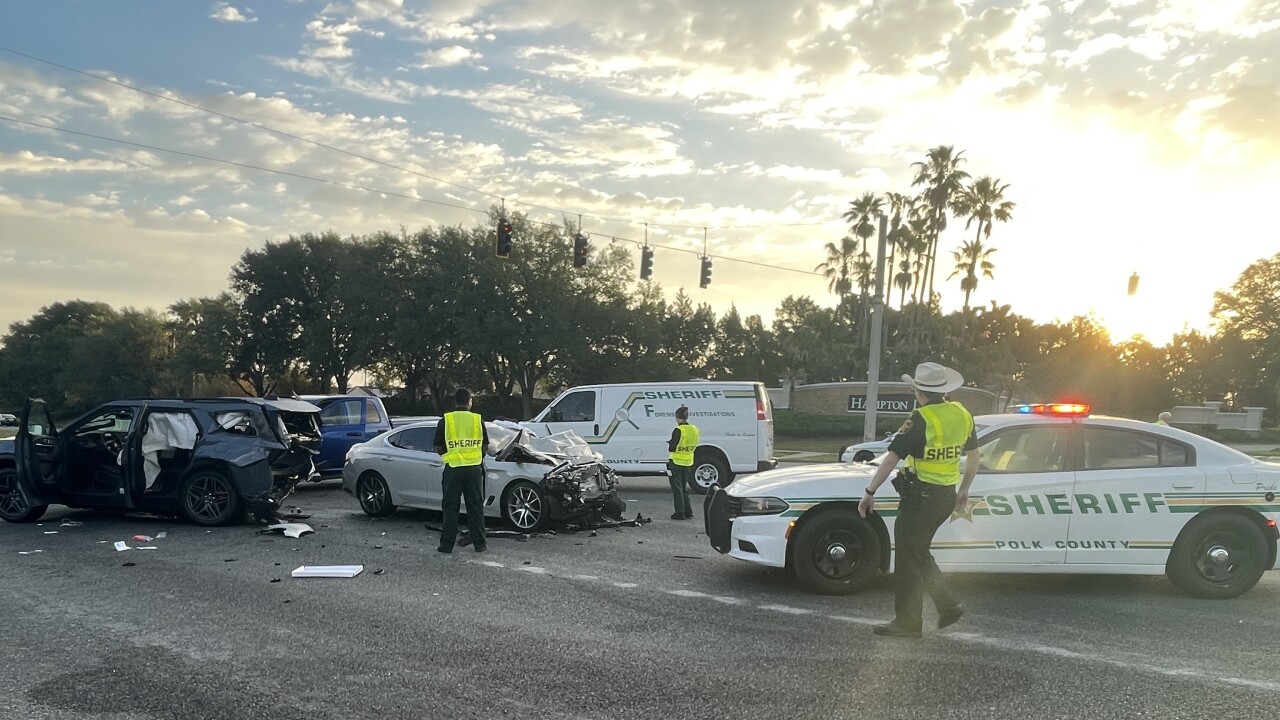
Image Caption A fatal crash on U.S. 27 in Davenport highlights the importance of crash investigations, roadway evidence, and legal rights after serious Florida collisions.
First, we want to express our condolences to the families grieving after this crash. A fatal collision leaves more than a damaged vehicle and a police report behind. It leaves families trying to understand what happened, what comes next, and whether anything could have been done to prevent the loss.
According to Tampa Bay 28’s report citing the Polk County Sheriff’s Office, two people died after a two-vehicle crash early Sunday morning in Davenport. Investigators reported that a Genesis G70 driven by a 21-year-old Summerfield man was traveling south on U.S. 27 when it struck a Ford Explorer stopped at a red light near California Boulevard.
The Genesis driver died at the scene. A 30-year-old Davenport woman who was riding as a passenger in the Genesis was taken to a local hospital with critical injuries and later died. The driver of the Ford Explorer, a 31-year-old Davenport man, suffered serious injuries and is expected to recover. The crash happened a little after 3:45 a.m., and the investigation remains ongoing.
This article is not written to assign blame before the investigation is complete. It is written to explain the legal and practical issues Florida families often face after a fatal red-light crash, especially when one vehicle is stopped at a signal and another vehicle strikes it from behind or at an intersection.
What Investigators Have Reported So Far
Based on the public reporting available at this stage, the crash involved three people and two vehicles:
- A Genesis G70 traveling south on U.S. 27 near California Boulevard in Davenport.
- A Ford Explorer stopped at a red light.
- The 21-year-old Genesis driver, who died at the scene.
- A 30-year-old Genesis passenger, who later died at the hospital.
- A 31-year-old Explorer driver, who suffered serious injuries and is expected to recover.
The report also states that the Genesis driver was not wearing a seat belt. That detail may matter in a later legal analysis, but it does not answer every question by itself. Fatal crash investigations often require reconstruction work, vehicle inspections, witness interviews, phone records, event data recorder downloads, traffic-signal timing information, toxicology results, and review of nearby video.
Why a Red-Light Crash Can Become a Serious Injury or Wrongful Death Case
Florida’s traffic signal statute requires drivers facing a steady red light to stop before entering the crosswalk or intersection and remain stopped until the signal changes, with limited exceptions such as a permitted right turn after stopping. That rule is found in Florida Statute § 316.075. When a vehicle is stopped at a red light and another vehicle crashes into it, investigators usually look closely at speed, braking, attention, impairment, lighting, weather, roadway design, and whether the moving driver had enough time and distance to react.
For the injured Explorer driver, the legal focus may be on proving the full extent of the injuries and identifying all available insurance coverage. For the family of the passenger who died, the legal focus may include whether a Florida wrongful death attorney should investigate a claim against any responsible party or available insurance policy.
Even when a crash appears simple from the outside, the insurance analysis can be complicated. One vehicle may have liability coverage. Another may have uninsured or underinsured motorist coverage. There may be Personal Injury Protection benefits, medical payments coverage, estate issues, or competing claims from multiple injured people. A serious crash is rarely just one claim form and one phone call.
The Seat Belt Issue: Important, But Not the Whole Case
The public report states that the Genesis driver was not wearing a seat belt. Florida’s seat belt law is found in Florida Statute § 316.614, and the National Highway Traffic Safety Administration explains that seat belts remain one of the most important safety tools in a passenger vehicle. NHTSA reports that seat belts saved an estimated 14,955 lives in 2017 and that nearly half of passenger vehicle occupants killed in 2024 were unrestrained, based on known seat belt use.
But a seat belt finding should be handled carefully. Florida’s seat belt statute says a violation is not negligence per se, though it may be considered as evidence of comparative negligence in a civil case. In plain English: not wearing a seat belt may become part of the argument, but it does not automatically end every claim or answer every question about fault, injury causation, or damages.
This distinction matters in fatal crash litigation. Insurance companies may use seat belt evidence to reduce responsibility. Families and injured people need a careful review of whether the seat belt issue actually contributed to the injuries being claimed and how Florida’s comparative fault law applies to the specific person bringing the claim.
What the Surviving Injured Driver May Need to Protect
The Explorer driver reportedly suffered serious injuries. In Florida, an injured person may start with PIP benefits after a car accident, but PIP is limited and does not cover everything. Serious injury cases often require a separate liability claim when another driver’s negligence caused the crash.
After a crash like this, the injured driver should preserve evidence as early as possible. That can include emergency room records, imaging studies, follow-up care records, photographs of vehicle damage, witness names, insurance correspondence, and the official crash report. FLHSMV provides information about Florida traffic crash reports and how crash reports can be obtained through the state crash portal.
The medical side also matters. Many crash injuries become clearer over time, especially neck, back, head, shoulder, knee, and nerve-related injuries. The fact that someone is expected to recover does not necessarily mean the injury is minor, short-lived, or financially simple. A recovery can still involve surgery, missed work, future care, permanent symptoms, and long-term pain.
What Families Should Know After a Fatal Florida Crash
When a person dies because of another person’s negligence, Florida law may allow certain survivors and the estate to pursue a wrongful death claim. The damages available in a fatal crash case may include lost support and services, funeral expenses, medical expenses related to the injury, and certain survivor claims for mental pain and suffering, depending on the family relationship and the facts of the case. Florida’s wrongful death damages statute is found in Florida Statute § 768.21.
The timeline is also critical. Florida’s statute of limitations includes a two-year deadline for wrongful death actions. That deadline is listed in Florida Statute § 95.11. Families should not wait until the investigation is fully closed before asking what evidence needs to be preserved, what insurance exists, or who has legal authority to act on behalf of the estate.
Armando Personal Injury Law has a detailed resource explaining how wrongful death lawsuits work in Florida. The key point is simple: wrongful death cases are not only about the crash scene. They are also about family relationships, estate authority, insurance limits, medical expenses, funeral costs, loss of support, and the evidence needed to prove why the crash happened.
Evidence That Can Matter After a U.S. 27 Crash in Davenport
U.S. 27 is a major Central Florida roadway, and crashes near traffic lights can involve multiple evidence sources. In a fatal or serious injury crash, the most important evidence may include:
- The official crash report and any supplemental homicide investigation materials.
- Traffic-signal timing records for the intersection near California Boulevard.
- Event data recorder information from the vehicles.
- Dashcam, nearby business, residential, or traffic camera footage.
- 911 calls, dispatch records, and body camera video if available.
- Vehicle inspections showing braking, lights, tires, airbags, and seat belt evidence.
- Toxicology, phone-use evidence, and witness statements.
- Medical records connecting the crash to the injuries or death.
This is why a serious crash investigation should move quickly. Some video is overwritten within days. Vehicles may be released, repaired, sold, or destroyed. Witness memories fade. The earlier a legal team begins preserving evidence, the harder it becomes for an insurance company to control the story later.
Florida Crash Claims Are Evidence Cases
A crash report may be the starting point, but it is not always the entire case. A strong Florida car accident claim is built from evidence, medical proof, insurance analysis, and a clear explanation of how the crash changed someone’s life. That is especially true when one person survives with serious injuries and two families are left facing death-related questions from the same collision.
Our Florida car accident lawyer resource explains how injury claims work after crashes across the state. We also maintain a guide to Florida car accident laws for people trying to understand insurance rules, fault, PIP, and legal deadlines after a collision.
No article can tell a family exactly what their case is worth or whether a claim should be filed. That requires the crash report, the medical records, the insurance policies, and the final investigation. But after a fatal or serious crash, waiting too long can make the legal side harder than it needs to be.
Talk With Armando Personal Injury Law After a Serious Florida Crash
If your family is dealing with a fatal crash, or if you were seriously injured in a Florida car accident, Armando Personal Injury Law can help you understand the next steps. We can review the crash facts, evaluate insurance coverage, preserve evidence, and explain whether a personal injury or wrongful death claim may be available.
Call (813) 482-0355 or contact Armando Personal Injury Law online for a free consultation. You do not pay attorney’s fees unless we win your case.
About the Author
Attorney Armando Edmiston is the founder of Armando Personal Injury Law in Tampa and St. Pete, Florida. A U.S. Marine veteran, Hillsborough County native, and ACS Forensic Lawyer-Scientist, he represents Floridians in serious personal injury and wrongful death cases.