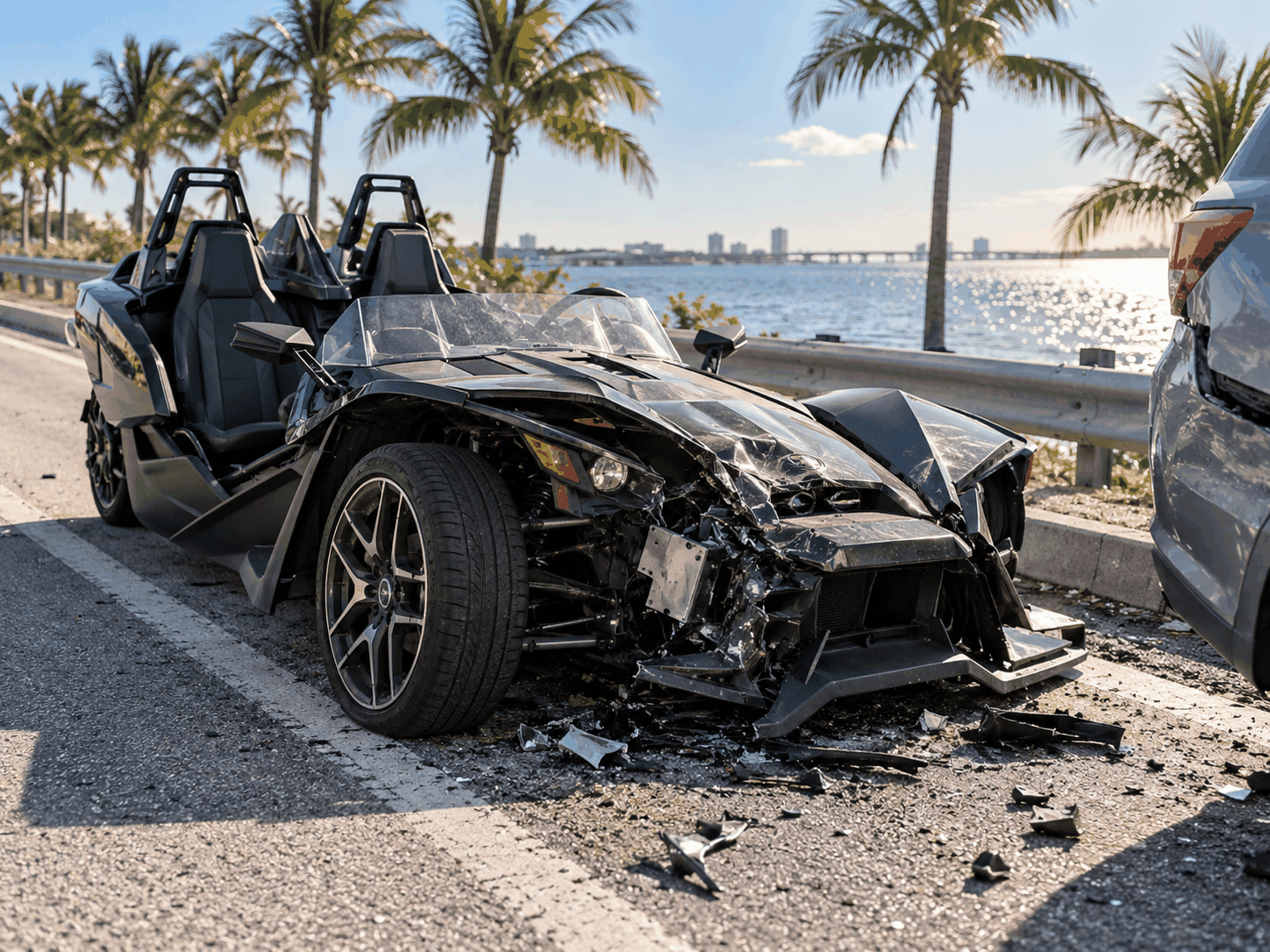
Slingshot crashes can involve the rental company, other drivers, or a defective part, and the vehicle itself may hold key evidence.
After a Slingshot rental crash in Florida, an at-fault driver, the rental company, a tour operator, or a manufacturer may be liable, depending on what caused the injuries. A rental company is not automatically liable because it owns the vehicle, but it may be responsible for its own negligence. A signed waiver does not resolve every claim.
For someone injured while exploring Tampa Bay, the immediate questions are practical: Who will pay for medical care? Does the rental agreement limit a claim? And how can the vehicle be preserved before it is repaired? The answers depend on the evidence, the rental documents, and the insurance policies involved.
|
Key Takeaways
|
What Is a Slingshot Rental?
A Polaris Slingshot is a three-wheeled vehicle with side-by-side seating and a steering wheel. Rentals may be self-guided or part of an organized tour. Although driving one can feel more like driving a car than riding a conventional motorcycle, its legal classification matters.
Florida defines an autocycle as a qualifying three-wheeled motorcycle with two front wheels and one rear wheel, roll protection, seat belts, specified braking equipment, a steering mechanism, and seating that does not require straddling. The definition also includes federal manufacturing requirements. A person may operate a qualifying autocycle without a motorcycle endorsement under Florida Statutes § 322.03(5). See the autocycle definition in § 316.003(2).
A valid driver’s license is still generally required. Rental businesses may impose additional age, experience, or contract requirements.
Who Can Be Liable for a Slingshot Rental Crash?
Liability depends on how the crash happened and what caused the injuries. The following examples identify possible claims, not automatic findings of fault.
| Potentially Responsible Party | Possible Basis for a Claim | Evidence to Investigate |
|---|---|---|
| Another driver | Careless driving caused the collision, such as an unsafe turn or running a red light. | Witness accounts, scene photos, available video, and vehicle damage. |
| The Slingshot driver | Careless driving injured a passenger or another road user. | Witness accounts, driving conditions, and available vehicle or GPS records. |
| The rental company | Negligent maintenance or another unreasonable rental practice contributed to the injury. | Inspection logs, repair history, rental documents, and prior complaints. |
| A manufacturer or seller | A defective product caused the crash or increased the injuries. | Vehicle inspection, component testing, and relevant recall information. |
| A tour operator | Negligent planning, instructions, or supervision contributed to the crash. | Tour route, guide communications, weather conditions, and witness accounts. |
Negligence generally involves failing to use reasonable care and causing injury. Product liability can also involve strict liability, so a defective-product claim does not always depend on proving a particular person was careless. Florida’s comparative-fault statute recognizes negligence, strict liability, and other product-liability theories.
When the Rental Company May Be Responsible
The Graves Amendment, 49 U.S.C. § 30106, generally prevents liability based solely on vehicle ownership when the owner is in the rental or leasing business and there is no negligence or criminal wrongdoing by the owner or its affiliate. It does not give a rental business blanket immunity.
A rental-company investigation may examine worn tires, brake or steering problems, ignored safety warnings, and whether the business reasonably inspected and maintained the vehicle. It may also examine a decision to rent to an obviously impaired driver. Any alleged failure must be connected to the crash or injuries.
Under Florida Statutes § 322.38, rental businesses generally must verify licensing eligibility, inspect the renter’s driver’s license, and check that it is unexpired. The statute includes provisions for nonresidents. A licensing violation alone does not resolve every question about civil liability.
Maintenance records, earlier complaints, and the instructions given at pickup can help establish what the company knew and whether it acted reasonably. In a guided tour, the investigation may also consider the pace, route, conditions, and directions provided by the guide.
When a Defective Slingshot May Support a Claim
A defective steering component, brake, tire, or restraint may cause a crash or make injuries worse. A product liability claim requires evidence linking the defect to the harm. A breakdown alone does not establish that a manufacturer or seller is liable.
Check the vehicle’s identifying information and relevant notices through NHTSA’s recall search. A recall can provide an investigative lead, but it does not by itself prove what caused a particular crash. Likewise, a search showing no open recall does not rule out a defect; recall searches have coverage limits.
An inspection of the Slingshot and its damaged parts may be essential. Ask for preservation before repairs, disposal, or testing that could alter important evidence.
How a Rental Waiver Can Affect an Injury Claim
A signed waiver may limit or bar some claims, but its effect depends on the language, the parties it protects, the claim, and applicable law. Florida courts can enforce clear releases of negligence liability. In Sanislo v. Give Kids the World, the Florida Supreme Court held that a release was not ineffective simply because it omitted the word “negligence.”
Do not assume a waiver is harmless because it was signed quickly on a tablet. Save the complete rental agreement and every release, including electronic copies. A lawyer can assess whether the document covers the defendant and conduct involved in your injury.
Passengers may have signed a separate release, so their paperwork needs its own review. A renter’s agreement also does not automatically resolve an independent claim against another driver or a manufacturer.
What Insurance May Pay After a Slingshot Rental Crash
Legal responsibility and insurance coverage are separate questions. An investigation should identify the policies that may cover each responsible driver or business, then check who is insured, which vehicles and uses are covered, exclusions, and policy limits. The fact that someone rented a Slingshot does not establish which insurer must pay.
Do not assume ordinary car-rental coverage applies to a three-wheeled Slingshot. Ask for the rental business’s insurance information and copies of any protection products purchased with the rental. Your own auto, motorcycle, uninsured or underinsured motorist, and medical-payments policies may also warrant review, but coverage cannot be promised without their terms.
Florida’s statutory personal injury protection system generally uses a definition of “motor vehicle” requiring four or more wheels. A three-wheeled Slingshot therefore does not fit that definition, and occupants should not assume ordinary Florida PIP benefits apply. Coverage must be evaluated under the relevant policy and law. See § 627.732(3) and § 627.736.
How Shared Fault Affects Compensation
For negligence actions governed by Florida’s current comparative-fault rule, compensation is reduced by the injured person’s percentage of fault. A person found more than 50 percent responsible for their own harm cannot recover damages. Someone exactly 50 percent at fault is not barred by that threshold, but any recovery is reduced by half. See Florida Statutes § 768.81.
An insurer may dispute speed, visibility, following distance, or how the Slingshot was handled. Those arguments need to be tested against the evidence. Driving an unfamiliar vehicle does not, by itself, establish responsibility for the collision.
Evidence to Preserve After the Crash
Get needed medical care first. When it is safe, document the scene and keep the rental paperwork. Useful evidence may include:
- The rental agreement, waivers, receipts, insurance information, and pickup instructions.
- Photos of vehicle damage, tires, road conditions, signs, and the crash location.
- Witness names and contact details, plus any available dashcam or nearby business video.
- Inspection and maintenance records, prior complaints, recall notices, and repair history.
- The Slingshot, damaged components, and any available GPS or electronic data.
Electronic records vary by vehicle and rental business. Cameras may not record or retain footage, and GPS data may not establish impact speed. A prompt preservation request can help protect available evidence, but it does not guarantee that a particular record exists.
Crash reports can help identify witnesses and guide an investigation. They are not a final determination of civil fault, and Florida limits the use of certain reports and reporting statements at trial under § 316.066.
Frequently Asked Questions
Can a Passenger Bring a Claim Against the Slingshot Driver?
Yes, an injured passenger may have a claim if the driver’s negligence caused the injury. Other parties may also be responsible. The passenger’s own conduct, any signed release, and applicable insurance coverage still need review; being a passenger does not automatically establish a right to payment.
What If I Was Visiting Florida When the Crash Happened?
Living outside Florida does not by itself prevent you from pursuing a claim for a Florida crash. A Florida lawyer can assess where a lawsuit may be filed, which law applies, and what work can be handled remotely. Insurance issued in another state can raise separate coverage questions, so keep copies of your own policy and the rental documents.
How Long Do I Have to File a Lawsuit?
For a recent Florida crash, a negligence lawsuit generally must be filed within two years after the claim accrues, usually the crash date. The change to a two-year negligence period applies to causes of action accruing after March 24, 2023; older claims require a separate transition analysis. Wrongful-death claims generally have a two-year period as well, usually measured from death. See Florida Statutes § 95.11 and the 2023 transition note.
Product-liability injury claims can have a different period, generally four years, with discovery and repose rules that may affect the deadline. Exceptions and the precise claim matter. Have the deadline calculated for your case rather than treating any general period as permission to wait. See § 95.031.
What Compensation May Be Available?
Depending on liability, proof, and applicable law, an injury claim may include medical expenses, future care, lost income, reduced earning ability, and pain and suffering. Available coverage and the facts affect what can actually be recovered.
If the crash caused a death, Florida’s wrongful-death action is brought by the deceased person’s personal representative for the benefit of eligible survivors and the estate. Surviving family members do not simply file separate wrongful-death lawsuits in their own names. See Florida Statutes § 768.20.
Get Help With a Slingshot Injury Claim in Tampa Bay
A Tampa motorcycle accident lawyer can help investigate a Slingshot crash, review the rental agreement, identify potential insurance coverage, and seek preservation of the vehicle and records. The goal is to determine what caused your injuries and which parties may be legally responsible.
Armando Personal Injury Law’s reported case results include a $1.25 million settlement in a wrongful-death motorcycle case and a $250,000 settlement in a rear-end motorcycle case. Past results do not guarantee a similar outcome; each case depends on its own facts.
If you were injured in a Slingshot rental crash in Tampa, St. Petersburg, or elsewhere in Tampa Bay, schedule a free consultation with Armando Personal Injury Law. Bring any rental paperwork, insurance documents, photographs, and communications you have so we can discuss the next steps, including if you have returned home out of state.
About the Author
Attorney Armando Edmiston is the founder of Armando Personal Injury Law in Tampa and St. Pete, Florida. A U.S. Marine veteran, Hillsborough County native, and ACS Forensic Lawyer-Scientist, he represents Floridians in serious personal injury and wrongful death cases.