FHP says a Jeep driver failed to stop at a red light before striking a Harley-Davidson at State Road 50 and County Road 581.
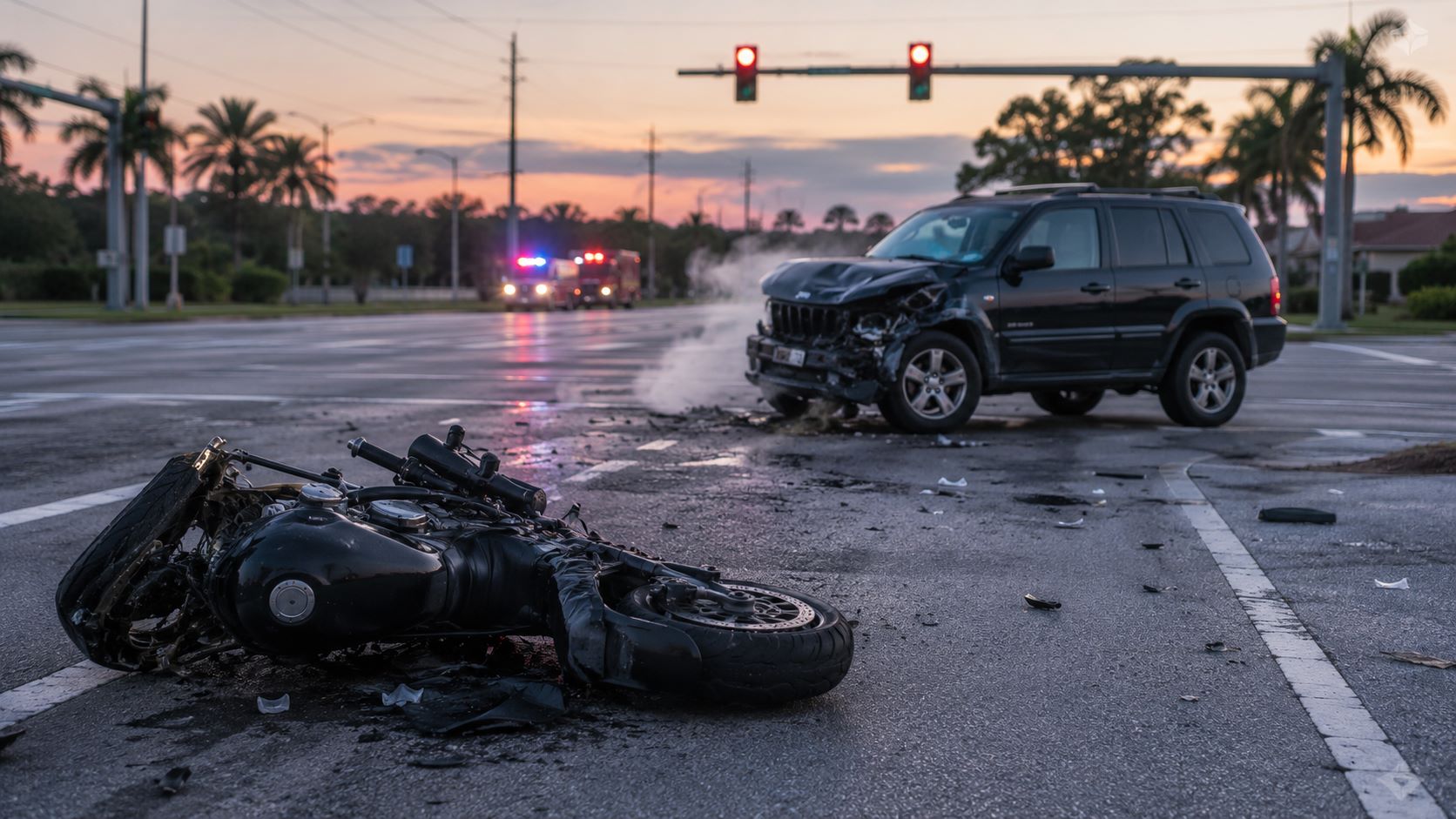
A motorcyclist died and a passenger was seriously injured after FHP says a Jeep driver ran a red light in Hernando County.
Motorcyclist Dies After Jeep Reportedly Runs Red Light in Hernando County
A Sunday morning crash in Hernando County left a motorcycle rider dead, his passenger seriously injured and two vehicles burning in the intersection.
It happened around 7:30 a.m. on August 9, 2026, at State Road 50 and County Road 581. WFLA reported that a Jeep Commander was headed east on State Road 50 when its driver failed to stop for a red light. The Jeep struck a northbound Harley-Davidson.
Both vehicles caught fire.
The rider made it to the hospital but did not survive. His passenger was hospitalized with serious injuries. The Jeep driver was not hurt.
That is what the Florida Highway Patrol has released so far. Investigators still have to pin down the signal timing, the movement of both vehicles and what happened in the seconds before impact. Because the vehicles burned, some of that work may be harder than usual.
The Reported Red-Light Violation Changes the Legal Picture
FHP did not describe an unexplained collision. The agency said the Jeep driver failed to stop at the light. If the evidence bears that out and connects the violation to the crash, the passenger could have a personal injury claim. The rider’s personal representative could pursue a wrongful death action for the estate and eligible survivors.
Still, the report leaves work to be done. Investigators must confirm the signal phase, speed, sight lines and sequence of impact. Insurers know that uncertainty creates room to argue, and they often begin looking for some share of blame to place on the rider almost immediately.
Armando Personal Injury Law handles serious Florida motorcycle accident claims, including crashes caused by drivers who fail to yield or enter an intersection against a traffic signal.
What Florida’s Red-Light Law Says
Florida Statute Section 316.075 says a driver facing a steady red signal must stop before the crosswalk or intersection and remain there unless a lawful movement is permitted.
There is nothing complicated about the rule. The danger is just as plain. A motorcycle rider moving through an intersection has almost no protection when a larger vehicle suddenly crosses from the side. Often, there is barely time to react.
The FLHSMV motorcycle safety guidance reminds drivers that motorcycles have the same right to the road as any other vehicle. It also warns against the quick glance that misses a smaller vehicle or badly misreads its distance and speed.
Here, FHP says the Jeep did not stop. That is a serious fact. Signal records, witness accounts and physical evidence will show how well that initial account holds up.
Some Evidence Could Be Gone Before the Case Is Filed
A video could answer the biggest question in a few seconds. The problem is that it could be recorded over just as quickly.
Nearby businesses may have surveillance footage. Another driver may have a dashcam. The intersection’s signal controller may preserve timing information. The vehicles can also tell part of the story through impact damage, braking evidence and whatever electronic data survived the fire.
Even after a fire, the scene can still yield evidence. Photos taken before the wreckage was moved, debris, marks on the roadway and first-responder records can help reconstruct the collision. Investigators may have to piece the answer together from smaller fragments.
Then there are the people who saw it. A neutral witness can become crucial if an insurer later disputes who had the light. Armando’s guide on why motorcycle crash witnesses matter explains why those accounts should be found and documented while the details are still fresh.
The Passenger Has a Claim of Her Own
If another person’s negligence caused the collision, the injured passenger can bring her own claim against the responsible party and any insurance coverage that applies.
Her case is separate from the rider’s, with losses that must be evaluated on their own. Hospital care may be only the beginning. A serious injury can change a person’s ability to work, move comfortably and manage daily life.
There may be more than one insurance policy to examine. If the at-fault driver carries too little bodily injury coverage, the passenger’s own coverage could matter. Nobody should assume the Jeep driver’s policy is the only place to look before the policies have actually been found and read.
Any Florida personal injury claim must connect the negligent act to the harm and document what that harm truly costs. The phrase “serious injuries” in a news report says very little about the months, or years, that may follow.
What the Rider’s Family May Be Able to Pursue
If negligence caused the rider’s death, the case falls under Florida’s Wrongful Death Act. The personal representative brings the action for the estate and the survivors recognized by law.
Florida Statute Section 768.19 creates the wrongful death cause of action. Section 768.20 identifies the personal representative as the person who files it and requires the complaint to name the survivors whose losses are being claimed.
The available damages depend on the family and the facts. Under Section 768.21, they can include lost support and services, funeral expenses, companionship and protection, and mental pain and suffering for qualifying survivors.
No civil case can undo this death. It can determine legal responsibility and address the financial harm the death left behind.
Armando Personal Injury Law explains who files, who may recover and how these losses are evaluated on its Florida wrongful death lawyer page.
Rider Bias Can Become Part of the Fight
Motorcyclists are often labeled reckless before anyone looks closely at the wreck. Insurance companies know the stereotype. They use it when they can.
Florida follows a modified comparative-fault system. Section 768.81 allows fault to be divided, which can reduce compensation by the claimant’s assigned share. In most negligence cases, someone found more than 50% responsible cannot recover.
If an insurer claims the motorcycle was speeding, entered late or could have avoided the Jeep, the answer has to come from the evidence: video, signal records, vehicle data and a careful reconstruction of the crash.
Armando’s article on how fault is proven after a red-light crash looks more closely at signal timing, independent footage and impact evidence in a disputed intersection case.
Two Years Is Not as Long as It Sounds
Florida Statute Section 95.11 generally gives two years to file negligence and wrongful death actions, although exceptions can change the deadline in a particular case.
The evidence will not wait two years. Camera footage can vanish in days. A burned vehicle can be released or destroyed. A witness who is certain today may remember far less six months from now.
Help After a Fatal Hernando County Motorcycle Crash
The injured passenger and the rider’s family may face separate claims, different losses and more than one source of insurance coverage. A timely investigation can preserve the records, footage, vehicle data and witness accounts needed to evaluate each claim.
Armando Personal Injury Law investigates fatal and catastrophic motorcycle crashes, preserves evidence, reviews available insurance coverage and responds to disputed-fault arguments. To discuss a Hernando County motorcycle crash or wrongful death claim, request a free, confidential case evaluation.
This article provides general information, not legal advice. The crash remains under investigation, and no civil finding of liability has been made.